Buying AI's Landlords At A Fair Price, With An 81% Asterisk
Nuveen's renamed real estate income fund pays close to 8.9%, owns roughly 8% in the data center REITs powering the AI buildout, and funds four fifths of that payout with return of capital

Today's Lead-Lag Report post is sponsored by Hedgia

Launching a hedge fund used to cost $50,000. Now it is $89 a month.
The $50,000 setup and the $1,000 a month in admin fees kept good managers from launching their own funds. Hedgia deleted both. Answer questions in plain English, the platform handles the setup, and $89 a month covers the ongoing administration of your fund. $0 upfront with free legal docs.
DISCLAIMER — PLEASE READ: This is sponsored advertising content for which Lead-Lag Publishing, LLC has been paid a fee. The information provided in the link is solely the creation of Hedgia. Lead-Lag Publishing, LLC does not guarantee the accuracy or completeness of the information provided in the link or make any representation as to its quality. All statements and expressions provided in the link are the sole opinion of Hedgia and Lead-Lag Publishing, LLC expressly disclaims any responsibility for action taken in connection with the information provided in the link.

KEY HIGHLIGHTS
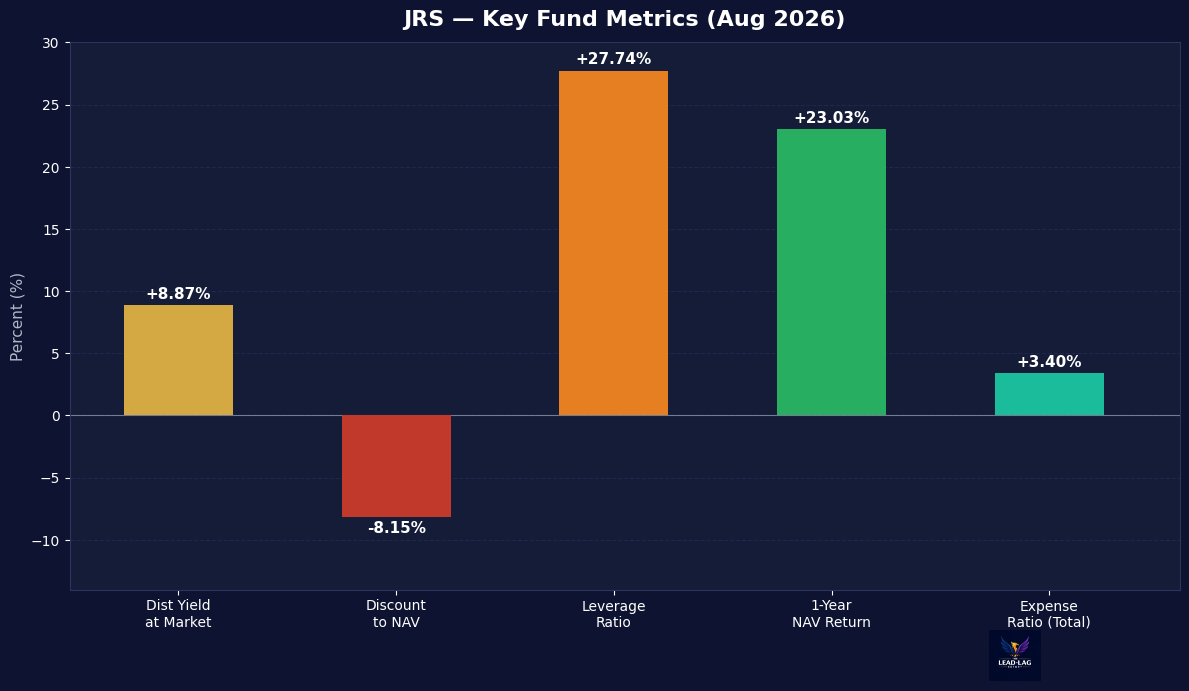
Yield: ~8.87% at market | 8.15% on NAV -- quarterly distribution of $0.19/share
ROC warning: 81% of distributions estimated as return of capital -- investors are largely receiving their own capital back, not income
Valuation: -8.15% discount vs -8.21% 52-week average -- fairly valued; 52-week range -4.33% to -11.33%
AI tailwind: Equinix (4.1%) + Digital Realty (4.0%) = ~8% in data center REITs benefiting from AI buildout
Cost: 3.40% total expense ratio (including 2.07% leverage interest) -- among the highest in this series
Every week, we'll profile a high yield investment fund that typically offers an annualized distribution of 6-10% or more. With the S&P 500 yielding less than 2%, many investors find it difficult to achieve the portfolio income necessary to meet their needs and goals. This report is designed to help address those concerns.

Real estate spent three years as the asset class nobody wanted. Rates went up, cap rates followed, office headlines did the rest, and a sector that had been a core income holding for a generation of retirees turned into a punchline. That is finally changing, because listed REITs have been recovering as the market prices in an easing cycle and real estate is the most rate-sensitive equity sector there is.
A second force has nothing to do with the Federal Reserve. The AI buildout has to happen somewhere physical, and that somewhere is a data center sitting on land, drawing power, connected to fiber. The companies that own those buildings are REITs, as are the industrial landlords leasing the warehouses that move the hardware. What was a bond-proxy corner of the equity market now holds some of the most direct real-asset exposure to the largest capital spending cycle in modern technology.
One vehicle packaging both stories into a single security is the Nuveen Real Estate Income Fund (JRS). Longtime followers will know it under a different symbol. It formerly traded as NRO and is now listed as JRS on the NYSE, so anyone pulling historical performance needs to confirm they have the right ticker. The fund yields roughly 8.87%, holds a diversified book of REIT common and preferred shares, and trades at a discount to net asset value near 8%. It is also one of the most expensive funds I have covered in this series, and it funds the large majority of that headline yield with return of capital. Both facts belong at the front of the analysis, not in a footnote.
Fund Background
JRS is a closed-end fund listed on the NYSE and managed by Nuveen. It launched on November 15, 2001, giving it nearly twenty-five years of history across two full cycles, including the financial crisis and the 2022 to 2024 rate shock. Its behavior in a real estate drawdown is a matter of record rather than speculation. The mandate is income-producing real estate securities, split between REIT common equity and REIT preferred stock, spread across 93 positions with annual turnover of just 22%, per [CEFConnect](https://www.cefconnect.com/fund/JRS). That is buy-and-hold, not actively traded.
Effective leverage sits at 27.74%. For a real estate fund that is double exposure to one variable, since portfolio companies carry mortgage debt at the property level while the fund borrows on top of it. Rate moves hit JRS twice, in both directions. As of August 13, 2026, JRS traded at $8.57 against a net asset value of $9.23, a discount of 8.15%. The 52-week average discount is 8.21% and the range ran from 4.33% to 11.33%. Today's price is almost exactly where this fund normally trades. No bargain, and no obvious overpayment.
Portfolio Composition
The mix is 68.19% REIT common equity, 28.13% preferred stock, and roughly 3.68% other. The preferred sleeve changes the character of the fund, because REIT preferreds behave far more like fixed income than equity, with fixed coupons, limited upside, and heavy rate sensitivity. Nearly a third of JRS is effectively a leveraged bond portfolio wearing a real estate label, which explains much of both the yield and the rate exposure.
The equity sleeve is high quality. Prologis is the largest position at 6.21%, followed by Equinix at 4.13%, Ventas at 3.99%, Digital Realty Trust at 3.95%, a Highwoods Properties preferred at 3.48%, Healthpeak at 3.05%, Welltower at 2.99%, VICI Properties at 2.67%, and Federal Realty at 2.30%, per [CEFConnect holdings data](https://www.cefconnect.com/fund/JRS). Prologis is the dominant global industrial landlord, Welltower and Ventas the two largest senior housing and medical REITs, VICI owns the ground under much of the Las Vegas Strip, and Federal Realty is among the better open-air retail owners in the country.
The AI angle is concrete rather than rhetorical. Equinix and Digital Realty together are roughly 8% of the portfolio, and they are the two listed pure-play data center REITs of consequence. Every dollar of hyperscaler spending on AI compute eventually needs colocation capacity, interconnection, and power, which is what these two sell. Prologis reinforces the theme from another direction, since logistics real estate is where the hardware supply chain physically lives. Investors wanting real-asset AI exposure without paying semiconductor multiples get a meaningful slice of it here. The remainder spreads across healthcare, gaming, retail, and office, which beats single-property-type funds but also means JRS is largely a leveraged proxy on listed real estate rather than a differentiated stock-picking product.

Performance Analysis
The recent numbers are strong. JRS has returned 17.81% year to date in 2026 on price and 10.29% over the trailing year, the REIT recovery in real time, and the kind of run that draws attention exactly when the easy part of the move is done.
The longer record is more sobering. The three-year annualized price return is 2.73%, which captures the rate shock and shows how painfully leveraged real estate performs when the discount rate rises. Five-year annualized is 9.78% and ten-year is 6.04%. Together those describe a full cycle: a mid single digit long-run return delivered with far more volatility than the number suggests.
The ten-year figure is the one I anchor on. A 6% annualized decade against a current 8.87% payout is an arithmetic statement about sustainability, and that gap is exactly what shows up in the return of capital data below. The discount picture, unusually for this series, is uninteresting in the best sense. At 8.15% against a 52-week average of 8.21%, there is no mean-reversion trade in either direction.


Macro Environment
The bull case is rate driven and clean. Rate-cut expectations have been the primary engine of the 2026 REIT recovery. Lower policy rates reduce property-level borrowing costs, compress cap rates, make refinancing less punitive, and improve REIT yields relative to Treasuries. For a fund carrying 27.74% effective leverage, falling short rates also cut the fund's own interest expense, currently 2.07 percentage points of the total expense ratio. That is an earnings tailwind layered on top of the portfolio effect.
The AI data center story provides a second, largely rate-independent driver. Hyperscaler capital commitments keep expanding, and the binding constraint on AI deployment has increasingly become power and space rather than chips. Equinix and Digital Realty sit inside that constraint.
The risks are equally clear. If inflation proves stickier and easing stalls, the thesis reverses, and leveraged real estate is among the worst places to be when long rates back up. Office remains a drag on sector sentiment. The preferred sleeve marks down alongside any rise in yields. And after a 17.81% move, much of the optimism is already priced.
Distribution Policy
JRS runs a managed distribution program and pays quarterly rather than monthly. The rate is $0.19 per share per quarter, roughly $0.0633 per month equivalent, producing about 8.87% on the $8.57 price and 8.15% on the $9.23 net asset value.
The composition of that distribution is the central problem, and it needs stating bluntly. Per Nuveen's Section 19a notice, approximately 81% of distributions are estimated as return of capital, detailed in the fund's [Nuveen distribution documentation](https://documents.nuveen.com/Documents/Nuveen/Viewer.aspx?uniqueId=690fab07-bf5f-4092-9199-3dc23ec8cd6e) and on the [Nuveen fund page](https://www.nuveen.com/en-us/closed-end-funds/jrs-nuveen-real-estate-income-fund). Only about a fifth of what lands in the account comes from net investment income and realized gains. The rest is the investor's own capital coming back.
Return of capital is not automatically destructive. In real estate, some of it is a legitimate pass-through of depreciation, and it defers tax by reducing cost basis. But 81% is not a depreciation artifact. At that level the payout is substantially funded with principal, and net asset value therefore carries a structural headwind, needing roughly 3% annual appreciation just to hold flat.
That matters for sizing and account placement. In a taxable account the deferral is a modest real benefit, though the eventual gain on sale is larger because basis has shrunk. In a retirement account the benefit vanishes entirely, leaving a fund returning capital and charging 3.40% to do it. This is not a yield an investor is earning. It is a yield an investor is receiving.

Advantages
Portfolio quality is the strongest argument for the fund. Prologis, Equinix, Digital Realty, Welltower, Ventas, VICI, and Federal Realty are among the best-capitalized real estate operators in the world. Buyers are not getting distressed assets or exotic structures, but a diversified, low-turnover basket of institutional-grade landlords with a preferred sleeve layered on for income.
The AI data center exposure is a differentiated tailwind most income funds cannot offer. Roughly 8% in Equinix and Digital Realty gives direct participation in the physical infrastructure of the AI buildout, with Prologis adding an adjacent logistics angle. That is real-asset AI exposure at REIT valuations rather than technology valuations.
The valuation is fair, which counts for something in a market where much is not. The 8.15% discount matches the 8.21% average almost exactly, well inside a range that ran from 4.33% to 11.33%, so investors get roughly 92 cents of assets for a dollar without chasing a crowded trade. The macro setup is directly supportive on top of that. Easing is the consensus expectation and JRS is levered 27.74% into that outcome, so continued cuts would improve both the portfolio and the fund's own 2.07% interest expense line at the same time.
Disadvantages
The 81% return of capital figure is the primary reason not to oversize this position. When four fifths of a distribution is a return of the investor's own money, the headline 8.87% is not an income statement, it is a withdrawal plan. The 6.04% ten-year annualized return sits well below the payout rate, meaning net asset value works against a structural drag every year, and anyone spending the full distribution is slowly liquidating.
The 3.40% total expense ratio is punishing. Even setting aside the 2.07% interest expense, the 1.33% in management and other fees is high, and the total is among the steepest in this series. The portfolio must generate 3.40% before shareholders see a basis point, and that hurdle compounds over years, as the [most recent N-CSR filing](https://www.stocktitan.net/sec-filings/JRS/n-csr-nuveen-real-estate-income-fund-sec-filing-2ad3ae5129f2.html) lays out.
The rate sensitivity that is currently a tailwind is symmetric. Effective leverage of 27.74% on top of property-level mortgage debt, combined with 28.13% in preferred stock, makes this a direct expression of a falling-rate view. If long yields back up, JRS gets marked down through all three channels at once, and the 2.73% three-year annualized return is the record of exactly that scenario.
Timing and structure round out the concerns. After a 17.81% advance, much of the recovery is priced, and the discount offers no cushion because it already sits at its average. The quarterly cadence is also less convenient than the monthly payers many income investors prefer.
Final Thoughts
JRS is a fairly priced fund holding excellent assets, paying a distribution it does not fully earn, and charging too much for the privilege. All three are true at once, and reconciling them is the whole exercise.
What I like is the portfolio and the setup. Prologis, Equinix, Digital Realty, Welltower, and VICI are exactly the real estate I want to own, the roughly 8% in data center REITs is a genuine AI tailwind rather than a marketing angle, and the rate path is directly bullish for a leveraged real estate vehicle at an honest price.
What keeps this from being a core holding is the 81% return of capital and the 3.40% expense ratio. Together they mean the fund must produce a high single digit gross return simply to stand still while distributing, and the 6.04% ten-year record says it has not consistently managed that. This is a satellite position for an investor who wants leveraged listed real estate with an AI kicker and accepts that most of the quarterly check is their own capital coming home. Size it accordingly, hold it where the deferral does something for you, and reinvest part of the distribution rather than spending all of it. At a fair price, that is a reasonable trade. It is not a free 8.87%.
The Lead-Lag Report is provided by Lead-Lag Publishing, LLC. All opinions and views mentioned in this report constitute our judgments as of the date of writing and are subject to change at any time. Information within this material is not intended to be used as a primary basis for investment decisions and should also not be construed as advice meeting the particular investment needs of any individual investor. Trading signals produced by the Lead-Lag Report are independent of other services provided by Lead-Lag Publishing, LLC or its affiliates, and positioning of accounts under their management may differ. Please remember that investing involves risk, including loss of principal, and past performance may not be indicative of future results. Lead-Lag Publishing, LLC, its members, officers, directors and employees expressly disclaim all liability in respect to actions taken based on any or all of the information on this writing.