The AI Buildout Needs Gas, And This 7.35% Yielder Owns The Pipes
Kayne Anderson Energy Infrastructure Fund (KYN) just raised its monthly distribution 5.9% and holds 33 midstream names at a 11.14% discount. The tailwind is real, but 0.5x NII coverage and 25% leverage mean the energy cycle has to keep cooperating.

Today’s Lead-Lag Report post is sponsored by Airthium
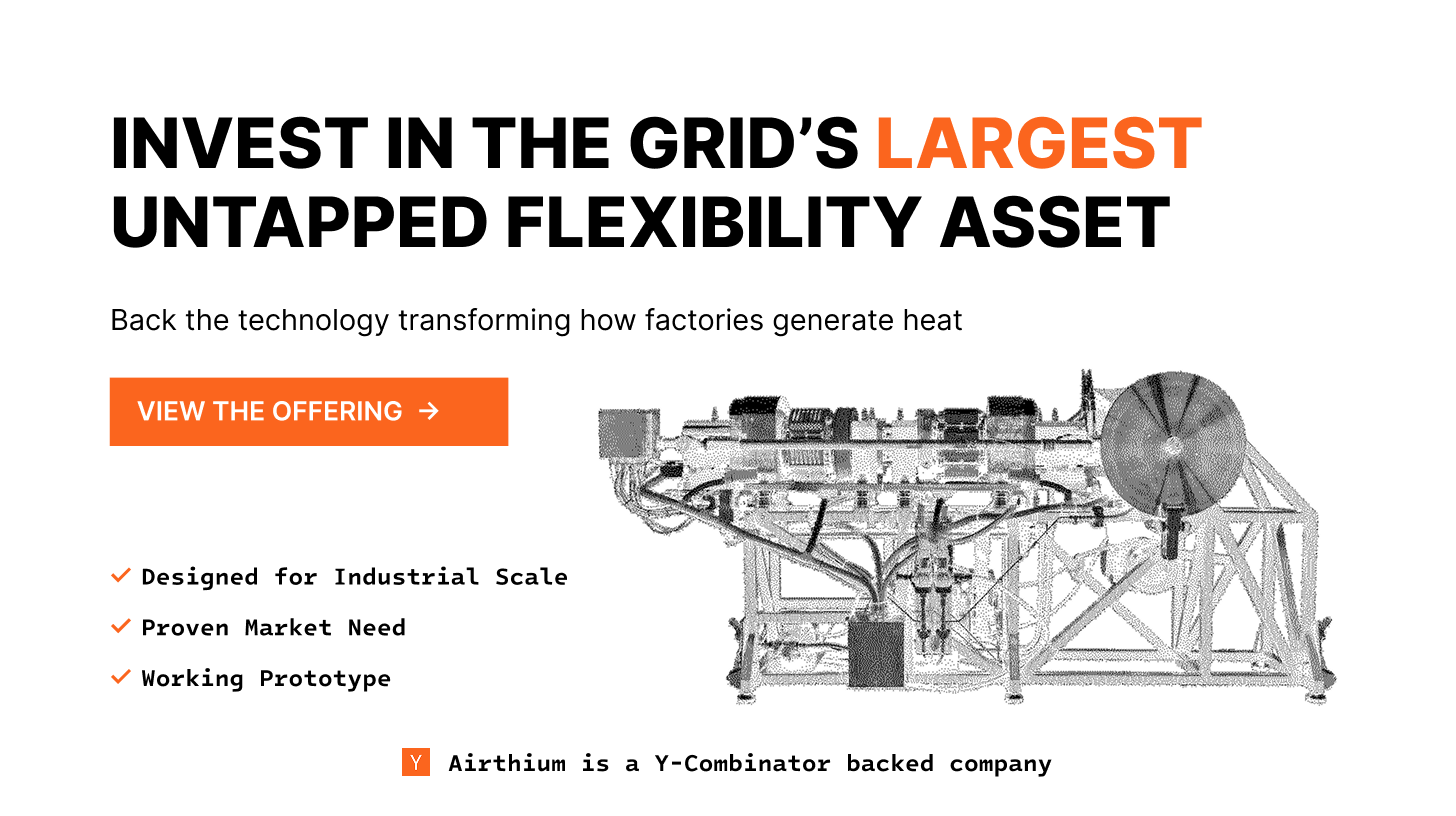
WE BUY POWER LOW AND SELL INDUSTRIAL HEAT.
Airthium is building a high-temperature heat pumps designed to turn volatile electricity prices into lower-cost factory heat.
We raised $6.5M+ from Y Combinator, DCVC, Daphni VC, Polytechnique Ventures, and 2,000+ retail investors. Help fund IP + key hires for the next machine.
DISCLAIMER — PLEASE READ: This is sponsored advertising content for which Lead-Lag Publishing, LLC has been paid a fee. The information provided in the link is solely the creation of Airthium. Lead-Lag Publishing, LLC does not guarantee the accuracy or completeness of the information provided in the link or make any representation as to its quality. All statements and expressions provided in the link are the sole opinion of Airthium and Lead-Lag Publishing, LLC expressly disclaims any responsibility for action taken in connection with the information provided in the link.
KEY HIGHLIGHTS
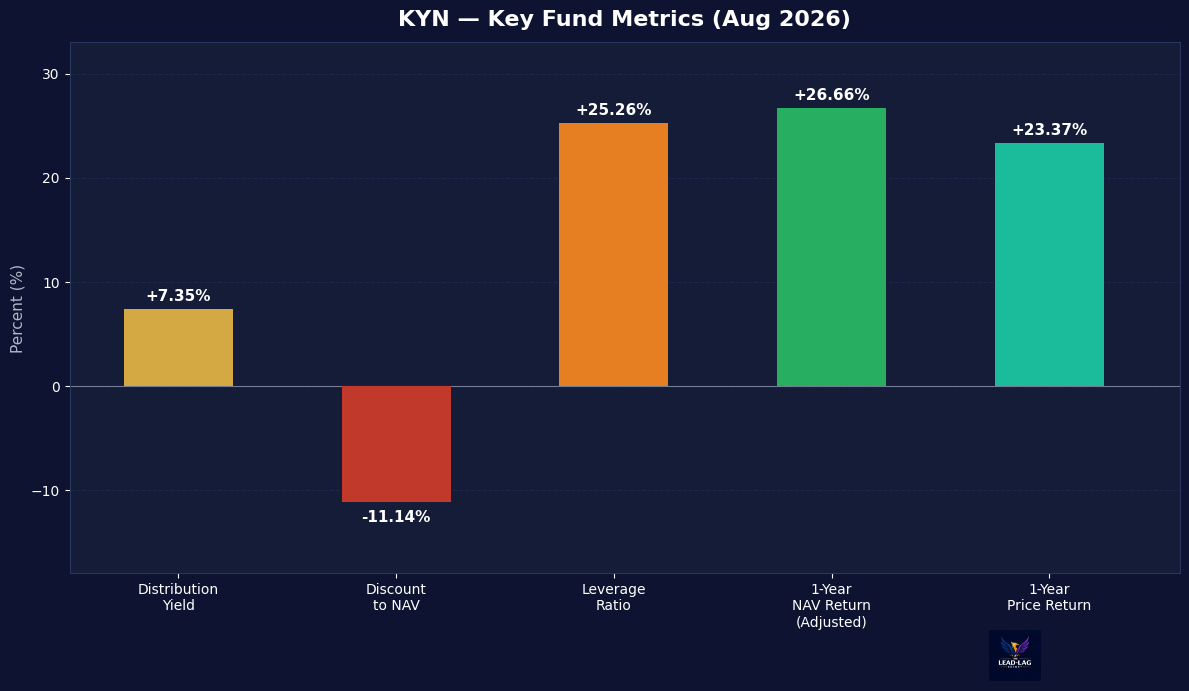
Yield: ~7.35% at market price | 6.56% on NAV
Distribution raised: $0.085 to $0.09/month in June 2026 (+5.9%) -- management signaling confidence
Valuation: -11.14% discount vs -12.04% 52-week average -- near average, slightly less attractive than deepest discounts of -16.15%
Coverage risk: ~0.5x NII coverage -- distributions rely heavily on net realized gains from energy holdings
AUM: $3.74B | 33 concentrated holdings | 25.26% leverage
Every week, we'll profile a high yield investment fund that typically offers an annualized distribution of 6-10% or more. With the S&P 500 yielding less than 2%, many investors find it difficult to achieve the portfolio income necessary to meet their needs and goals. This report is designed to help address those concerns.

For most of the last decade, owning midstream energy meant owning a value trap. The pipelines threw off cash, the market refused to pay for it, and every rally got sold on the argument that the asset base was a stranded liability waiting for the energy transition to finish the job.
Then something changed, and it did not come from the energy industry at all. It came from data centers. The compute buildout behind artificial intelligence needs electricity on a scale renewables cannot deliver on the required timeline, and the marginal source of firm generation in the United States is natural gas. Gas has to be gathered, processed, and moved, and the companies that own the molecules' path to market get paid on volume regardless of where the commodity price sits. Add LNG export capacity that keeps expanding, and the demand curve for American gas infrastructure looks structurally different than it did in 2019.
The Kayne Anderson Energy Infrastructure Fund (KYN) is one of the most direct ways to own that thesis with a large income component attached. It is a closed-end fund launched on September 28, 2004, running $3.74 billion in total investment exposure across just 33 holdings, 94% of it in midstream energy ([Kayne Anderson](https://kaynefunds.com/kyn/)). Shares trade near $14.70 against a NAV of $16.61, an 11.14% discount, and the fund pays $0.09 per share monthly for a distribution rate of roughly 7.35% on price and 6.56% on NAV ([CEFConnect](https://www.cefconnect.com/fund/KYN)). That payout went up in June 2026, which is not something you see in a sector the market has spent years writing off.
Fund Background
KYN has been running this strategy for more than twenty-one years, marked through every cycle the sector can produce: the shale boom, the 2014-2016 crude collapse, the MLP structure's tax and index problems, the 2020 demand shock, and the recovery since. I would rather underwrite a manager forced to survive than one whose record starts after the last drawdown.
What it owns is the toll-road layer of the energy value chain: pipelines, gathering and processing systems, storage, LNG terminals, export facilities. These businesses are fee-based and volume-driven rather than price-driven, which separates midstream from producers and is the entire reason this asset class can support a 7% income stream.
Total assets sit at $3.75 billion, with leverage of $665.9 million, or approximately 25.26% of assets ([StockTitan](https://www.stocktitan.net/news/KYN/kayne-anderson-energy-infrastructure-fund-provides-unaudited-balance-3f3tw350aqko.html)). That is meaningful leverage, but the coverage behind it is strong: 644% asset coverage on senior debt and 497% on total leverage, comfortably above the thresholds that force deleveraging, which is precisely what went wrong for levered energy funds in March 2020. Annual turnover of 18.60% tells you this is a long-term portfolio rather than a trading vehicle wearing a fund wrapper.
Portfolio Composition

The allocation is 94% midstream energy, 4% power infrastructure, and 2% other ([Kayne Anderson](https://kaynefunds.com/kyn/)). There is no diversification argument to make here. This is a single-sector fund and should be evaluated as one.
Concentration inside that sector is equally stark. Thirty-three holdings, with the top ten at roughly 73% of long-term investments: Enterprise Products Partners at 10.0%, Energy Transfer at 9.8%, Williams Companies at 9.5%, Cheniere Energy at 8.0%, MPLX at 7.0%, ONEOK at 6.3%, Enbridge at 5.9%, Kinder Morgan at 5.9%, TC Energy at 5.4%, and Targa Resources at 5.2%.
That list is essentially the entire investable universe of large-cap North American midstream: the two biggest MLPs, the owners of the natural gas transmission backbone, the dominant American LNG exporter, the gathering and processing names levered to Permian volumes, and the two Canadian majors. That last piece is why the geographic split reads 116% United States and 20% Canada, the sum exceeding 100% because of leverage.
The honest read is that you cannot own this sector in a diversified way, because the sector itself is concentrated. Maybe fifteen companies matter, so thirty-three names is not excessive single-name risk relative to the opportunity set. What it is taking is complete sector risk, and no amount of position sizing inside energy infrastructure changes that.
Performance Analysis


The return history is violent in both directions. The fund returned 11.64% on price in 2019, then lost 52.89% in 2020 as the pandemic collapsed energy demand and MLP valuations simultaneously ([CEFConnect](https://www.cefconnect.com/fund/KYN)). NAV fell 47.19% that year, so the discount widened on top of the asset decline. Recovery followed: up 44.17% in 2021, 20.11% in 2022, 12.84% in 2023, then an exceptional 60.02% in 2024 as the AI power demand narrative took hold. 2025 was flat at 3.03%, and year to date in 2026 the fund is up 23.37% on price against 26.35% on NAV.
That 2020 number is the risk statement for this entire investment. A 53% single-year drawdown is what a 25% levered, 94% single-sector portfolio does when its sector breaks. Anyone buying KYN for the income should size the position against that repeating, not against the 2024 return.
Valuation is the more actionable question. The current 11.14% discount compares to a 52-week average of 12.04% and a range of 8.20% to 16.15%. Shares sit slightly tighter than their own one-year average, so you are paying roughly what this fund normally costs rather than getting a bargain. Patient buyers in prior years got 16% discounts. Today's entry is fine, not exceptional.
Macro Environment
The bull case is genuinely strong, and I do not say that often about energy.
Data center electricity demand is rising faster than any credible forecast from three years ago, and the fill-in generation is natural gas. That is not an ideological statement, it is a scheduling one. Gas turbines can be permitted and built on a timeline matching compute deployment; nuclear cannot, and intermittent renewables without storage cannot supply the firm baseload a training cluster requires. More gas burned domestically means more volume through the systems KYN's holdings own, and every incremental LNG export train compounds it, pulling molecules through gathering, processing, and long-haul pipe, each step a fee collected by a company in this fund.
The deeper point is that the energy transition, treated for a decade as the terminal threat to midstream, has quietly repositioned natural gas as a bridge fuel with a longer bridge than anyone expected. Coal retirement plus load growth plus renewable intermittency equals a structural gas demand floor extending well into the 2030s. What would break that is a storage breakthrough, a data center capex pause, or policy penalizing new pipeline capacity. None look imminent. All are possible over a holding period long enough to matter.
Distribution Policy

This is where I part ways with the simple bull case.
Start with the good news, because it is real. KYN switched from quarterly to monthly distributions in November 2024, which is straightforwardly investor-friendly for anyone using this for income ([Kayne Anderson distribution history](https://kaynefunds.com/kyn/distribution-history/)). The monthly rate then went from $0.08 to $0.085 in March 2026, a 6.25% increase, and from $0.085 to $0.09 in June 2026, a further 5.9%. That is $1.08 annualized and two raises inside six months. Boards do not raise distributions twice in a year without conviction about the cash flow behind them.
Now the problem. Coverage from net investment income runs approximately 0.5x. Half the payout is funded by portfolio income; the rest depends on net realized gains from selling appreciated holdings.
In a year like 2026, with the fund up more than 23%, realized gains are abundant and that funding source is not a concern. In a year like 2020, when NAV fell 47%, there are no gains to realize and the choice becomes cutting the distribution or paying out of capital. That is why I treat 7.35% here differently than 7.35% from a credit fund whose coupons arrive regardless of price. CEFConnect classifies the distribution as income only with no return of capital flag, which helps, but classification is a backward-looking tax characterization, not a forward-looking sustainability guarantee.
Advantages
The macro tailwind is the strongest advantage, and this is the rare case where a sector story and an income story point the same direction. AI-driven power demand plus LNG export growth creates volume growth for fee-based infrastructure, and volume growth is what funds distribution increases. Every top ten holding participates.
Second, the two 2026 raises are a genuine signal. Management has information about contracted cash flow that outside investors do not, and raising the payout twice inside two quarters, in a sector with a history of cuts, is a meaningful statement of confidence.
Third, asset coverage is strong. At 644% on senior debt and 497% on total leverage, this fund is nowhere near the tests that force liquidation into weakness, unlike the levered energy vehicles that were compelled sellers in 2020.
Fourth, the monthly schedule plus the discount means you buy $1.00 of the highest-quality assets in North American midstream for about 89 cents and collect cash twelve times a year.
Disadvantages
The 94% single-sector concentration is the dominant risk and cannot be diversified away inside the fund. If energy infrastructure derates, nothing in the portfolio offsets it. Size this as a sector bet, not as an income allocation.
Second, 0.5x NII coverage means the distribution depends on continued appreciation. In a flat or falling energy market, realized gains disappear and the payout becomes vulnerable. A cut in a closed-end fund typically triggers discount widening on top of the NAV decline, so the price damage compounds.
Third, the 25.26% leverage amplifies both directions, and 2020 showed what that means: down 52.89% on price in a single year. The leverage that makes 7.35% possible is the same leverage that produces that outcome.
Fourth, valuation offers no cushion at an 11.14% discount against a 12.04% average and a 16.15% wide. And energy transition risk remains real over long horizons. The gas bridge is longer than the market assumed in 2020, but it is still a bridge, and terminal value questions about pipeline assets have not been permanently answered.
Final Thoughts
KYN is the cleanest publicly traded expression I know of the idea that artificial intelligence is a natural gas story. Compute needs power, power needs gas, gas needs pipes, and this fund owns the pipes at a discount while paying 7.35%. When a thesis is that legible, the market has usually already noticed, and a 23% year-to-date return plus a discount tightening toward its average suggests exactly that.
My read is that the fundamental setup deserves the enthusiasm. Volume growth from data center load and LNG export expansion is contracted, visible, and multi-year, and it flows to the fee streams of the ten companies making up nearly three-quarters of this portfolio. The two raises are management saying the same thing in the only language a board really speaks.
The bear case is not that the thesis is wrong, it is what happens if the thesis merely pauses. With half the distribution funded by realized gains and 25% leverage on a 94% single-sector book, KYN does not need an energy collapse to have a bad year. It needs only a flat one. Gains stop accruing, coverage tightens, the board faces a choice, and a cut gets punished twice, once through NAV and once through a wider discount.
So I would own this as a deliberate, sized sector position for investors who want energy infrastructure exposure and want to be paid monthly for holding it. I would not own it as a core income holding, because the payout is not structurally covered, and I would not chase it on valuation, because an 11% discount in a fund that has traded at 16% is not an entry that makes the math forgiving. Take the AI gas trade if you want it, and keep it small enough that a repeat of 2020 is survivable. It is not the exposure that ruins people in this sector, it is the size of it.
The Lead-Lag Report is provided by Lead-Lag Publishing, LLC. All opinions and views mentioned in this report constitute our judgments as of the date of writing and are subject to change at any time. Information within this material is not intended to be used as a primary basis for investment decisions and should also not be construed as advice meeting the particular investment needs of any individual investor. Trading signals produced by the Lead-Lag Report are independent of other services provided by Lead-Lag Publishing, LLC or its affiliates, and positioning of accounts under their management may differ. Please remember that investing involves risk, including loss of principal, and past performance may not be indicative of future results. Lead-Lag Publishing, LLC, its members, officers, directors and employees expressly disclaim all liability in respect to actions taken based on any or all of the information on this writing.