Brazil Lost 20% in a Day. The Rest of Emerging Markets Barely Noticed.
Brazil's ETF fell 19.8% in a day after Lula's upset win. Emerging markets fell 0.31%. A crowded trade, a contained shock and the Bank of Japan next.

LIVE TODAY FOR ADVISORS

Ask Michael Anything: Advisor Connect, Today at 2 PM ET
Join Michael live on Zoom today, Friday, October 30, at 2:00 PM ET / 11:00 AM PT. Bring a market question, a portfolio question or a practice question, or just listen in. Advisor Connect is where the Lead-Lag Media team and advisors in the network share insights, discuss market themes and look for ways to work together.
Brazil's main U.S.-listed ETF fell 19.8% on October 26 after a runoff result the market had priced as unlikely. The broader emerging market fund lost 0.31% that day. What a crowded election trade, a contained shock and two central bank meetings tell a global allocator.
MICHAEL A. GAYED, CFA
Key Highlights
- EWZ closed down 19.82% at $34.15 on October 26, its second-worst day since the fund launched in 2000, after Lula won Brazil's runoff 51.8% to 48.2%.1, 2
- The same day, the iShares MSCI Emerging Markets ETF fell only 0.31%, Mexico rose 0.05% and South Korea rose 0.97%.3
- The real lost about 7.1% against the dollar from October 23 to October 27, while the Mexican peso slipped 0.16%.4
- The Fed held at 3.75% to 4% on October 28 with two dissents for a hike, and the Bank of Japan held at 1.25% on October 30 in an 8-1 vote.16, 17
The Trade That Everyone Was In
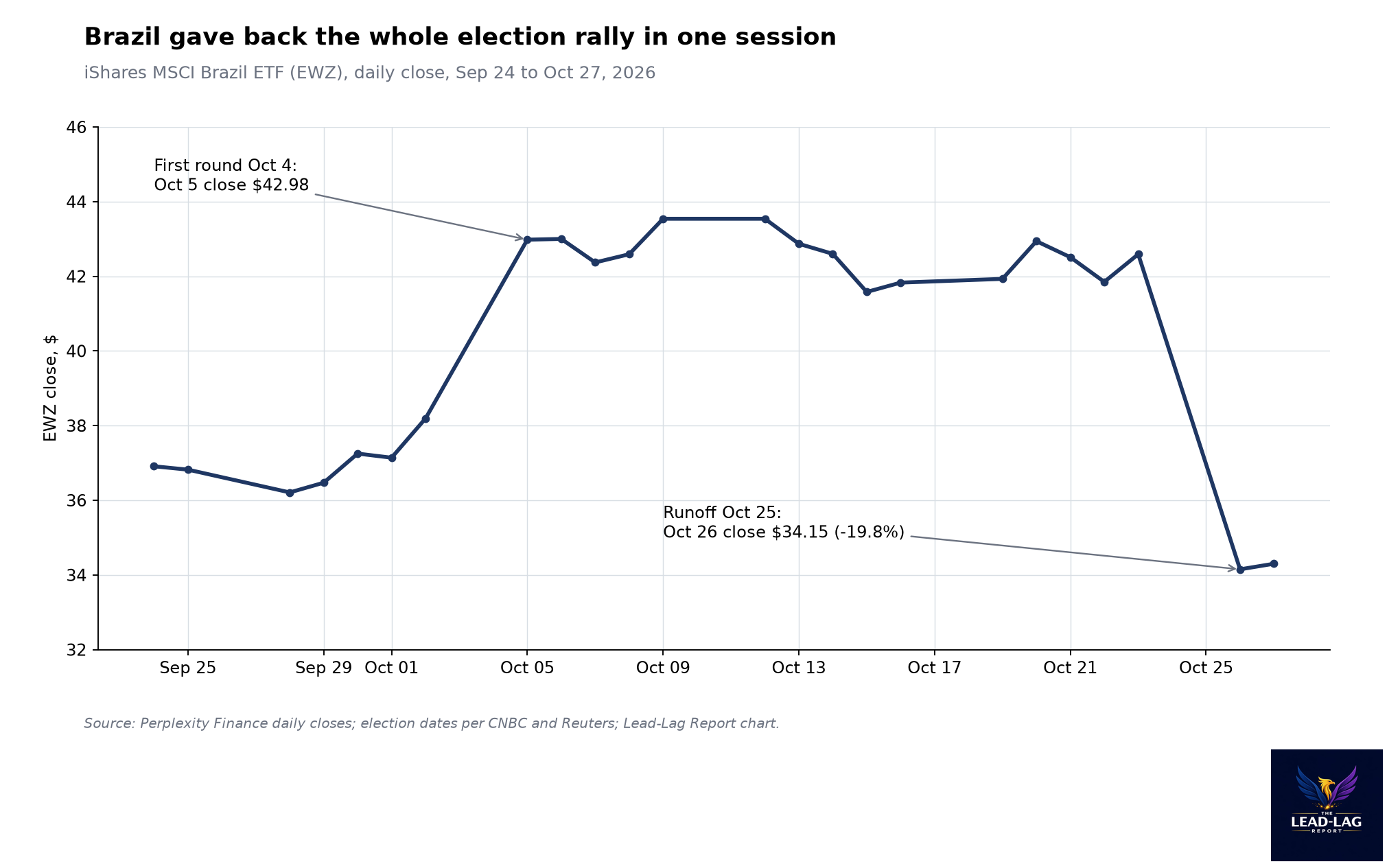
Three weeks ago, Brazil looked like the cleanest political trade in emerging markets. Senator Flávio Bolsonaro led the first round on October 4, and EWZ jumped from $38.19 on October 2 to $42.98 on October 5.3, 7 Money followed the move. The ETF took in $4.09 billion in three weeks as investors positioned for a more market-friendly government.2
Betting markets agreed. Before the runoff, prediction markets priced Bolsonaro at roughly 75% to 80%.8, 9 Then Luiz Inácio Lula da Silva won a fourth term, 51.8% to 48.2%, according to Brazil's Superior Electoral Court.7
On Monday, October 26, the trade unwound in one session. EWZ closed at $34.15, down 19.82%, after touching $31.40 intraday.1 That close was below where the fund sat on September 30, before the first round.3 The whole election rally was gone in a day.
How Bad It Was Inside Brazil
The local market was worse than the ETF headline in some places. Brazil's B3 exchange halted trading for 30 minutes after the Ibovespa fell 10% at the open, triggering its circuit breaker.10 The index closed down 13.88% at 176,608, its biggest daily drop since March 2020.11
Smaller companies took the hardest hit. The iShares MSCI Brazil Small-Cap ETF fell 31.6% on October 26, against 19.9% for the Franklin FTSE Brazil ETF.12 Domestic banks and the state oil company led the declines in U.S. trading.13
And the political risk is not settled. Bolsonaro has refused to concede and says he will seek to annul the result.10 That keeps a second layer of uncertainty on top of the policy question.
The Contagion That Did Not Happen
Here is the part I think matters most for a global allocator. Brazil crashed. Emerging markets did not.
On October 26 the iShares MSCI Emerging Markets ETF fell 0.31%.3 Mexico, the other big Latin American market, rose 0.05%.3 South Korea rose 0.97%, Taiwan 0.68%, India 0.28% and China 0.24%.3 The S&P 500 gained 0.71%.3
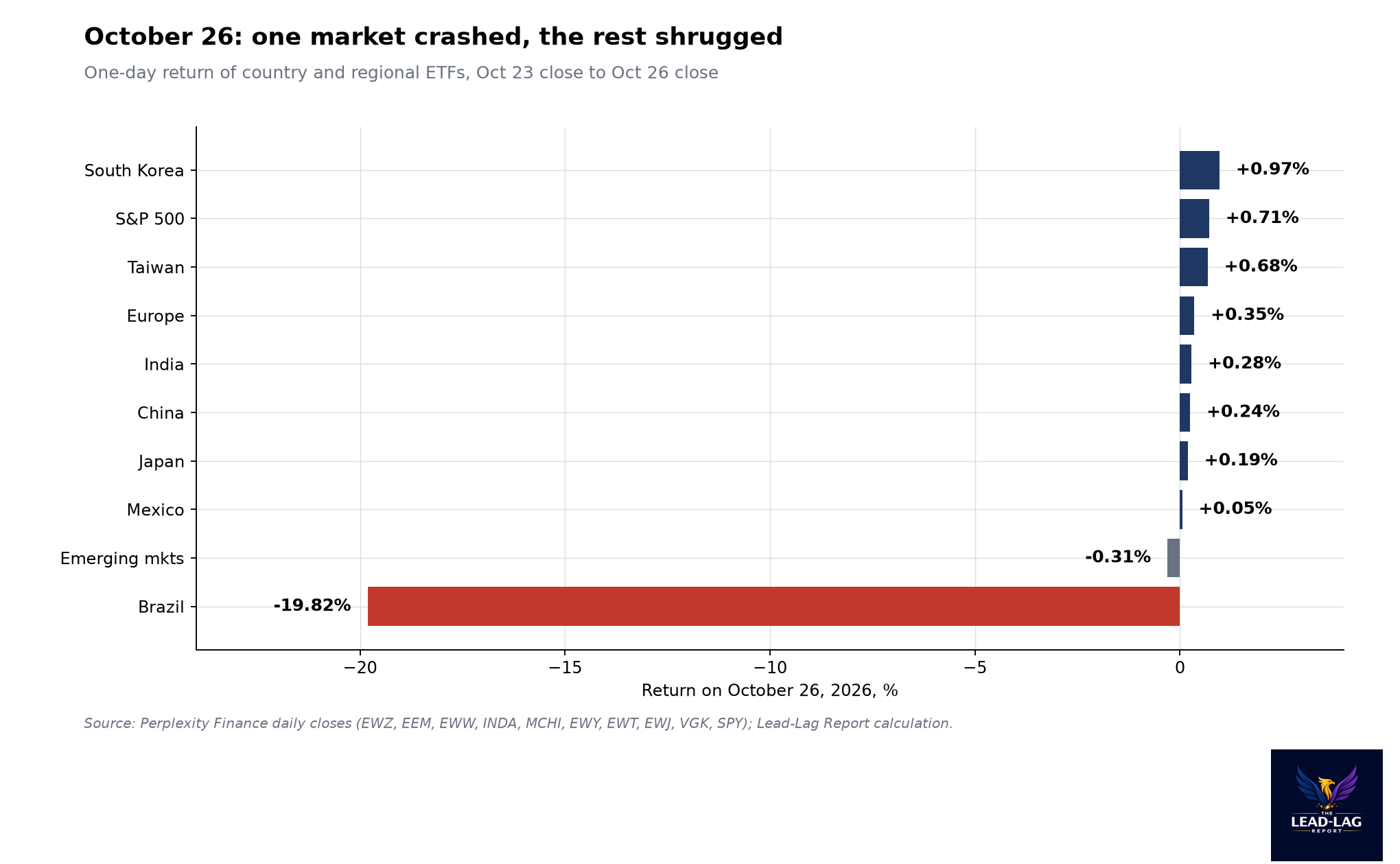
The next day, the broad emerging market fund rose another 1.13%, led by South Korea at 3.10%.3 EWZ itself managed only a 0.44% bounce.3
That is what an idiosyncratic shock looks like. When a crash stays in one country and one currency, it is telling you the problem was positioning in that country, not stress in the system. When it spreads, through funding markets or forced selling, it shows up in places like Mexico and the broad index within hours. It did not.
The Currency Told The Same Story
The real is where the damage was clearest. The dollar bought about 4.97 reais on October 23 and about 5.35 on October 27, a decline of roughly 7.1% for the real.4 Over the same days the Mexican peso slipped just 0.16% and the Japanese yen 0.72%.4
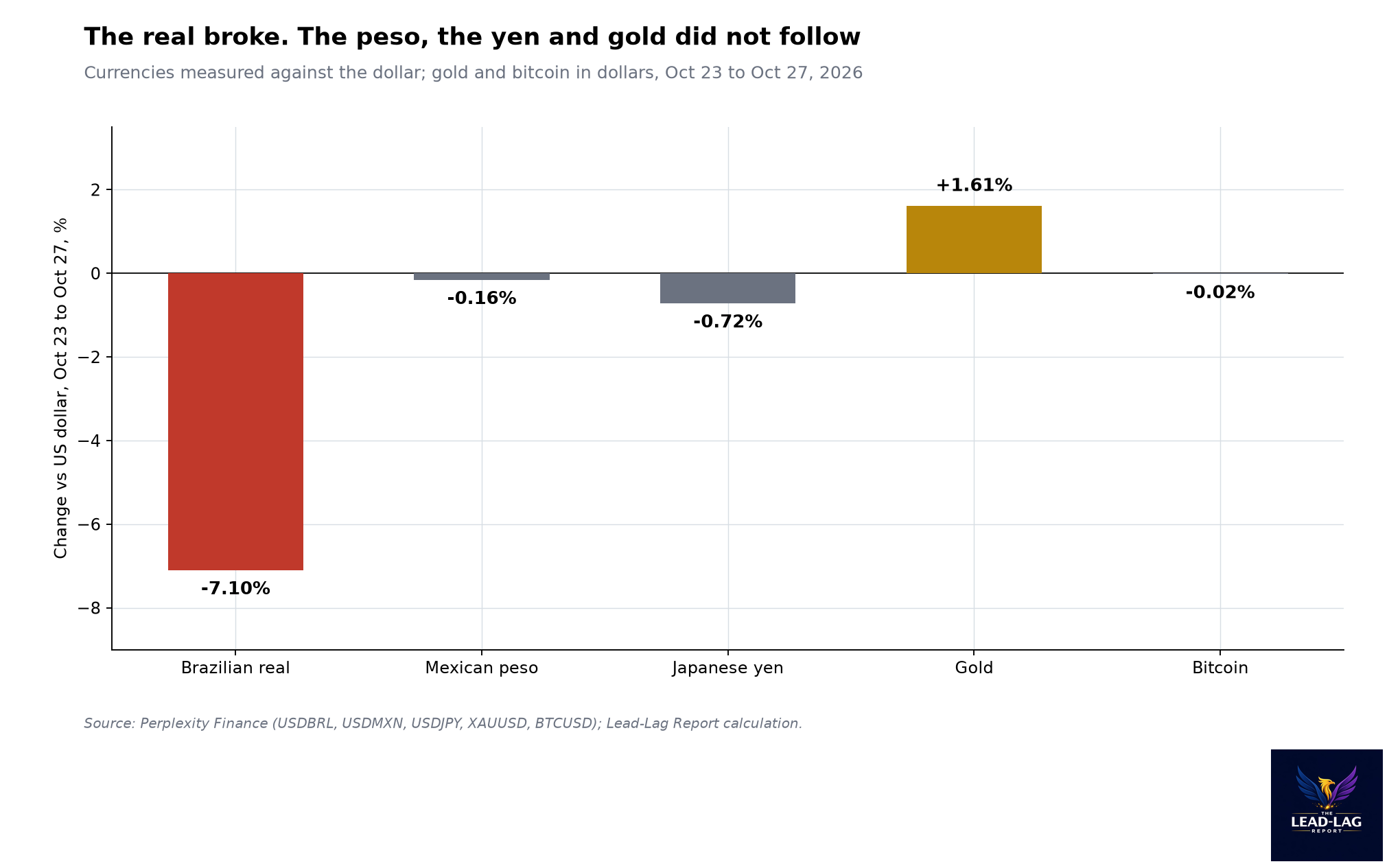
Gold rose 1.61% from October 23 to October 27 and bitcoin was flat at -0.02%.4 Nothing here looks like a global flight to safety. It looks like a local repricing of Brazil's fiscal and political path, with everything else carrying on.
I would not treat that as an all clear for Brazil. A currency that falls 7% in two days resets the inflation math and the interest rate math at the same time. Rate futures in Brazil rose sharply on the result.10 What it does say is that global investors are drawing a line around the problem.
The Year In One Chart
Step back and the year still belongs to Asia's hardware markets. Since the end of 2025, Taiwan's ETF is up 68.82% and South Korea's 61.96% through October 27.3 Japan is up 17.97% and the S&P 500 12.87%.3 Brazil, even after Monday, is up 7.96%, and Europe 4.10%.3 India is down 13.52% and China 18.30%.3
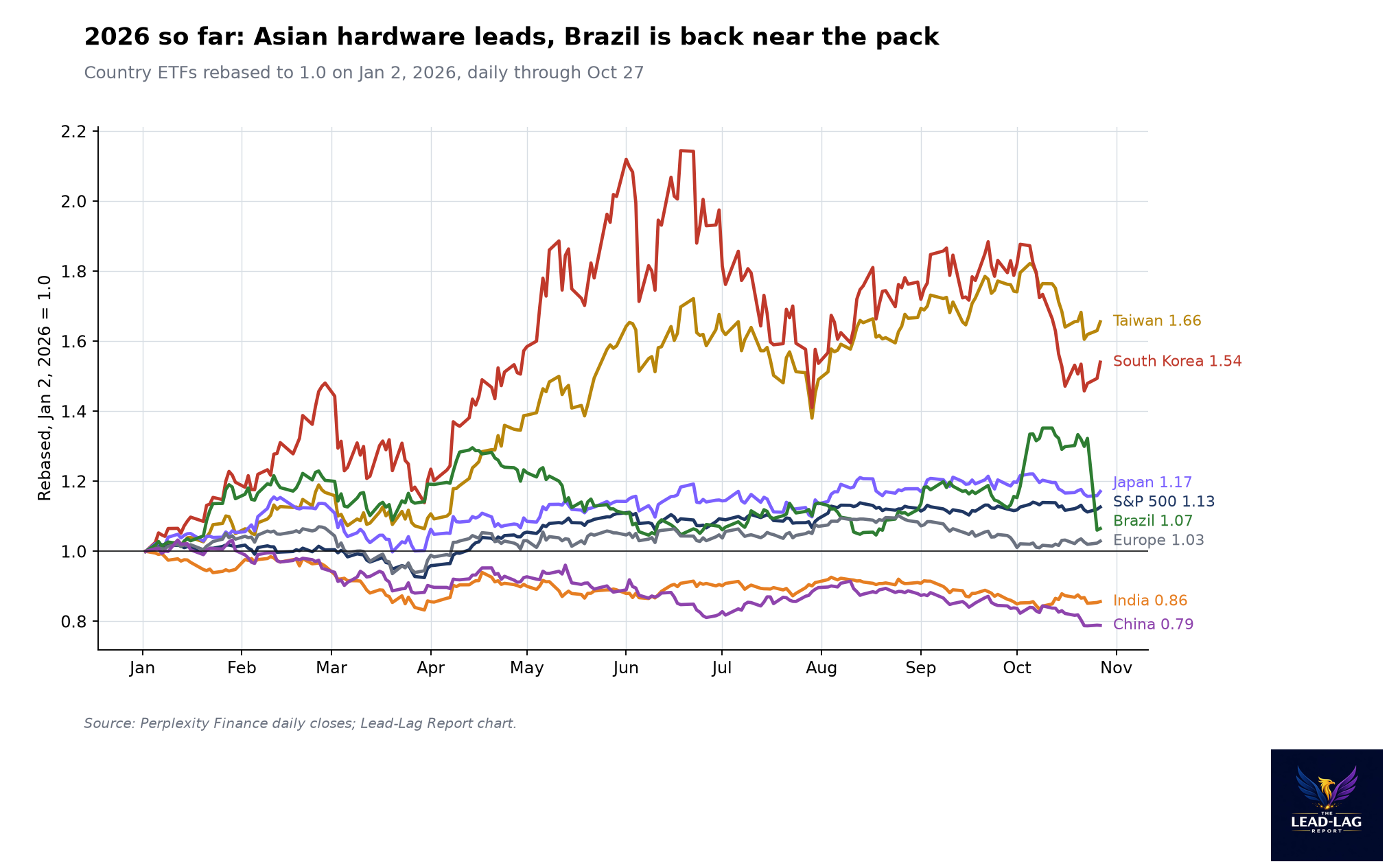
Brazil went from one of the year's better stories back into the middle of the pack in one session. That is the cost of a crowded trade that depends on a single event. It can be right for three weeks and wrong in a day.
The United States And Europe Kept Going
The developed world treated Brazil as a footnote. From the October 23 close to October 27, the S&P 500 ETF rose 1.28%.3 Europe's broad ETF gained 0.92%, with Germany up 1.42% and the United Kingdom down 0.69%.3 Japan's ETF added 1.22%.3
If you hold a mostly U.S. and European portfolio, you probably did not notice Monday at all. That is worth saying plainly. A 20% crash in a major emerging market used to be a global event. This one was a regional one, and the regional exposure was owned by a narrow group of investors who had piled in over three weeks.2
For the U.S. investor, the more relevant moves this week are domestic. The Fed held on Wednesday and the Bank of Japan held on Friday, and both left the door open to tighter policy.16, 17 Those two decisions are doing more to set prices than anything in São Paulo.
The Oil Overlay
Oil is the one global input that connects to Brazil directly. Petrobras was among the hardest-hit stocks on Monday.13 The U.S. Oil Fund (USO) fell 1.95% on October 26 and another 1.41% on October 27.3 Over the same two days, the dollar strengthened against the real by about 7.1%, so a barrel priced in reais was worth more at the end of those two days than at the start, even as the stock fell.3, 4
Step back and oil has been the year's biggest single move. USO is up 136.96% since the end of 2025.3 West Texas Intermediate crude was $107.89 a barrel on October 20, against $57.26 at the end of 2025.15 That backdrop matters for Brazil's inflation and its central bank, and it matters for Japan, where the Bank of Japan just raised its inflation forecast.18
If you are wondering why a commodity exporter's stocks fell while oil sat above $100, the answer is that the market was not pricing oil. It was pricing who controls fiscal policy for the next four years.
Japan Is Next
The bigger test for global markets this week is not in Brazil. It is in Tokyo. The Bank of Japan held its policy rate at 1.25% on October 30 in an 8-1 vote, with board member Hajime Takata dissenting in favor of a hike to 1.5%.17 It had raised the rate to 1.25% in September in a 7-2 vote.6 It also said underlying inflation is now consistent with its 2% target, and it more than doubled the pace of its ETF sales to about 860 billion yen a year.18, 19 Traders now price about an 80% chance of a hike in December.20
A Bloomberg survey published October 22 had found that none of the economists polled expected a hike at this meeting, and 83% expected the next increase in December, up from 35% a month earlier.6 The hold matched that call, and the Bank published its new Outlook Report the same day.5, 18
The yen has moved the other way from Brazil's currency this week, weakening modestly against the dollar from 156.81 on October 23 to 157.95 on October 27.4 I think the yen is the real global risk to watch. Brazil's crash was a local repricing. A disorderly yen move would hit every market that has been funded with cheap yen. After the decision, the yen strengthened to as much as 157.115 per dollar before giving back part of the move.21 That is not the sharp rally that would signal trouble. Not yet.
And The Fed
The Federal Reserve held the federal funds target range at 3.75% to 4% on October 28 by a 10 to 2 vote. Governor Lisa D. Cook and Cleveland Fed President Beth M. Hammack dissented in favor of a quarter-point hike.16 The point for this letter is the sequencing. A Fed hold with two hawkish dissents, followed two days later by a Bank of Japan hold with its own hawkish dissent, is the kind of week where currency markets do the deciding, and where a contained shock in one country can look small next to a move in the dollar-yen rate.
What About The Laggards?
India and China are the two big markets still down for the year, at -13.52% and -18.30% since the end of 2025.3 Neither moved much on Brazil's bad day, and both rose slightly.3 Their problems are their own: different policy paths, different flows. Brazil's crash did not change them, and I would not read anything into their small gains on October 26.
How I Am Reading This
I think the lesson of the week is about crowding, not about Brazil. Three weeks of inflows into one country fund on the back of one expected result is the kind of setup that breaks hard when the result goes the other way.2 The fact that the rest of emerging markets barely moved tells you the crowd was concentrated in Brazil, not spread across the asset class.
For anyone running a global portfolio, that is a useful distinction. A single-country bet can be a reasonable position. It just should not be sized as if the outcome is known. Prediction markets put Bolsonaro near 80% before the vote.9 One in five chances happen about one time in five.
I could be wrong if the shock spreads with a lag. If Mexico, the broad emerging market fund or other high-yielding currencies start to slide over the next week, the contained reading would be wrong, and the story would shift from Brazil to a broader exit from emerging markets.
What Would Change My View
Three things would tell me this is turning from a local event into a global one. First, the iShares MSCI Emerging Markets ETF falling below its October 23 close of $62.01.3 Second, the Mexican peso weakening past 19 per dollar from about 18.67 on October 27.4 Third, a sharp rally in the yen now that the Bank of Japan has opened the door to a December hike, which would put pressure on carry trades everywhere at once.20
Until then, the read is simple. Brazil repriced. The world did not. Few understand this.
Notes
- [1] EWZ daily close and intraday low, October 26, 2026: Perplexity Finance, www.perplexity.ai/finance/EWZ
- [2] EWZ $4.09 billion in three weeks of inflows; second-worst decline since 2000 launch: Yahoo Finance, au.finance.yahoo.com/news/brazil-etf-took-4-09b-125000186.html
- [3] Daily closes for EWZ, EEM, EWW, INDA, MCHI, EWY, EWT, EWJ, VGK and SPY, December 31, 2025 to October 27, 2026, via Perplexity Finance; returns are Lead-Lag Report calculations: www.perplexity.ai/finance/EEM
- [4] USDBRL, USDMXN, USDJPY, XAUUSD and BTCUSD daily closes via Perplexity Finance; changes are Lead-Lag Report calculations: www.perplexity.ai/finance/USDBRL
- [5] Bank of Japan release schedule and Monetary Policy Meeting dates, October 29 and 30, 2026: www.boj.or.jp/en/about/calendar/index.htm
- [6] Bloomberg survey of October 22 (83% expect a December hike, up from 35%; none expect October), and the 25-basis-point September hike to 1.25% in a 7-2 vote: EBC Financial Group, www.ebc.com/forex/boj-october-2026-rate-decision-december-hike-usd-jpy
- [7] Lula 51.8% to Bolsonaro 48.2%, Superior Electoral Court count; Bolsonaro first-round lead: CNBC, www.cnbc.com/2026/10/26/brazil-lula-win-presidential-election-runoff-vote.html
- [8] Betting markets had Bolsonaro over 75% after the first round: investingLive, investinglive.com/stock-market-update/brazilian-markets-headed-for-a-rout-after-surprise-lula-election-win/
- [9] Polymarket and Kalshi priced Bolsonaro at roughly 80% before the vote: Cryptonews, cryptonews.net/news/finance/33652906/
- [10] B3 circuit breaker and 30-minute halt; real weakened about 12% early; rate futures rose sharply; Bolsonaro refused to concede and seeks annulment: Reuters, www.reuters.com/business/finance/investors-expect-markets-unwind-brazils-lula-reelected-2026-10-26/
- [11] Ibovespa closed down 13.88% at 176,608, biggest daily drop since March 2020: Financial Express, www.financialexpress.com/market/global-markets/brazil-stock-market-crash-explained-why-lulas-election-win-triggered-a-13-88-plunge/4370624/
- [12] EWZS down 31.6% and FLBR down about 19.9% on October 26: Citywire, citywire.com/americas/news/brazil-etfs-stabilize-after-historic-sell-off-as-the-lula-trade-unwinds/a2502030
- [13] Petrobras, Itaú Unibanco and Ambev declines in U.S. trading: CNBC, www.cnbc.com/2026/10/26/brazil-stocks-neoclouds-selloff.html
- [15] Crude Oil Prices: West Texas Intermediate (DCOILWTICO), U.S. Energy Information Administration via FRED: fred.stlouisfed.org/series/DCOILWTICO
- [16] Federal Reserve FOMC statement, October 28, 2026 (target range 3-3/4 to 4 percent, 10-2 vote, Cook and Hammack preferred a 1/4 point hike): www.federalreserve.gov/newsevents/pressreleases/monetary20261028a.htm
- [17] Bank of Japan, Statement on Monetary Policy, October 30, 2026 (call rate around 1.25 percent, 8-1 majority vote): www.boj.or.jp/en/mopo/mpmdeci/mpr_2026/k261030a.pdf
- [18] Investing.com via Yahoo Finance, BOJ keeps interest rates steady as expected, October 30, 2026 (underlying CPI consistent with 2% target; inflation forecast raised): finance.yahoo.com/economy/policy/articles/boj-keeps-interest-rates-steady-035108483.html
- [19] The Tribune (ANI), BOJ keeps policy rate unchanged at 1.25%, raises annual ETF sales pace to 860 billion yen, October 30, 2026: www.tribuneindia.com/news/boj-keeps-policy-rate-unchanged-at-1-25-raises-annual-etf-sales-pace-to-860-billion-yen/
- [20] Investing.com via Yahoo Finance, Asian currencies mixed as yen steadies after BOJ hold (about 80% chance of a December hike priced), October 30, 2026: au.finance.yahoo.com/news/asian-currencies-mixed-dollar-retreats-034327432.html
- [21] Reuters via Lufkin Daily News, Yen gains after BOJ; AI jitters dent dollar (high of 157.115 per dollar), October 30, 2026: lufkindailynews.com/news_reuters/business/yen-has-brief-gain-after-boj-while-ai-jitters-weigh-on-dollar/article_ca6296d7-0209-5f2b-9320-fc865bfbb1bb.html