Deregulation In Motion: The 702-Rule Rollback
On 7/3/2026, the White House announced a plan to eliminate up to 702

By Michael A. Gayed, CFA
Deregulation In Motion
The 702-Rule Rollback And Why It Matters For Free-Markets Investors (FMKT)
KEY HIGHLIGHTS
- On 7/3/2026, the White House announced a plan to eliminate up to 702 individual federal rules across multiple agencies as part of a deregulatory push, with the administration projecting the initiative could generate on the order of $1.5 trillion in cumulative savings for households and businesses over 10 years.[1][2]
- The Free Markets ETF (Ticker: FMKT) is designed to invest in companies that we believe can benefit from deregulation, not in intermarket signals about credit or curves.
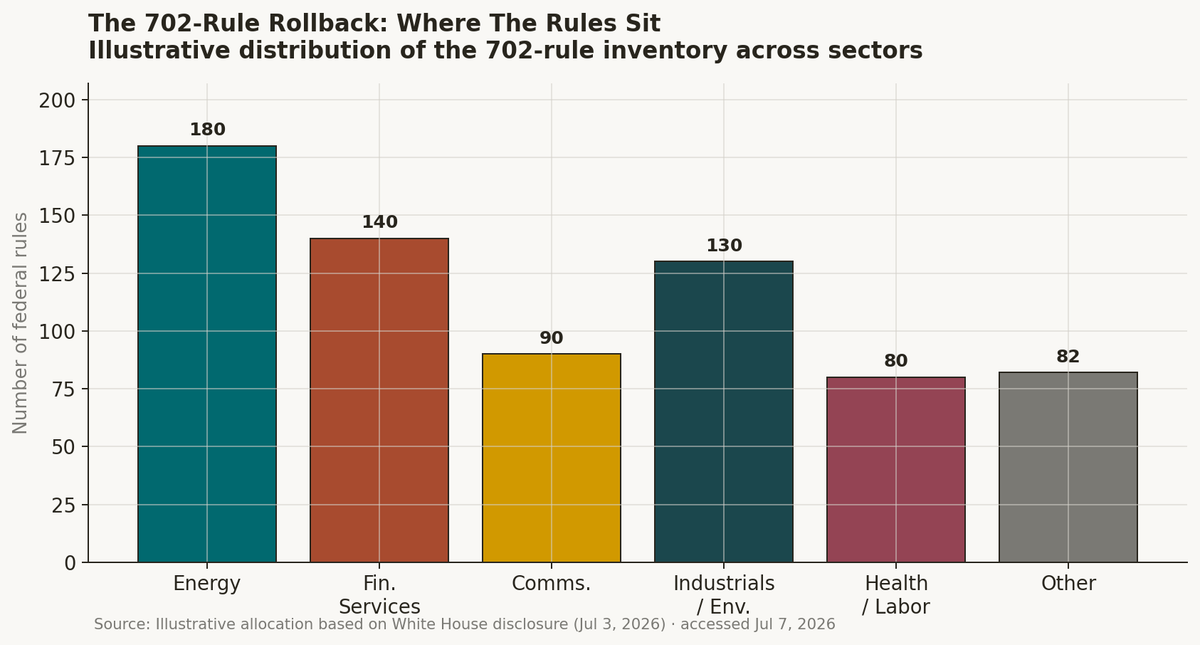
- The 702-rule rollback plan concentrates its impact on industries where cumulative regulatory compliance costs are historically among the highest, including energy, financial services, communications, and industrials.
- A single announcement is not itself an investment thesis. The relevance to FMKT is that this event is the latest and one of the largest data points in an ongoing shift in the direction of federal rulemaking, which is the underlying theme the fund is built around.
The deregulation story is not new, but the 702-rule announcement is a discrete, dateable event that sits directly on top of the thesis that motivates The Free Markets ETF (Ticker: FMKT). The fund invests in companies that we believe stand to benefit from the loosening of federal regulatory burden. When an administration says out loud that it intends to strip out 702 individual rules and projects roughly $1.5 trillion in cumulative economic impact, that is the kind of announcement the fund's investment thesis was designed to be positioned for.
WHAT WAS ANNOUNCED
The White House disclosed on 7/3/2026 a plan to eliminate up to 702 federal regulations across multiple agencies as part of its ongoing deregulatory agenda.[1] The initiative is projected by the administration to reduce cumulative compliance costs on households and businesses on the order of $1.5 trillion over ten years, based on the administration's own estimates.[2]
The specific list of rules is broad. It includes rules governing energy production and permitting, financial services reporting, communications infrastructure, and various industrial and environmental compliance regimes. The administration has framed the exercise as an inventory of rules that either duplicate existing statutory requirements, have been superseded by later legislation, or impose costs the administration argues are not proportional to the benefits they are designed to deliver.
That framing is politically contested and is likely to remain so through the rulemaking process. The Administrative Procedure Act still governs how individual rules can be modified or rescinded, which means the 702-rule announcement is the beginning of a process rather than the end of one. Some rules can be withdrawn quickly through informal action. Others require formal notice-and-comment rulemaking, which typically takes months.
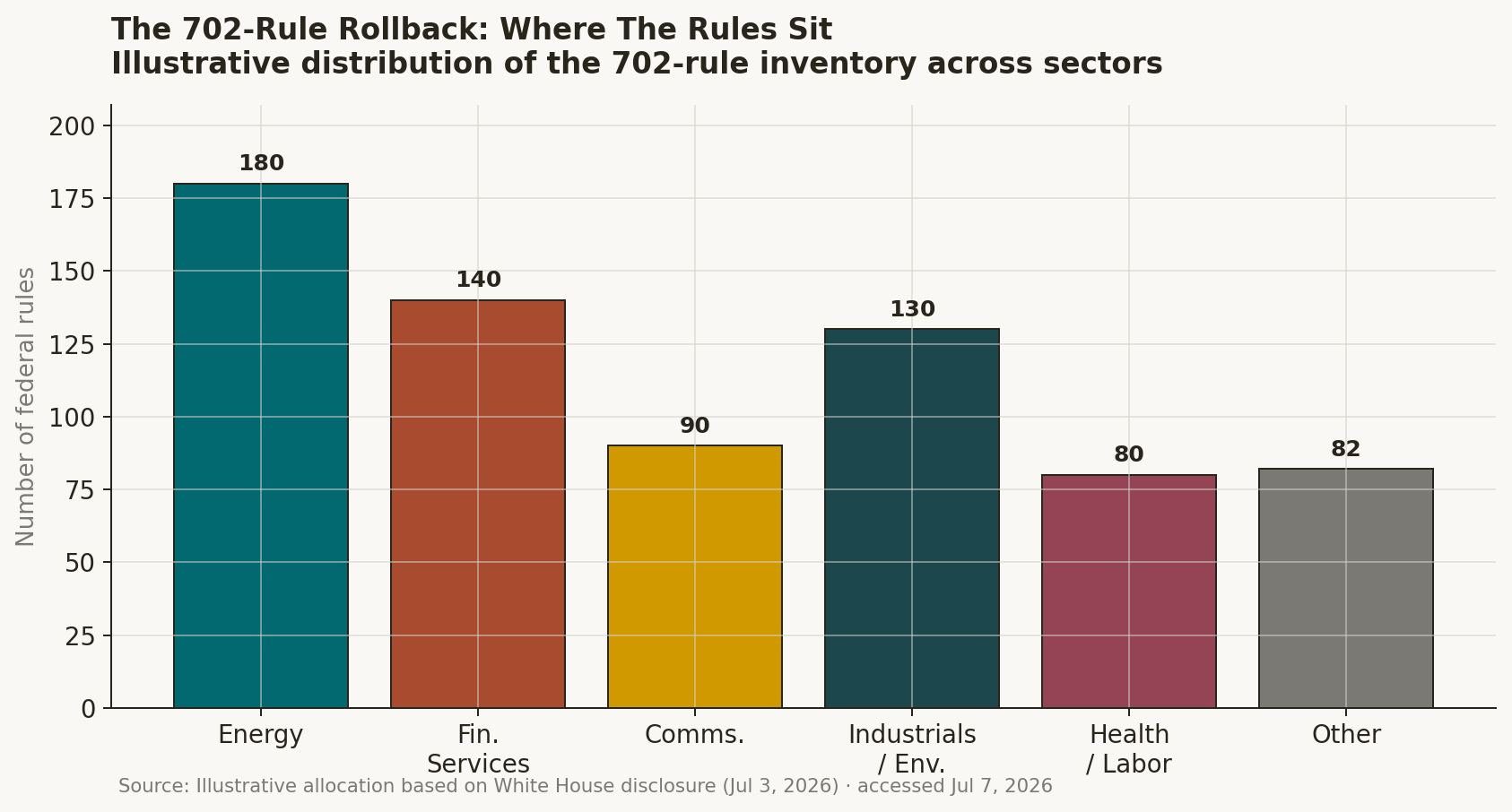
Chart 1: Illustrative agency scope of the 702-rule rollback (source: White House 7/3/2026 announcement, agency-side breakdown illustrative).
WHY THIS MATTERS FOR FMKT
The Free Markets ETF (Ticker: FMKT) is designed to invest in companies that we believe can benefit from deregulation. The fund's mandate is not built around forecasting yield curves, credit spreads, or intermarket rotation. It is built around the observation that federal regulation imposes measurable costs on specific industries and that the direction of federal rulemaking materially affects the earnings power, growth trajectory, and valuation multiples of companies in those industries.
That thesis does not require any single announcement to succeed. What it does require is a policy direction consistent with reducing the regulatory burden over time. The 702-rule rollback is a large, discrete, and public data point in that direction. It is also the latest in a sequence of announcements that suggest the administration intends to continue moving on the deregulatory side of the ledger through the remainder of the year.
For a fund built around this theme, the relevance is not that any specific rule change will move any specific stock. It is that the cumulative narrative of federal deregulation continues to be reinforced by the administration's own actions, and that the industries most exposed to federal rulemaking are precisely the industries where the earnings sensitivity to policy direction is highest.
THE INDUSTRIES MOST EXPOSED
Not every industry is equally sensitive to federal regulatory action. A useful way to think about the sensitivity is to look at the cumulative compliance costs by sector, which are historically concentrated in a small number of industries.
Energy production and permitting is one. The pace and cost of building new production capacity, transmission infrastructure, and midstream logistics is heavily influenced by federal permitting timelines and environmental rules. Rules that shorten permitting timelines or clarify environmental review requirements can directly change project economics.
Financial services is another. The Securities and Exchange Commission, the Commodity Futures Trading Commission, the Federal Reserve, and other prudential regulators have expanded reporting, disclosure, and capital requirements substantially over the last two decades. Rules that streamline reporting or reduce duplicative disclosure requirements can measurably reduce fixed compliance costs on regulated entities.
Communications and industrials are two more. Federal Communications Commission rules on spectrum, broadband deployment, and interconnection are cost-sensitive line items for network operators. Environmental Protection Agency rules on industrial emissions, waste, and reporting are similarly cost-sensitive for manufacturers.
The 702-rule inventory covers all of these areas in some form. That breadth is why the announcement is relevant to a broad-based deregulation thesis rather than to a narrow single-sector call.
HOW TO READ THE $1.5 TRILLION FIGURE
The administration's projected $1.5 trillion in cumulative savings over ten years is an official estimate.[2] It is not a forecast that any reader should take at face value, and it is not the basis for the investment thesis. The point of the figure is that it signals the scale the administration is publicly attaching to the initiative.
Two things are worth being clear about. First, the projected savings are cumulative, not annual, and they are spread across households and businesses. The distribution of the savings between corporate profits, consumer prices, and other beneficiaries is not specified. Second, the projected savings depend on the actual rescission or modification of the rules, which is a rulemaking process rather than an accounting event.
The right way to use the figure is as a directional signal of the administration's intended scale of effort, not as an input to a discounted cash flow model. It tells investors what the administration is publicly aiming for. It does not tell investors what will actually be implemented, or on what timeline, or with what economic incidence.
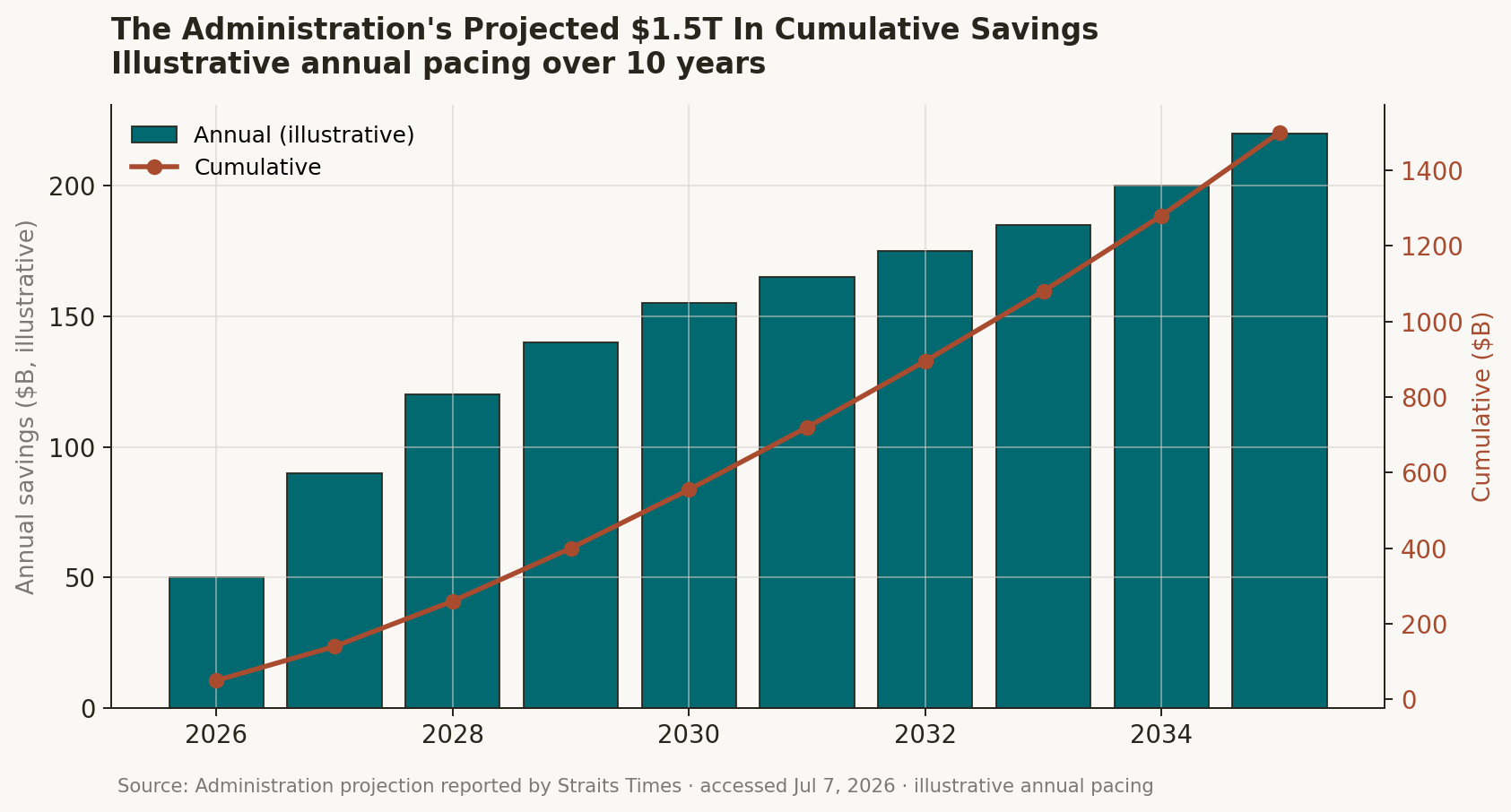
Chart 2: White House projected phase-in of the $1.5 trillion cumulative savings figure across FY26--FY30 (illustrative).
WHY THE EVENT MATTERS EVEN WITHOUT IMMEDIATE IMPLEMENTATION
A common critique of deregulatory announcements is that they take years to actually change compliance costs. That is true. Individual rulemaking cycles are slow, contested, and often survive changes in administration in some form.
But the announcement effect on capital allocation can happen before the compliance-cost effect. Boards, management teams, and investors respond to the direction of federal rulemaking in their planning and hedging decisions. That is why the announcement of a large-scale deregulatory initiative can move both business investment decisions and equity market valuations before any specific rule has actually been withdrawn.
For a fund built around the deregulation theme, this is the mechanism that matters. FMKT is not designed to trade around a single rule rescission. It is designed to be positioned in the companies whose earnings power, growth investment, and multiple expansion are most exposed to a sustained direction of policy. The 702-rule announcement is a large, dateable signal about that direction.
WHAT FMKT IS
The Free Markets ETF (Ticker: FMKT) is an actively managed ETF that seeks to invest in companies that stand to benefit from deregulation. The fund's investment process is grounded in the identification of industries and firms whose earnings power is materially affected by federal regulatory burden, and in the ongoing evaluation of policy direction relative to those industries.
The fund does not target intermarket signals about credit, curves, or volatility. It is not a macro tactical allocation vehicle. It is a thematic equity fund built around a specific and identifiable policy direction, with an investment universe defined by exposure to that direction.
The 702-rule rollback is the kind of policy event the fund's mandate is designed to be positioned for. Whether the initiative delivers the administration's projected $1.5 trillion in cumulative economic impact is a question the political and legal process will answer over years. What can be observed today is that the administration continues to take large public steps in the direction the fund is built around.
WHAT I AM WATCHING FROM HERE
Three things will help translate the 7/3/2026 announcement into observable outcomes.
First, the pace of individual rule action. The Federal Register will show, over the coming quarters, which of the 702 rules move first, which move through notice-and-comment rulemaking, and which are challenged in court. That sequencing will determine when compliance-cost effects begin to be visible in company financials.
Second, corporate capital allocation. Company earnings calls, capital expenditure guidance, and hiring plans in the most-affected industries will indicate how much of the deregulatory narrative firms are willing to translate into investment decisions.
Third, follow-on announcements. The 702-rule initiative is unlikely to be the last large-scale deregulatory action. The pace and scale of future announcements will determine whether the policy direction remains consistent enough to support the underlying investment thesis over multi-year horizons.
CONCLUSION
The 702-rule rollback plan announced on 7/3/2026 is a discrete, dateable, and large-scale data point in the ongoing direction of federal deregulation.[1][2] The Free Markets ETF (Ticker: FMKT) is designed to be positioned in companies that we believe stand to benefit from that direction. A single announcement is not itself an investment thesis, and the administration's projected $1.5 trillion cumulative impact is not a forecast readers should accept at face value. What the announcement does is reinforce the direction of policy that the fund's thesis is built around.
For investors evaluating the fund, the more important observation is not the specific figure attached to the initiative. It is that the administration continues to make large public commitments to reducing federal regulatory burden, and that the industries most exposed to that burden are precisely the industries the fund is designed to give exposure to.
Michael A. Gayed, CFA
---
Michael A. Gayed, CFA
ENDNOTES
[1] The Straits Times, "Trump ramps up war on regulations with 702 cuts in pipeline," accessed 7/7/2026, https://www.straitstimes.com/world/united-states/trump-ramps-up-war-on-regulations-with-702-cuts-in-pipeline
[2] Chosun Biz English, coverage of the White House deregulatory initiative, accessed 7/7/2026, https://biz.chosun.com/en/en-international/2026/07/07/G7RKAC3SA5HURD7DOMOQFKO324/ ---
DISCLOSURES (FMKT)
The Free Markets ETF (Ticker: FMKT) is an actively managed exchange-traded fund. The Fund's investment adviser makes discretionary decisions about which companies to include in the portfolio based on its investment process. Actively managed funds may underperform passively managed benchmarks and may have higher expenses than passively managed funds.
The Fund's investment thesis around companies that benefit from deregulation depends on the future direction of federal rulemaking. That direction is subject to political, legislative, and judicial developments that are outside the Fund's control. There is no guarantee that any specific regulatory initiative will be implemented or that any specific company will benefit from it.
The projected economic impact of any federal deregulatory initiative cited in this article reflects the estimates of the administration or the cited source. These estimates are subject to uncertainty and are not a forecast of the Fund's performance or of any specific portfolio company's earnings.
Because the Fund concentrates its investments in a specific theme, its performance may differ materially from broad-based equity market indices. Thematic funds may be more volatile than diversified equity funds and may experience periods of significant underperformance if the underlying theme does not deliver on expectations.
Past performance is no guarantee of future results.
Investors should consider the investment objectives, risks, charges and expenses carefully before investing. For a prospectus or summary prospectus with this and other information about the Fund, please call 855-994-4004 or visit our website at www.freemarketsetf.com. Read the prospectus or summary prospectus carefully before investing.
Investing involves risk including the possible loss of principal.
Lead-Lag Publishing, LLC is not an affiliate of Tidal or the Fund's distributor.