The AI Trade Nobody Files Under Income: 23 Midstream Names, 9.8%, Two Raises
The data center buildout runs on natural gas. These are the toll roads, in a concentrated CEF at a 10% discount.

Today’s Lead-Lag Report post is sponsored by TappAlpha

Income while staying fully invested in equities.
TappAlpha S&P 500 Growth & Daily Income ETF (TSPY)
TappAlpha Innovation 100 Growth & Daily Income ETF (TDAQ)
Investors have always had to choose: generate income or stay fully invested. TSPY and TDAQ do both—adding tax-efficient income potential to the S&P 500 and Nasdaq-100.
A tax-efficient alternative to traditional income strategies. Growth + Income — with the TappAlpha Growth & Daily Income ETFs.
Disclosures:
Investors should carefully consider the investment objectives, risks, charges and expenses of the ETFs identified on this site. This and other important information about the Fund are contained in the prospectus, which can be obtained by visiting tappalphafunds.com or by calling (844) 403-2888. The prospectus should be read carefully before investing.
ETFs are subject to additional risks that do not apply to conventional mutual funds, including the risks that the market price of an ETF’s shares may trade at a premium or discount to its net asset value, an active secondary trading market may not develop or be maintained, or trading may be halted by the exchange in which they trade, which may impact a Fund’s ability to sell its shares. Shares of any ETF are bought and sold at market price (not NAV) and are not individually redeemed from the Fund. Brokerage commissions will reduce returns.
The Fund invests in options contracts that are based on the value of the Index, including SPX and XSP options for TSPY and XND and NQX options for TDAQ. This subjects the Fund to certain of the same risks as if it owned shares of companies that comprised the Index, even though it does not own shares of companies in the Index. The Fund will have exposure to declines in the Index. The Fund is subject to potential losses if the Index loses value, which may not be offset by income received by the Fund. To the extent that the Fund invests in other ETFs or investment companies, the value of an investment in the Fund is based on the performance of the underlying funds in which the Fund invests and the allocation of its assets among those ETFs or investment companies. The Fund may incur high portfolio turnover to manage the Fund’s investment exposure. The Fund is classified as “non-diversified” under the 1940 Act.
As of the date of this prospectus, the Fund has no operating history and currently has fewer assets than larger funds. Like other new funds, large inflows and outflows may impact the Fund’s market exposure for limited periods of time. This impact may be positive or negative, depending on the direction of market movement during the period affected.
Due to the short time until their expiration, 0DTE options are more sensitive to sudden price movements and market volatility than options with more time until expiration. Because of this, the timing of trades utilizing 0DTE options becomes more critical. Even a slight delay in the execution of 0DTE trades can significantly impact the outcome of the trade. 0DTE options may also suffer from low liquidity, making it more difficult for the Fund to enter into its positions each morning at desired prices. The bid-ask spreads on 0DTE options can be wider than with traditional options, increasing the Fund’s transaction costs and negatively affecting its returns. These risks may negatively impact the performance of the fund.
Distributor: Foreside Fund Services, LLC
DISCLAIMER – PLEASE READ: This is sponsored advertising content for which Lead-Lag Publishing, LLC has been paid a fee. The information provided in the link is solely the creation of TappAlpha. Lead-Lag Publishing, LLC does not guarantee the accuracy or completeness of the information provided in the link or make any representation as to its quality. All statements and expressions provided in the link are the sole opinion of TappAlpha, and Lead-Lag Publishing, LLC expressly disclaims any responsibility for action taken in connection with the information provided in the link.
HIGH YIELD SPOTLIGHT
The AI Trade Nobody Files Under Income: 23 Midstream Names, 9.8%, Two Raises
The data center buildout runs on natural gas. These are the toll roads, in a concentrated CEF at a 10% discount.
MICHAEL A. GAYED, CFA
Key Highlights
- Yield: 9.78% on price, 8.86% annualized on NAV, from the $0.41 monthly income-only distribution, per CEFConnect
- Concentration: 23 holdings, with the top ten midstream names at roughly 67% of the portfolio, Targa Resources 12.33% and Energy Transfer 9.50% at the top, per CEFConnect
- Discount: NAV $55.50 versus a $50.31 price, a 10.02% discount, versus a 5-year average of 12.45%, per CEFConnect
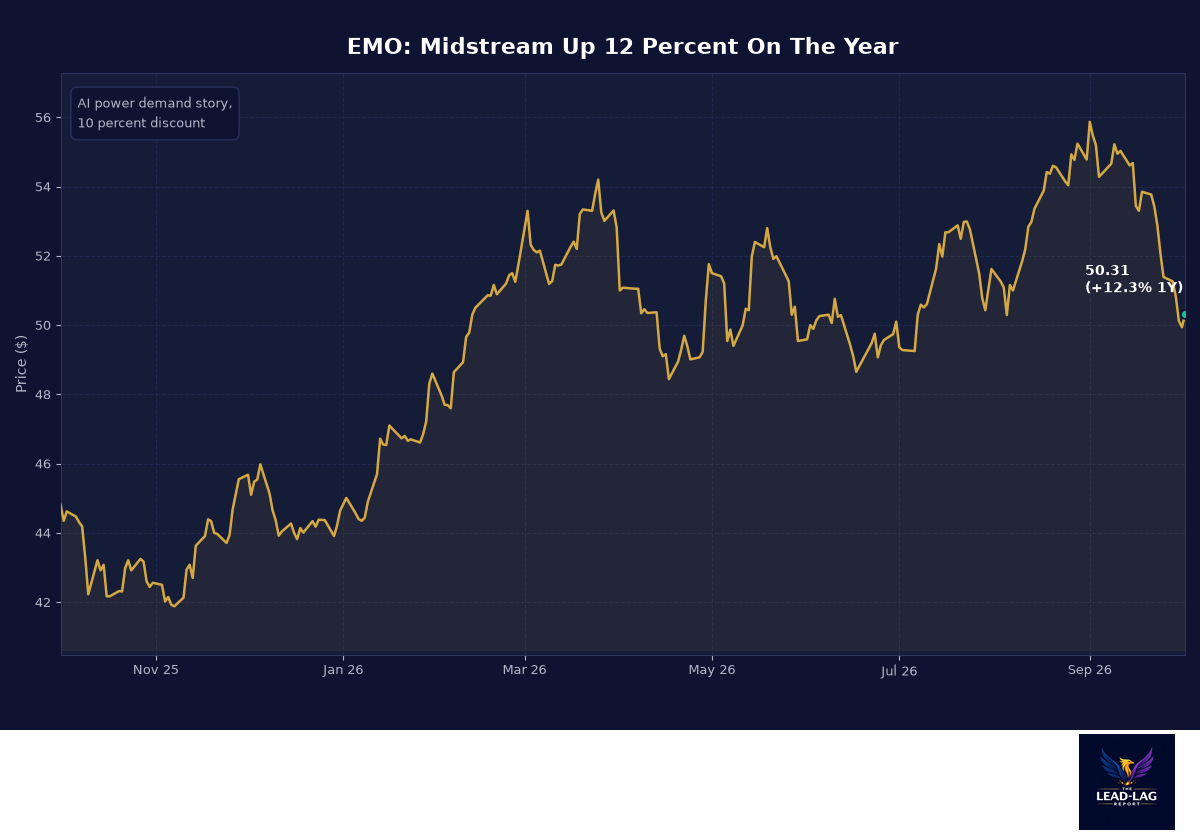
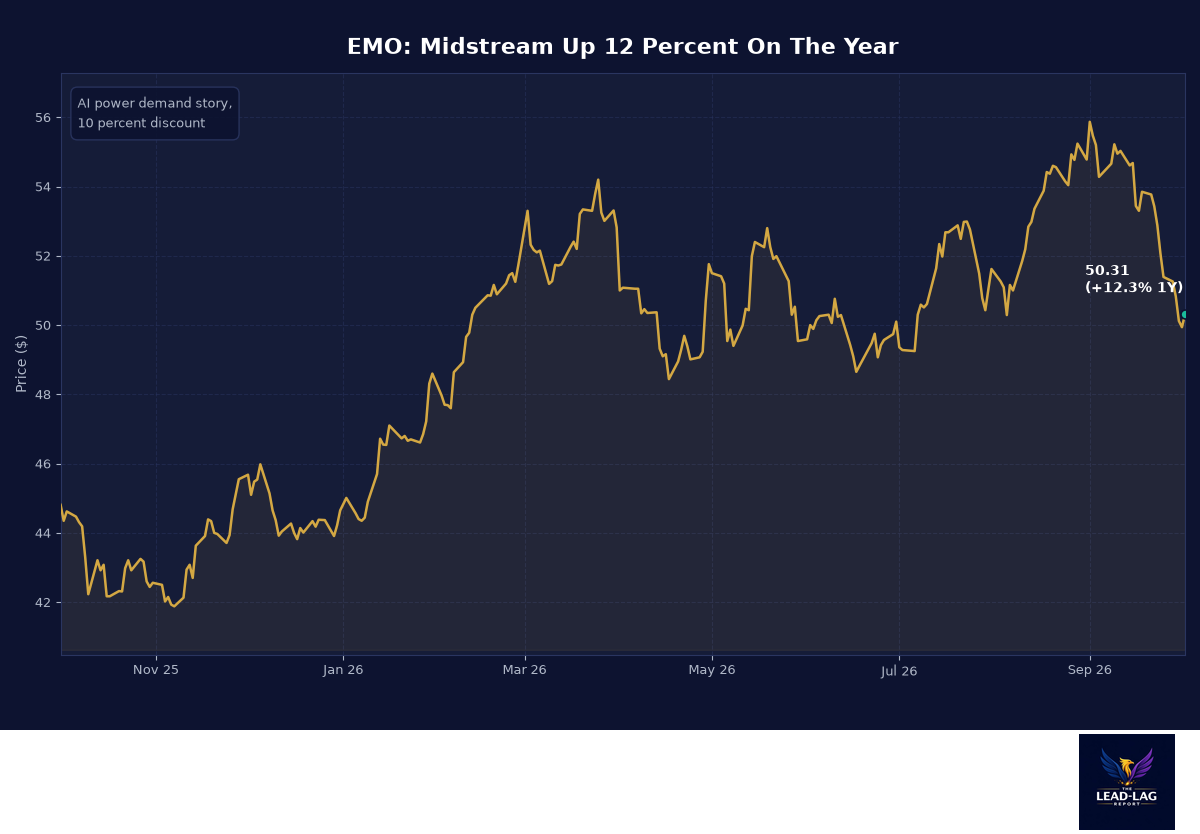
- Momentum: Share price up 12.3% over the trailing year per daily closes, while the monthly distribution was raised from $0.33 to $0.36 to $0.41 across eighteen months
- Cost: 3.12% total expense ratio including interest expense, per CEFConnect, the highest of this batch
Every week, we'll profile a high yield investment fund that typically offers an annualized distribution of 6-10% or more. With the S&P 500 yielding less than 2%, many investors find it difficult to achieve the portfolio income necessary to meet their needs and goals. This report is designed to help address those concerns.
The AI Trade Nobody Files Under Income
The market's AI story is usually told through chips and hyperscalers. The income version runs through steel and compressor stations. ClearBridge Energy Midstream Opportunity Fund (EMO) holds 23 midstream companies, Targa, Energy Transfer, Williams, MPLX, Kinder Morgan, per CEFConnect, the pipes and processing infrastructure that move the natural gas powering the data center buildout. The share price rose 12.3% over the past year per daily closes, the monthly distribution was raised twice to $0.41, and the fund still trades at a 10.02% discount to a $55.50 NAV per CEFConnect.
What makes this profile different from the usual midstream fund piece is the concentration. Most energy income funds hold 60 to 100 positions and dilute the thesis into an index-like blur. EMO holds 23, with the top ten at roughly two-thirds of assets. You are not buying "energy exposure." You are buying a conviction book of the largest, fee-based midstream franchises in North America, levered 1.4 times over by the fund's own capital structure, paying out 9.78%. When the thesis works, concentration is the feature. When it does not, it is the bug, and I will price both sides.
My stance: this is the highest-quality hold of the six funds in this batch, with the best momentum and the most visible macro tailwind, offset by genuine concentration risk and a fee load that deserves scrutiny. It is the one I would own first and size largest, which is not the same as saying it is safe.
Fund Background
EMO is part of the ClearBridge closed-end complex, managed by Franklin Templeton's specialist equity arm. The fund's mandate is energy infrastructure: midstream pipelines, processing, and storage, overwhelmingly in the United States and Canada, per the country allocation of 89.77% US and 9.03% Canada in CEFConnect as of July 31. Total portfolio exposure runs about $1.48 billion against $1.11 billion of common assets, and annual portfolio turnover is just 14%, which tells you this is a buy-and-hold book, not a trading vehicle.
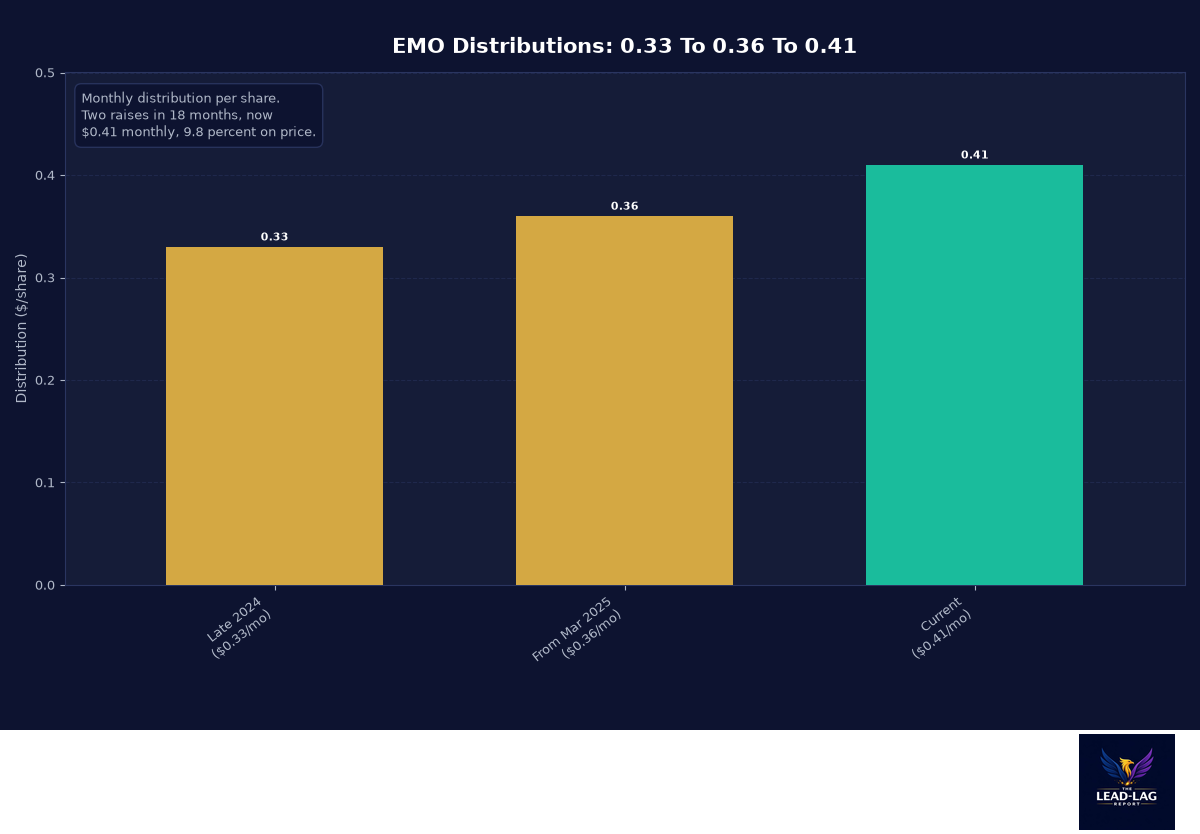
The distribution is $0.41 monthly, income-only in classification per CEFConnect, which annualizes to $4.92, the 9.78% rate on the $50.31 price. The raise history is the quiet story: $0.33 monthly in late 2024, $0.36 from March 2025, and $0.41 now, per StockAnalysis and CEFConnect. Two raises in eighteen months, a combined 24% increase, funded by the underlying companies' own growing free cash flow, and arriving while the fund trades at a double-digit discount.
Twenty-Three Names, One Thesis
The top of the book per CEFConnect as of July 31: Targa Resources at 12.33%, Energy Transfer at 9.50%, Williams at 7.71%, MPLX at 7.31%, Western Midstream at 7.24%, ONEOK at 6.85%, Kinder Morgan at 6.58%, Enterprise Products at 6.16%, Enbridge at 5.05%, and Antero Midstream at 4.66%. Every one of these is a fee-based or largely fee-based franchise whose cash flows depend on volumes and reservations, not commodity prices. That is the structural argument for midstream income: the pipes get paid whether or not the gas is expensive.
The demand driver is the part advisors should be able to explain to clients in one sentence. Data center power demand is pulling forward a decade of natural gas infrastructure buildout, and the gas has to move through exactly these systems. The 12.3% one-year price gain is the market slowly recognizing that midstream is an AI infrastructure play with a 9.78% yield attached. The risk in the sentence is the word "demand": if the buildout slows, or if power demand gets met faster than expected by other sources, the volume growth thesis stretches out and the multiple stops expanding. The companies would keep paying; the capital gain story would pause.
What A Working Thesis Looks Like
EMO's trailing year is the mirror image of every other fund in this batch. The share price rose 12.3%, from $44.81 to $50.31, per daily closes, while the NAV reached $55.50 per CEFConnect, leaving a 10.02% discount even after the rally. The other five funds I profiled this month all fell in price. This one rose, paid two raises, and still trades below its own book value. That combination, positive momentum, growing income, and a discount, is rare in the CEF universe, and it exists because the market still treats midstream as the post-2020 washout sector rather than the AI-era infrastructure trade the numbers now describe.
The concentration cuts both ways in any stress scenario. The top ten at roughly 67% of assets means a single-name event is a portfolio event, but the names are the sector's systemic franchises: the failure mode that matters is not any one company stumbling, it is the volume thesis itself, gas demand growth falling short of the data center buildout's promises. That is a macro scenario, not a credit scenario, and it would show up first as multiple compression across the whole book rather than as defaults. The income stream, the 9.78% distribution funded by the underlying companies' dividends, would likely survive such a pause, which is why this fund's downside case is a valuation case, not an income case. Holders should size it as the equity-adjacent holding it is, not as the bond substitute its yield suggests.
Two Raises And An Income-Only Label
The distribution mechanics here are cleaner than most of what this column covers. The $0.41 monthly payout is classified as income-only per CEFConnect, meaning it is funded by dividends and distributions received from the underlying 23 companies rather than by return of capital. Those underlying payers are themselves the disciplined capital-return story of the energy sector post-2020, with the large midstream complexes prioritizing distribution growth and buybacks over growth capex.
The caveat is the expense structure. At 3.12% total, including 1.28% management fees and 1.04% of interest expense per CEFConnect, this fund charges more than most of its category, and the leverage that amplifies the 8.86% NAV-level yield to 9.78% on price also amplifies any midstream drawdown. The 10.02% discount is the market's standing charge for that combination. Against the 5-year average discount of 12.45% per CEFConnect, the current price is actually slightly rich for this fund's own history, which tells you how much of the thesis the market has already started to pay for.
Advantages
The macro alignment is exceptional. Fee-based energy infrastructure monetizing electricity and data center demand growth is one of the few income theses where the macro tailwind is specific and current rather than hoped for. The 12.3% trailing price return plus a 9.78% yield is what a working thesis looks like in numbers.
The distribution quality is verifiable at two levels. The fund's payout is income-only, and the underlying companies have their own multi-year records of distribution growth. Two raises in eighteen months, to $0.41 from $0.33, is a 24% increase in the income stream, arriving not from leverage changes but from the portfolio's cash receipts.
The portfolio quality is the highest in this batch. These are the dominant North American midstream franchises with investment-grade-leaning balance sheets at the corporate level, 89.77% US exposure, and 14% turnover. You are not taking credit risk on frontier sovereigns or BDC marks; you are taking sector and concentration risk on the best assets in that sector.
Disadvantages
Concentration is the defining risk. Twenty-three holdings, the top ten at roughly 67%, and a single name, Targa, at 12.33%. A company-specific event, a pipeline incident, a regulatory action against any one of the top positions moves the whole fund. Diversification within midstream is limited because the sector itself is an oligopoly.
The fee load is heavy. 3.12% all-in per CEFConnect is a third of the underlying yield, and there are cheaper ways to own midstream, including direct ownership of the underlying companies or low-cost ETFs. The fund's justification is the leverage and the CEF structure; investors should ask whether 1.4x levered exposure to a 23-name book is worth that drag versus buying the names directly.
The entry point is no longer early. A 12.3% one-year gain, a discount slightly tighter than the 5-year average, and a raise already in the price mean the easy re-rating has happened. If the AI power thesis disappoints, the fund gives back the multiple expansion quickly, and the 10% discount offers less cushion than it did a year ago.
How It Fits In An Income Portfolio
The client-facing version of the thesis fits in one sentence: the AI buildout runs on electricity, the electricity comes increasingly from natural gas, and these are the toll roads the gas travels through, collected in one fund paying 9.78%. That sentence is why EMO works as the equity-adjacent income holding in this month's batch, the piece of the portfolio that participates in the AI capital cycle without buying the semiconductors at their multiples. The 12.3% trailing year plus two distribution raises is what the thesis looks like once the market starts believing the sentence.
Where it sits relative to the column's other energy and infrastructure coverage: the utility CEFs profiled earlier this year, UTG and UTF, express the same power-demand story through regulated electric utilities, slower cash flows, tighter discounts, lower headline yields. EMO is the midstream expression, fee-based pipes rather than rate-regulated wires, a 23-name concentrated book rather than a diversified utility portfolio, and a 9.78% yield rather than a utility-grade payout. Same macro driver, different point on the risk curve: more sector concentration, more single-name risk, more distribution growth.
Sizing follows from the concentration math. The top ten at roughly 67% of assets means this is a portfolio of twenty-three decisions, not a sector index. Hold it as the income-sleeve expression of a power-and-infrastructure view you already hold, size it knowing a midstream-wide multiple compression year would mark the NAV down equity-style, and let the income-only $0.41 monthly distribution, raised twice in eighteen months, be the part of the return that does not depend on the market re-rating anything.
The fee drag deserves honest arithmetic because it is the loudest objection. At 3.12% of assets, the fund's all-in cost runs roughly $46 million a year on the $1.48 billion portfolio, against a distribution stream around $100 million to shareholders. In plain terms, about a third of the income the portfolio produces funds the structure before it reaches you, which is the price of leverage, active management, and the CEF wrapper in one line item. The justification has to come from what the structure adds: a 9.78% income rate well above what the underlying companies yield directly at their own market prices, plus the discount entry. Investors who can buy and manage twenty-three midstream names themselves should do that. For everyone else, this is the one-decision version of the trade, and the fee is the toll.
Conclusion
EMO is the quality pick of this six-fund batch: a concentrated, income-only, momentum-backed midstream book with the cleanest macro story in income investing right now. The trade-offs are concentration and cost, and the valuation has moved from cheap toward fair. Short-term, the distribution momentum and the AI power buildout argue for continued strength. Long-term, this is a sector bet expressed through the sector's best franchises, and it should be sized as energy exposure, not as a bond substitute. Of everything I profiled this month, this is the fund I would hold through volatility, and the one whose story I would explain to clients in a single sentence: the AI boom runs on natural gas, and these are the toll roads.
The Lead-Lag Report is provided by Lead-Lag Publishing, LLC. All opinions and views mentioned in this report constitute our judgments as of the date of writing and are subject to change at any time. Information within this material is not intended to be used as a primary basis for investment decisions and should also not be construed as advice meeting the particular investment needs of any individual investor. Trading signals produced by the Lead-Lag Report are independent of other services provided by Lead-Lag Publishing, LLC or its affiliates, and positioning of accounts under their management may differ. Please remember that investing involves risk, including loss of principal, and past performance may not be indicative of future results. Lead-Lag Publishing, LLC, its members, officers, directors and employees expressly disclaim all liability in respect to actions taken based on any or all of the information on this writing.