The Permitting Story Nobody Is Pricing In (FMKT)
Permitting reform is the deregulation story that moves on 24-month timelines and gets priced in on 24-hour cycles.

KEY HIGHLIGHTS
Deregulation is a specific, dateable, and investable phenomenon, not a slogan. This piece focuses on upstream exploration and production (E&P), midstream pipelines, liquefied natural gas (LNG) export, nuclear, and grid-scale generation, where the regulatory tape has genuinely shifted.
The relevant policy machinery here sits at the Federal Energy Regulatory Commission (FERC), the Environmental Protection Agency (EPA), the Bureau of Land Management (BLM), and the Nuclear Regulatory Commission (NRC). Each has moved in the past 24 months in ways that create identifiable beneficiaries.
Named beneficiaries in this cycle include the U.S. LNG export complex, pipeline operators, small modular reactor developers, and independent upstream producers. These are not thematic guesses; they are companies and categories whose economics depend directly on the regulatory posture described above.
The Free Markets ETF (FMKT) is an exchange-traded fund that seeks to invest in companies positioned to benefit from federal deregulation across the sectors named above. I co-launched the Free Markets ETF and helped bring the strategy to market.
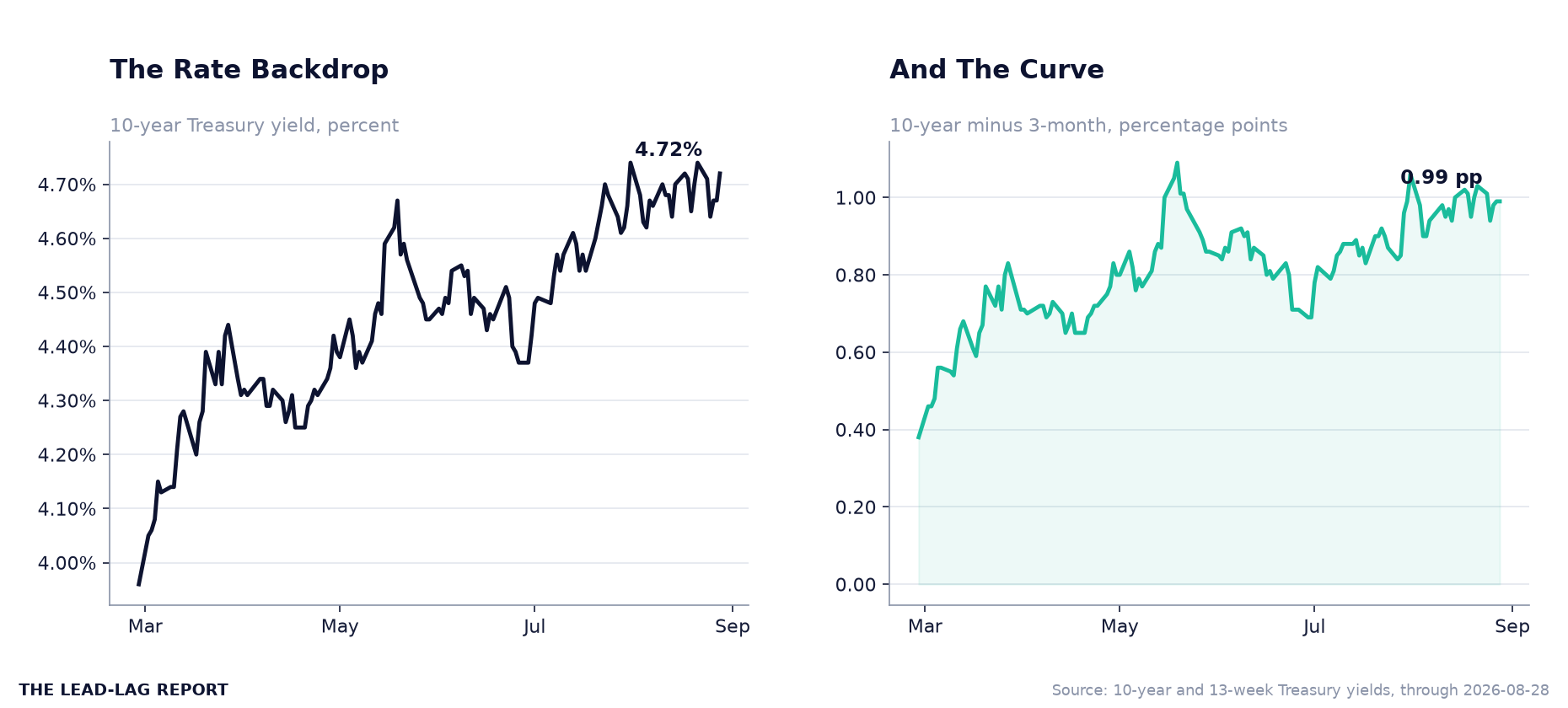
For market context as of 2026-08-28: the 10-year Treasury yield sat at 4.72% with the 10-year to 3-month curve at 0.99 percentage points (pp).[1][2] Rates are the backdrop, not the driver of this thesis.
Permitting reform is the deregulation story that moves on 24-month timelines and gets priced in on 24-hour cycles. Every time a FERC docket clears, an EPA rule gets stayed, or a BLM lease sale actually happens on schedule, a specific class of energy assets re-rates. The market keeps treating each event as a surprise. It shouldn't.
THE POLICY BACKDROP
Permitting reform is the deregulation story that moves on 24-month timelines and gets priced in on 24-hour cycles. Every time a FERC docket clears, an EPA rule gets stayed, or a BLM lease sale actually happens on schedule, a specific class of energy assets re-rates. The market keeps treating each event as a surprise. It shouldn't. What matters for investors is that the catalyst is legible: the compression of federal permitting timelines and the rollback of the most costly overlays on E&P, midstream, and nuclear projects. That is not a forecast about what politicians might do. It is a description of what regulatory bodies have already been doing.
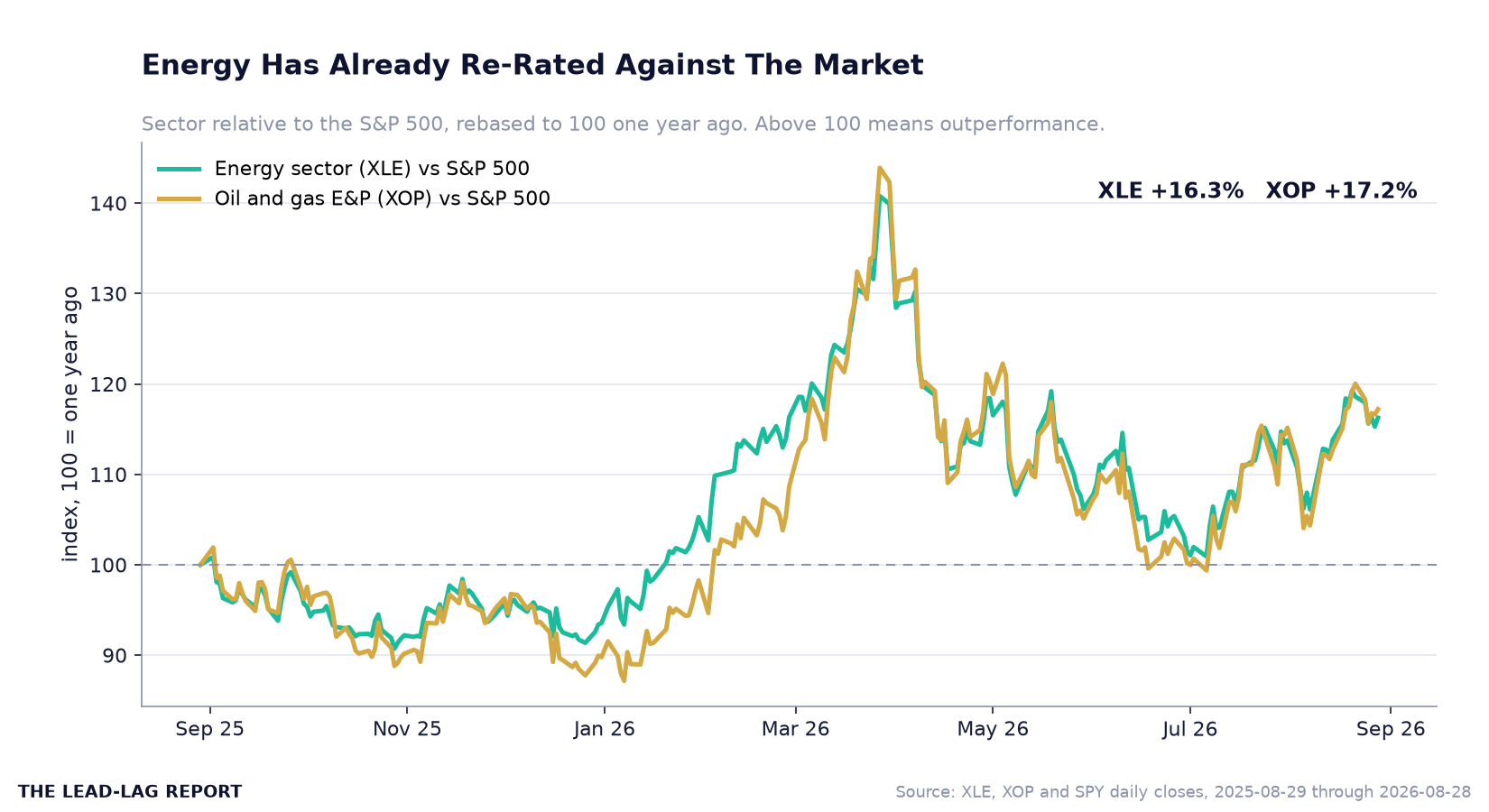
It is worth being precise about what has already happened in the price, because the answer is quite a lot. Over the twelve months through 2026-08-28, the broad energy sector returned +38.7% and oil and gas E&P returned +39.8%, against +19.3% for the S&P 500.[3][4][5] On a relative basis the energy sector sits +16.3% ahead of the index over that window. The re-rating is not hypothetical and it is not waiting to begin. What the market keeps getting wrong is the timing of individual events, not the direction of the regime, and that is a narrower claim than saying nothing has been priced.
A necessary caveat on the two sector measures charted below. They are broad index exposures used to illustrate the regulatory-tape argument. They are not the Free Markets ETF, they are not its holdings, and they are not a proxy for its performance. Past performance of any index or sector is no guarantee of future results.
WHY THIS IS A DEREGULATION TRADE, NOT A MACRO TRADE
One of the most common mistakes I see investors make with deregulation is treating it as a macro overlay, something that only matters when growth is slow, or rates are high, or credit is tight. That framing gets deregulation exactly backwards. Deregulation changes the cost curve and the addressable market for specific companies in specific sectors. It is a microeconomic event with sector-level consequences, and it can compound regardless of whether the 10-year yield is at 4.72% or somewhere entirely different.
When a rule is rolled back, a specific class of companies gets a lower cost of doing business, or a larger addressable market, or both. The stock market prices that in, sometimes on the day of the announcement, sometimes over the following quarters as it shows up in margin.
The policy examples worth tracking in this vertical include FERC LNG export authorization schedules, EPA Waters of the U.S. narrowing, NRC licensing throughput, and interstate pipeline approval cadence. Each of those is a dateable event with a named beneficiary set.
WHY NAMED BENEFICIARIES MATTER
Deregulation trades fail when they are executed as sector-ETF trades against sectors that also carry a lot of non-deregulation exposure. A broad sector ETF gives you the deregulation beneficiaries and everything else in the sector, which dilutes the signal.
The Free Markets ETF is designed for the opposite exposure. The fund seeks to hold companies where deregulation is the primary economic driver of the investment case: upstream E&P, midstream pipelines, LNG export, nuclear, and grid-scale generation, chosen specifically because federal policy shifts change their unit economics. The names that make the cut in the U.S. LNG export complex, pipeline operators, small modular reactor developers, and independent upstream producers share a common feature: their margin structure and their addressable market depend materially on what the FERC, EPA, BLM, and NRC do in the next 24 months.
WHAT INVESTORS SHOULD ACTUALLY DO WITH THIS INFORMATION
Deregulation is not a substitute for a risk-management process. It is a thesis about where economic returns are likely to concentrate given a specific set of policy conditions that are currently in place and appear likely to persist. That thesis can be right or wrong, and it can be right at the wrong time.
What the Free Markets ETF tries to give investors is a publicly traded expression of the deregulation thesis, one that names its beneficiaries explicitly rather than burying them inside a diversified sector fund. If you believe the regulatory tape has genuinely shifted at the FERC, EPA, BLM, and NRC, the follow-up question is not whether to have exposure. It is how to have exposure without also owning every unrelated company inside a broad sector index.
THE BOTTOM LINE
Most of what gets called “deregulation” in financial media is either a slogan or a headline. The version that matters, the version that shows up in company margins and equity returns, is the one that happens at the staff level, in the FERC, EPA, BLM, and NRC, on timelines that are already visible in the docket.
The Free Markets ETF was built to give investors a direct expression of that thesis: upstream E&P, midstream pipelines, LNG export, nuclear, and grid-scale generation chosen because federal policy shifts are actively changing their economics.
ENDNOTES
[1] U.S. 10-Year Treasury yield (^TNX) daily close, 2026-08-28. Source reference, not a hyperlink: finance.yahoo.com/quote/%5ETNX
[2] 10-year minus 3-month Treasury spread, computed from ^TNX and ^IRX daily closes for 2026-08-28. Source reference, not a hyperlink: finance.yahoo.com/quote/%5EIRX
[3] State Street Energy Select Sector SPDR ETF (XLE) daily closes, 2025-08-29 through 2026-08-28, used as a broad energy sector measure. Source reference, not a hyperlink: finance.yahoo.com/quote/XLE
[4] State Street SPDR S&P Oil & Gas Exploration & Production ETF (XOP) daily closes, 2025-08-29 through 2026-08-28, used as an E&P measure. Source reference, not a hyperlink: finance.yahoo.com/quote/XOP
[5] State Street SPDR S&P 500 ETF (SPY) daily closes, 2025-08-29 through 2026-08-28, used as the index comparison. Source reference, not a hyperlink: finance.yahoo.com/quote/SPY
Sector and index measures cited above are shown to illustrate the policy argument. They are not the Free Markets ETF and are not indicative of the Fund's holdings or performance.
DISCLOSURES (FMKT)
Investors should carefully consider the investment objectives, risks, charges and expenses of the Free Markets ETF (FMKT) before investing. This and other information can be found in the Fund's prospectus and summary prospectus, which may be obtained by visiting freemarketsetf.com. Read the prospectus carefully before investing.
Investing involves risk, including possible loss of principal. There is no guarantee that the Fund will achieve its investment objective. Investments concentrated in specific sectors and companies expected to benefit from federal deregulation may be more volatile than diversified portfolios and may be materially affected by legislative, regulatory, and policy developments.
The Free Markets ETF is distributed by Foreside Fund Services, LLC.
The Lead-Lag Report is provided by Lead-Lag Publishing, LLC. All opinions and views mentioned in this report constitute our judgments as of the date of writing and are subject to change at any time. Information within this material is not intended to be used as a primary basis for investment decisions and should also not be construed as advice meeting the particular investment needs of any individual investor. Trading signals produced by the Lead-Lag Report are independent of other services provided by Lead-Lag Publishing, LLC or its affiliates, and positioning of accounts under their management may differ. Please remember that investing involves risk, including loss of principal, and past performance may not be indicative of future results. Lead-Lag Publishing, LLC, its members, officers, directors and employees expressly disclaim all liability in respect to actions taken based on any or all of the information on this writing.