DoubleLine's 13% Yielder: A Third Emerging Markets, 10% Below NAV
DSL's 34% emerging-market sleeve, 5.18-year duration and doubled discount into a hiking Fed.



Michael is hosting a small private dinner for Vermont-area financial advisors this Thursday evening at 6:30 PM - roughly twenty seats, one long table, dinner and drinks on us, plus a short working session on agriculture and commodity ETFs with Jake Hanley, CMT of Teucrium Investment Advisors.
Every advisor at the table walks away with free leads to grow their practice, complimentary marketing services from the Lead-Lag Media team, and their own free AI agent for content, research and client communications.
Seating is very limited and the table closes tonight. Financial advisors only - reply to this email with “I’m in” and the details come straight back to you.
Reply “I’m in” to claim your seat
Special announcement from Lead-Lag Media. For financial advisors only; attendance confirmed by reply. No venue or location details are disclosed publicly; details are provided directly to confirmed attendees.
This is a sponsored announcement. Lead-Lag Media, LLC is compensated for hosting this event. Sponsorship does not constitute an endorsement, recommendation, or offer to buy or sell any security or investment product. Investing involves risk, including loss of principal. Teucrium Investment Advisors is the sponsor of the session content; attendance does not constitute investment advice.
The Lead-Lag Report is provided by Lead-Lag Publishing, LLC.
Key Highlights
- Yield: 13.17% distribution rate on a $0.11 monthly payout per CEFConnect as of 9/25/2026; 13.31% indicated on the $9.92 close computed from Yahoo Finance
- Discount: -10.44% to NAV ($9.95 price vs $11.11 NAV) versus a 52-week average of -5.07% per CEFConnect
- Portfolio: 483 holdings as of 7/31/2026; emerging markets 34.46% and high-yield corporates 22.20% per the DoubleLine fact sheet (March 2026)
- Leverage: 24.14% effective leverage per CEFConnect; gross leverage 21.69%, duration 5.18 years per DoubleLine
- Cost: 2.98% total expense ratio per CEFConnect
Every week, we'll profile a high yield investment fund that typically offers an annualized distribution of 6-10% or more. With the S&P 500 yielding less than 2%, many investors find it difficult to achieve the portfolio income necessary to meet their needs and goals. This report is designed to help address those concerns.
The 13% Yielder Where A Third Of The Book Is Emerging Markets
DoubleLine Income Solutions Fund (DSL) is what happens when a first-rate credit franchise, Jeffrey Gundlach's DoubleLine, runs a leveraged, multi-sector income book and lets it wander well beyond US borders. The fund pays $0.11 monthly, a 13.17% distribution rate per CEFConnect as of September 25, and its sector mix per the March 2026 fact sheet puts emerging markets debt at 34.46% of assets with US high-yield corporates at 22.20%. The rest is the rest of the global credit spectrum.
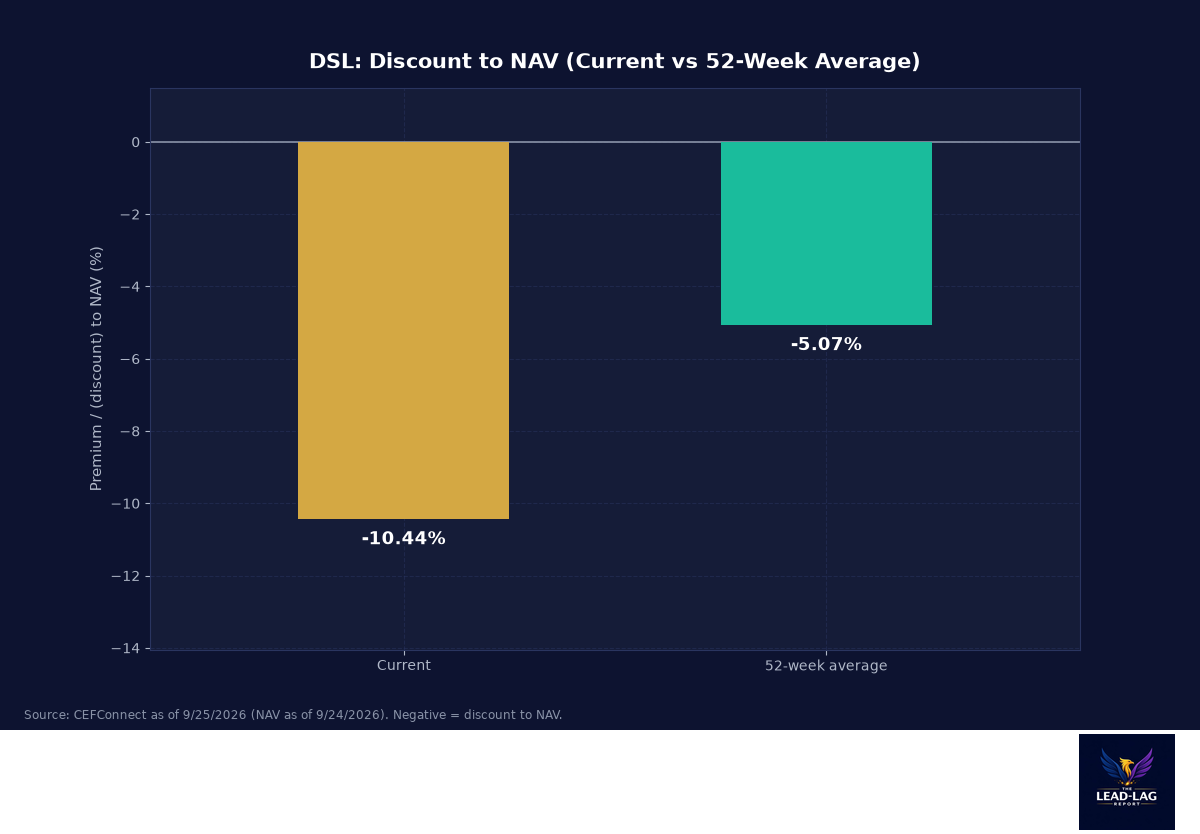
The market currently prices this book at a -10.44% discount to NAV versus a 52-week average of -5.07% per CEFConnect. A doubled discount on a doubled mandate, one-third emerging markets, 24% leverage, five-year duration, in the same week the Fed hiked to 3.75% to 4.00% (source: Federal Reserve), makes this one of the more layered risk-reward setups I have profiled this month.
Fund Background
DSL launched April 26, 2013 per both CEFConnect and the DoubleLine fact sheet. It is DoubleLine's flagship closed-end income vehicle: $1.27 billion of common assets against $1.68 billion of total investment exposure per CEFConnect, 483 holdings, 24.14% effective leverage, and a 2.98% total expense ratio of which 1.57% is interest cost on the borrowings. The March 2026 fact sheet puts duration at 5.18 years with a weighted average life of 8.03, meaning this book is meaningfully longer than the short-duration junk funds I typically favor here.
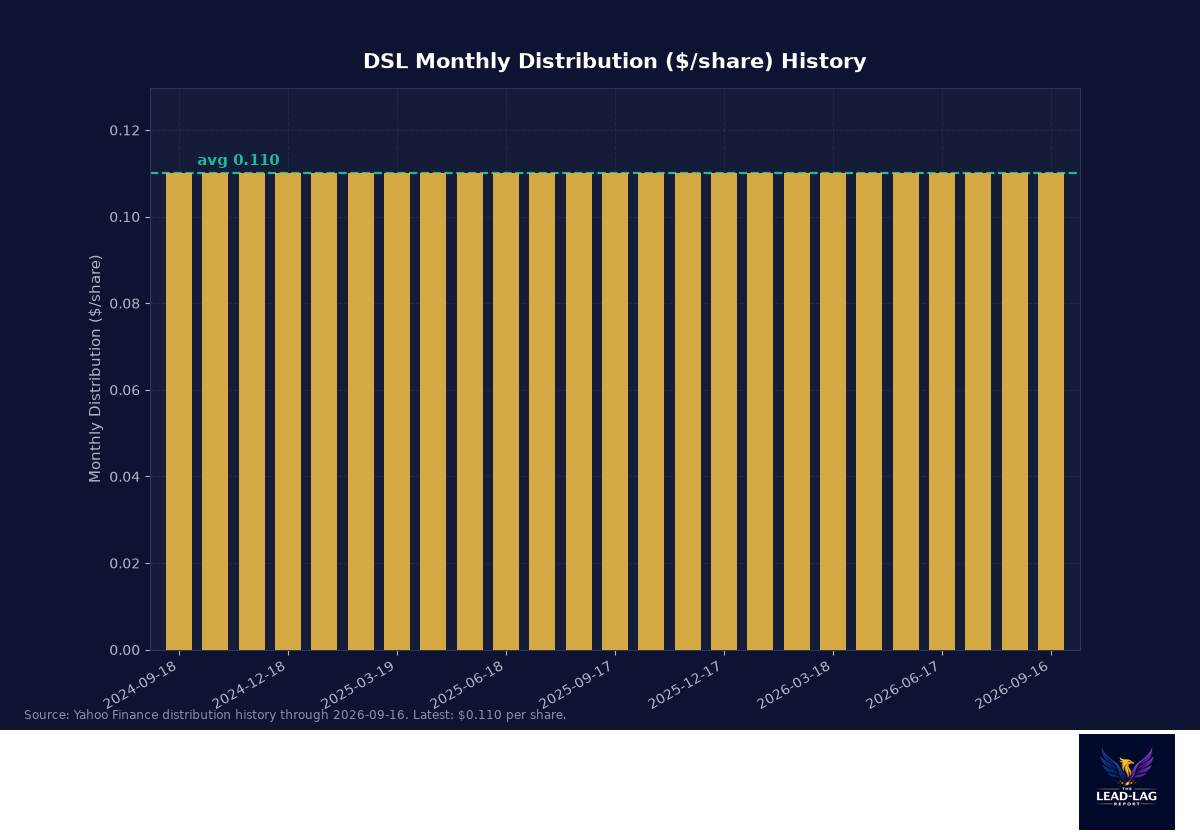
The monthly distribution is $0.11 per share, which against the $9.95 CEFConnect price produces the 13.17% rate, and against Friday's $9.92 close computes to 13.31% indicated per Yahoo Finance trailing payouts. For investors who reinvest, the mechanics here compound attractively at the current discount: $0.11 monthly reinvested at 10.44% below NAV buys incrementally more book value than the same dollar at par, which is how discount positions quietly build NAV-per-share advantages for patient holders. The reverse also held on the way down, which is part of why long-term CEF holders experienced this fund's decade so differently depending on their entry discount. At a doubled discount, the reinvestment math is doing work for you that is invisible in the distribution rate.
Portfolio Composition
Per the March 2026 fact sheet, emerging markets debt is the largest sector at 34.46%, followed by US high-yield corporates at 22.20%, with the remainder spread across the broader multi-sector credit spectrum across 483 holdings per CEFConnect. Understand what that means in practice: a third of this fund is EM credit, sovereign and corporate, which carries its own dollar-cycle dynamics, and another fifth is US junk. At 5.18 years of duration, the book also carries real rates exposure, roughly double the 2.89-year duration of the short-junk benchmark funds. This is a diversified credit portfolio with three live risk axes: credit spreads, EM dollar sensitivity, and duration.
Historical Performance
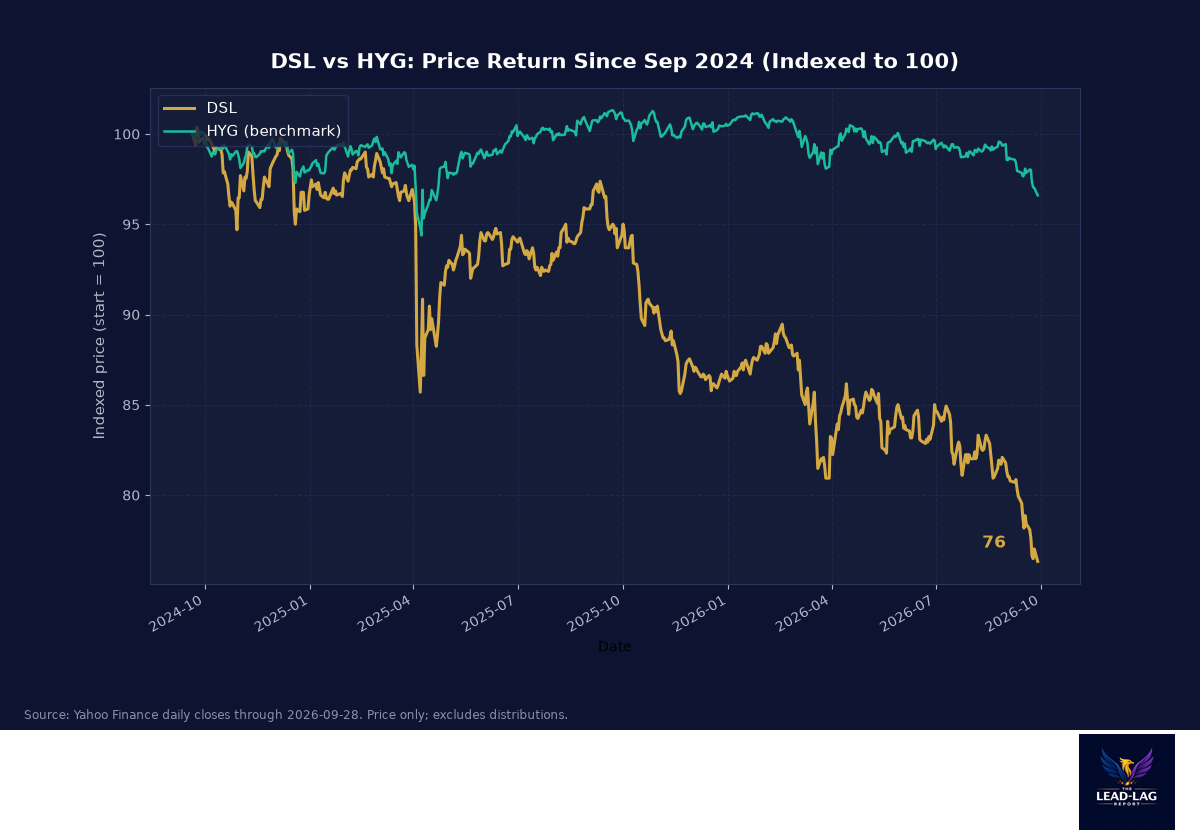
Since September 2024, DSL computed a -3.4% total return on a -23.7% price return, with $2.64 per share of distributions collected (from Yahoo Finance closes and payouts). The story is the same one the CEF sector has written all year: NAV ground while price fell, and the discount doubled. Realized volatility of 10.8% against HYG's 4.3% places this firmly in the leveraged-CEF risk class despite the blue-chip manager label.
Volatility Comparison
10.8% computed 1-year volatility against HYG's 4.3%. The sources of that extra risk are legible in the composition: 24.14% effective leverage per CEFConnect layered on 34.46% EM debt per the fact sheet, with 5.18 years of duration in a hiking cycle. Each of those three factors alone would justify a premium over US junk volatility; together they explain 2.5x the realized risk.
Discount To NAV
At -10.44% versus a 52-week average of -5.07% per CEFConnect, DSL trades at roughly double its customary discount. Simple reversion to the one-year average is about 5.4 points of price recovery before any income or NAV growth. The honest caveat is that EM-heavy CEFs can spend years at wider discounts when the dollar is strong, and this discount doubled for macro reasons rather than fund-specific ones, so mean reversion requires either the macro to turn or patience measured in years, not weeks.
Macro Environment
Here is my macro read for DSL specifically. The September hike to 3.75% to 4.00% per Federal Reserve press releases pressures this fund on two of its three risk axes at once: the dollar stays firm against emerging-market currencies, pressuring the 34.46% EM sleeve, and the front end of the curve pressures a 5.18-duration leveraged book. That is why the market pays you 13% to own it. The bull case is that hiking cycles end, and when they do, duration plus EM plus a doubled discount is precisely the combination that reverts hardest, with DoubleLine's credit selection deciding how much of the snapback you keep. I would not front-run the turn aggressively, but at a doubled discount the entry is at least being paid for the wait, which was not true when this fund traded near its average.
Distribution Policy
The $0.11 monthly distribution annualizes to $1.32, a 13.17% rate per CEFConnect. Trailing payouts over the last twelve months summed to $1.32 per share per Yahoo Finance, consistent with a stable base distribution with no recent supplementals. Coverage requires the multi-sector book's income to clear a 2.98% expense load, of which 1.57% is leverage interest per CEFConnect; with short rates at 3.75% to 4.00%, that interest line is not getting cheaper. The distribution has been maintained, but the funding-cost math is the number to watch each quarter, alongside whether the EM sleeve's coupon keeps pace with the dollar's effect on its marks.
Advantages
Institutional credit management is worth paying for when spreads widen; DoubleLine's multi-sector machinery with 483 holdings is a genuinely diversified book, not a single-theme bet.
The doubled discount, -10.44% versus -5.07% average per CEFConnect, provides a real margin of safety versus buying this same portfolio at par, and roughly 5 points of reversion potential.
The 13.17% distribution has been stable at $0.11 monthly with no supplementals to annualize optimistically, so the headline number is the actual number.
Disadvantages
Three simultaneous risk exposures, EM (34.46% of assets), duration (5.18 years), and 24.14% leverage, in a Fed hiking cycle is the exact wrong side of the current macro, and the -23.7% computed price return since September 2024 is the evidence.
The 2.98% expense ratio including leverage interest rises in cost precisely when the Fed hikes, squeezing coverage from the funding side while spreads pressure it from the asset side.
EM-heavy CEF discounts can stay doubled for years; mean reversion is a thesis, not a mechanism, and no one is obligated to close this gap for you. The honest historical note on that patience: the fund's own discount history shows it trading at premiums for long stretches in the low-rate era and at widened discounts through tightening cycles, which is the pattern you would expect from a leveraged duration-plus-EM structure. The reversion trade in CEFs works, on average, but it works through time and often requires holding through further widening. Investors who need the recovery inside two quarters should not own this fund at any discount, and investors who can wait a cycle are being paid 13% annually to do it.
Conclusion
DSL is the quality name in the leveraged multi-category batch: a diversified DoubleLine credit book paying a stable 13.17%, marked at double its usual discount, carrying EM, duration, and leverage into a hiking cycle. My verdict: short-term under macro pressure with the doubled discount as your compensation, long-term an attractive reversion holding if and when the Fed's cycle turns, with the distribution giving you 13% a year to be patient in. Buy it for the discount and the manager at this price, not for the yield alone, and position it as the aggressive satellite of an income allocation rather than its core.
The Lead-Lag Report is provided by Lead-Lag Publishing, LLC. All opinions and views mentioned in this report constitute our judgments as of the date of writing and are subject to change at any time. Information within this material is not intended to be used as a primary basis for investment decisions and should also not be construed as advice meeting the particular investment needs of any individual investor. Trading signals produced by the Lead-Lag Report are independent of other services provided by Lead-Lag Publishing, LLC or its affiliates, and positioning of accounts under their management may differ. Please remember that investing involves risk, including loss of principal, and past performance may not be indicative of future results. Lead-Lag Publishing, LLC, its members, officers, directors and employees expressly disclaim all liability in respect to actions taken based on any or all of the information on this writing.