40% Leverage, Asia-Pacific Bonds, A 15% Trailing Yield: Inside FAX
A 40-year-old CEF lending across Asia-Pacific at 40% leverage, marked at a wider-than-average discount.

Today's Lead-Lag Report post is sponsored by Relative Sentiment
The Relative Sentiment Tactical Allocation ETF is a flexible, multi-asset fund that invests across stocks, bonds, commodities, precious metals, and currencies. Its approach is guided by a research-based factor called relative sentiment — which tracks how optimistic or cautious professional investors are compared to individual investors. Studies show professionals tend to have an edge over time, and this ETF seeks to capture that insight by increasing exposure to areas where institutions are more optimistic and reducing exposure where they're more cautious. Relative sentiment often complements trend-following strategies, helping create portfolios that may be more balanced and less prone to sharp swings.
The Fund's investment objectives, risks, charges and expenses must be considered carefully before investing. This and other important information is contained in the Prospectus and SAI, which may be obtained by following the links or by calling +1.215.882.9983. Please read the prospectus carefully before investing.
Investments involve risk. Principal loss is possible.
The Fund is distributed by PINE Distributors LLC.
ETFAC-4976143-11/25
DISCLAIMER – PLEASE READ: This is sponsored advertising content for which Lead-Lag Publishing, LLC has been paid a fee. The information provided in the link is solely the creation of Relative Sentiment. Lead-Lag Publishing, LLC does not guarantee the accuracy or completeness of the information provided in the link or make any representation as to its quality. All statements and expressions provided in the link are the sole opinion of Relative Sentiment. and Lead-Lag Publishing, LLC expressly disclaims any responsibility for action taken in connection with the information provided in the link.
Key Highlights
- Yield: $0.15 monthly distribution, a 13.33% rate per CEFConnect as of 9/25/2026; trailing payouts including supplementals summed to $1.965, a 15.06% indicated yield computed from Yahoo Finance
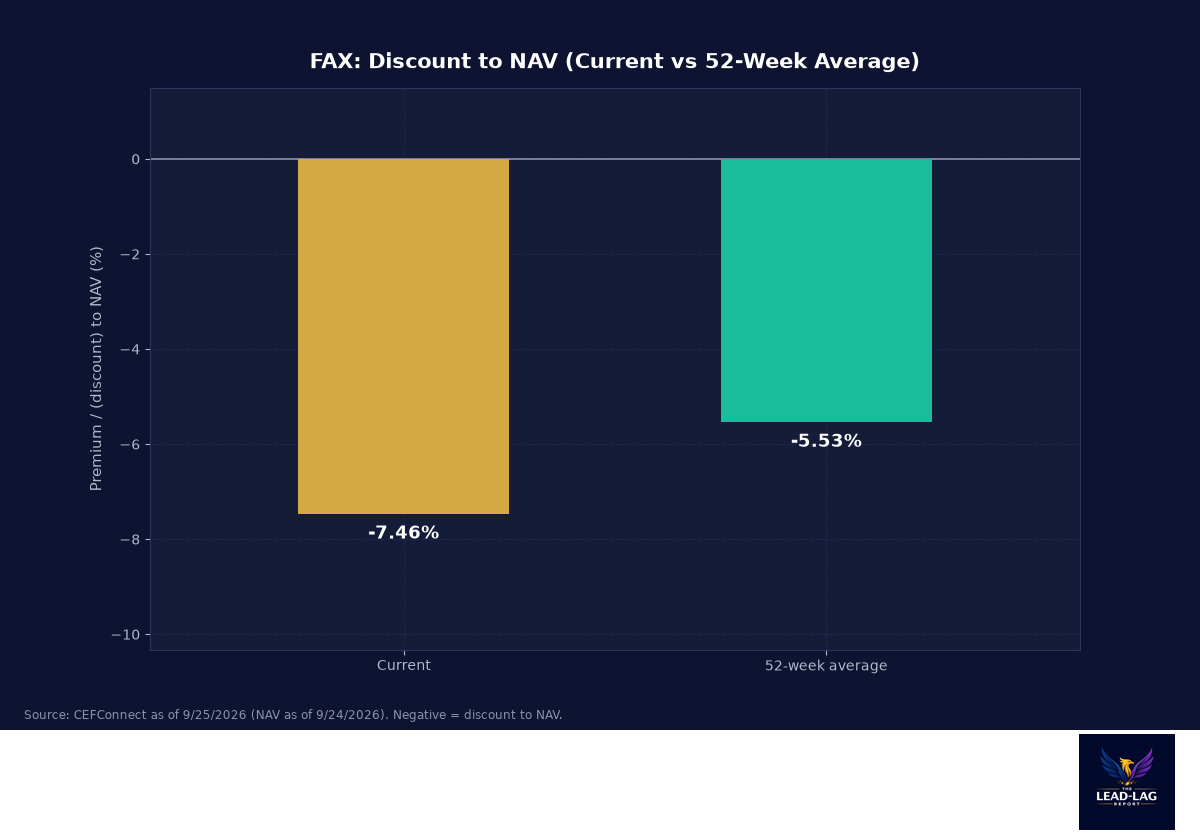
- Discount: -7.46% to NAV ($13.53 price vs $14.62 NAV) versus a 52-week average of -5.53% per CEFConnect
- Leverage: 40.22% effective leverage, $643.3 million of common assets against $1.08 billion of exposure per CEFConnect
- Portfolio: 311 holdings as of 8/31/2026, 46.43% corporate bonds and 44.82% government plus 8.35% government-related, in Asia-Pacific debt per CEFConnect
- Cost: 4.22% total expense ratio per CEFConnect, among the highest I have profiled
Every week, we'll profile a high yield investment fund that typically offers an annualized distribution of 6-10% or more. With the S&P 500 yielding less than 2%, many investors find it difficult to achieve the portfolio income necessary to meet their needs and goals. This report is designed to help address those concerns.
Forty Years Of Foreign Paychecks
Most US income investors own the same dollar-denominated universe, which makes abrdn Asia-Pacific Income Fund, Inc. (FAX) a genuine oddity: a closed-end fund, in operation since April 24, 1986 per CEFConnect, that lends across the Asia-Pacific region in local and foreign-currency bonds. It currently pays $0.15 per month, a 13.33% annualized rate per CEFConnect as of September 25, and over the trailing twelve months its payouts, including supplemental distributions, summed to $1.965 per share, a 15.06% indicated yield computed from Yahoo Finance.
A 15% trailing yield from a bond fund forces the right questions. What does it own, how much leverage stands behind the check, and what does 40.22% effective leverage do when foreign-currency debt and US rate hikes collide? The Fed's September hike to 3.75% to 4.00% (source: Federal Reserve) matters for this fund in ways a domestic fund never experiences.
Fund Background
FAX is one of the oldest closed-end funds in existence, launched April 24, 1986 per CEFConnect, and managed by abrdn. It normally invests at least 80% of assets in Asia-Pacific debt securities per CEFConnect, split as of August 31, 2026 between 46.43% corporate bonds and 53.18% in the government super sector (44.82% government plus 8.35% government-related). Common assets are $643.3 million with total investment exposure of $1.08 billion, the ratio producing the 40.22% effective leverage figure.
That leverage number is the highest in this week's batch of spotlights, and it operates on a book of 311 holdings. The monthly distribution is $0.15, and total expenses run 4.22% per CEFConnect as of 10/31/2025, a heavy drag that the leverage-subsidized distribution has to clear before shareholders earn anything.
Portfolio Composition
The composition is the entire reason to own this fund: Asia-Pacific corporate and government debt, roughly 46/53 corporates to governments per CEFConnect, across 311 holdings. The currency mechanics deserve their own paragraph, because they drive more of this fund's price action than its credits do. When the fund holds Australian or Indonesian-denominated bonds, a US investor's return is the local bond yield plus or minus the currency move. A strengthening dollar, the recurring theme since the Fed began tightening, subtracts from NAV every month the trend persists, before any credit event occurs. Roughly speaking, you should think of FAX as three layered positions: a foreign bond portfolio, a currency position, and a leverage position, and price each of them separately when deciding whether today's 15% trailing payout compensates you. This is emerging and developed Asia credit plus Australian and New Zealand government paper, a mix that has nothing to do with the US high-yield index. The flip side of that independence is currency: unhedged foreign-currency exposure means the dollar's direction moves this fund's NAV as surely as its credits do. With 40.22% leverage on top, you have three stacked risk factors, credit, currency, and leverage, compounding in both directions.
Historical Performance
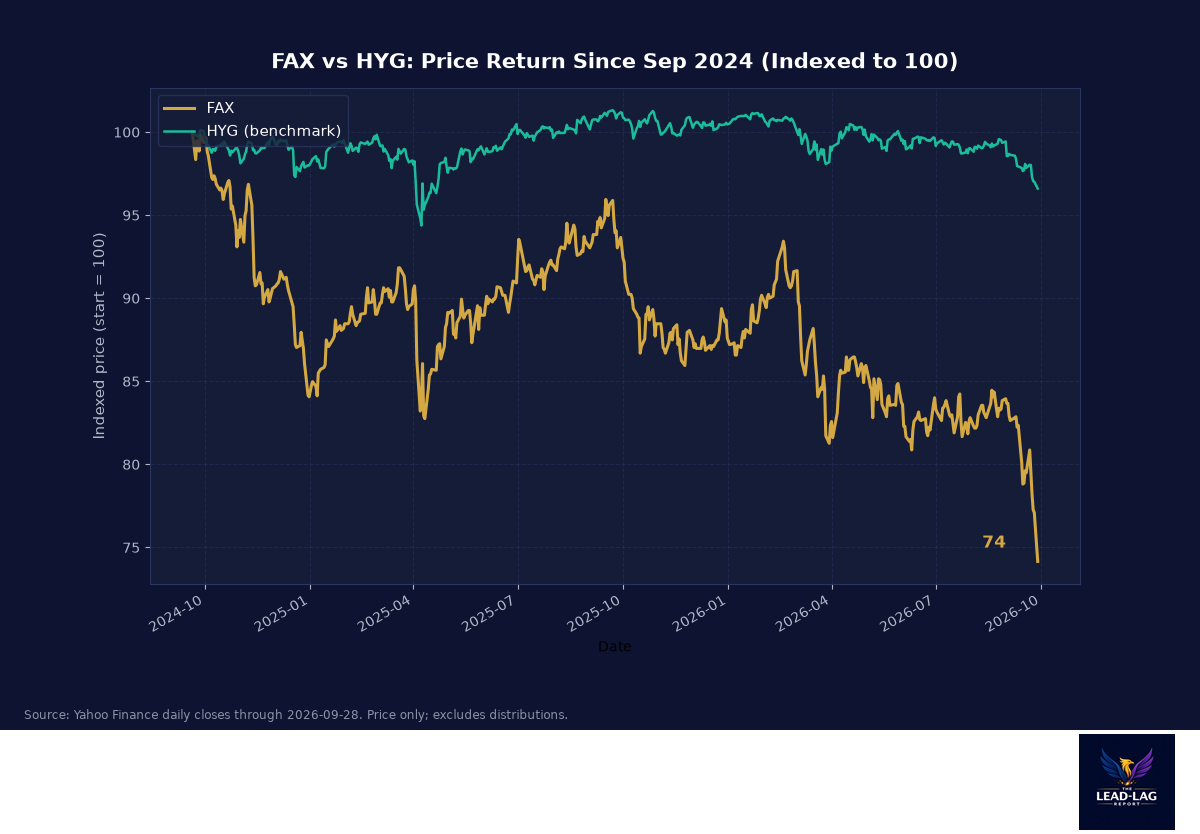
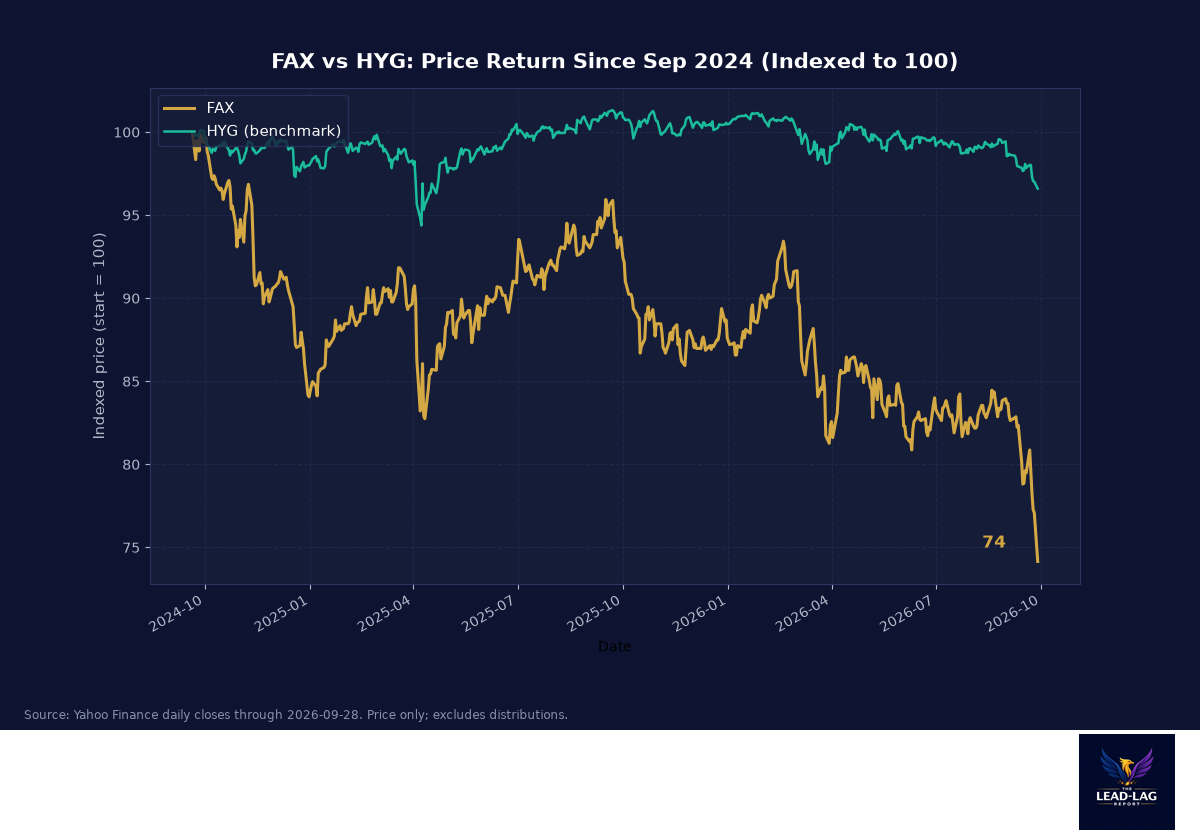
Since September 2024, FAX's computed price return is -25.8%, one of the worst price charts in this batch, though $4.11 of trailing distributions brought the computed total return back to -2.4% (from Yahoo Finance closes and payouts). Realized volatility of 14.1% against HYG's 4.3% quantifies exactly how different this ride is from plain US junk. The market has spent a year marking this fund down; the discount and the NAV tell different halves of that story.
Volatility Comparison
14.1% annualized 1-year price volatility against 4.3% for HYG, computed from daily closes. Same asset-class label on the wrapper, 3.3x the risk in the tape. The drivers are identifiable: 40.22% leverage amplifies both currency swings and credit spreads, and foreign-currency bonds reprice against the dollar every day. Anyone comparing FAX's 13.33% rate to HYG's 6% trailing yield without this volatility context is comparing prices while ignoring the risk being sold.
Discount To NAV
The fund trades at a -7.46% discount versus a 52-week average of -5.53% per CEFConnect. The widening is modest compared with the US junk CEFs I profiled this week, which is the market's way of saying the NAV itself already absorbed the damage. After a -25.8% computed price decline, you are not catching a pristine asset at a bargain-bin discount; you are catching a wounded one at a slightly better-than-normal price.
Macro Environment
Here is the framework I use for FAX. The Fed hiked to 3.75% to 4.00% in September per Federal Reserve press releases, and US front-end yields are the gravitational field every foreign-currency bond trades against. A firmer dollar mechanically pressures unhedged foreign bond NAVs, which is a large share of this fund's -25.8% price history. The bull case is genuine diversification: Asia-Pacific credit cycles do not sync with ours, 46% corporates plus 53% governments is a different animal from the US junk index, and a 15.06% trailing payout is the compensation for holding it. The bear case is the expense ratio: 4.22% of cost against a 13.33% distribution means nearly a third of what the fund pays you never leaves the expense line intact.
Distribution Policy
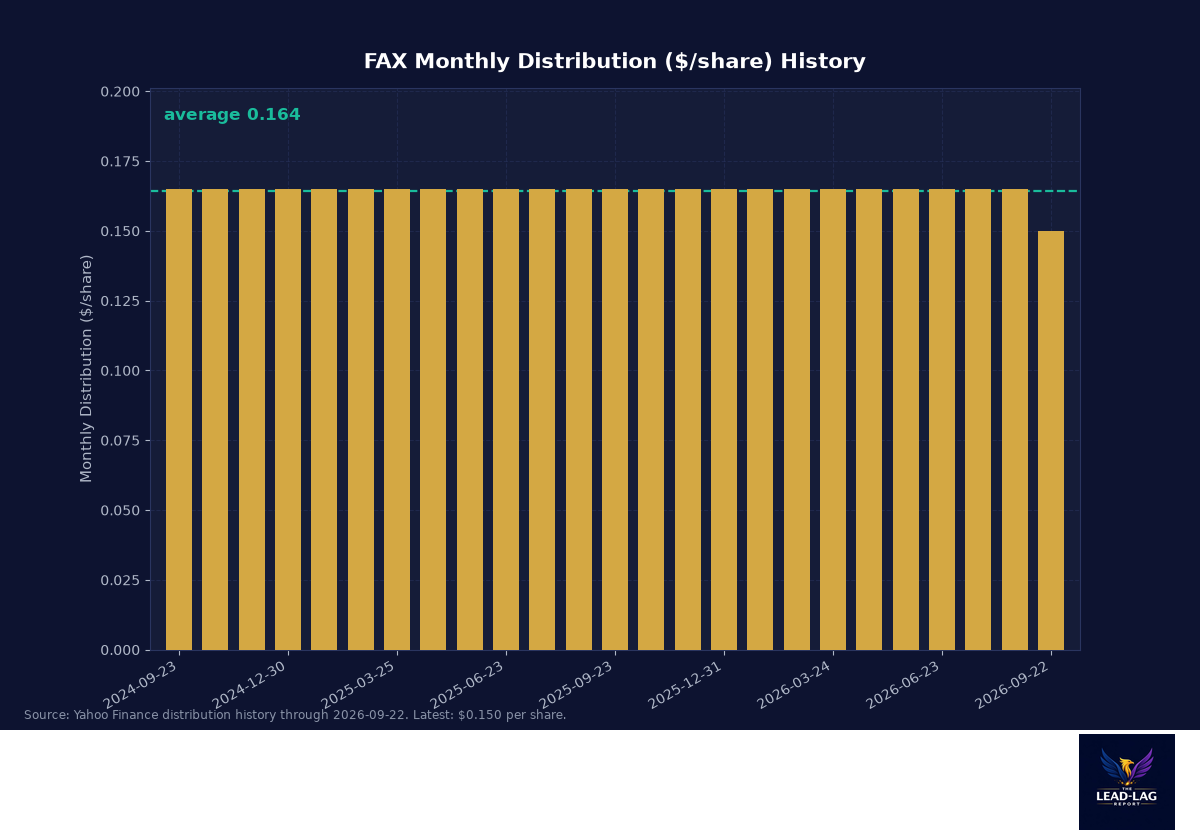
The base distribution is $0.15 monthly, a 13.33% rate per CEFConnect. Trailing-twelve-month actual payouts were higher, $1.965 per share per Yahoo Finance, meaning supplemental distributions added roughly $0.165 beyond the $1.80 base. I treat supplementals as a bonus from a strong year, never as the run rate. The structural question with 40.22% leverage and a 4.22% expense load is the same one every leveraged CEF faces: when the supplemental disappears and leverage costs rise with US rates, does the $0.15 base hold? The fund's 40-year survival record says probably. The 52-week discount widening to -7.46% says the market is not certain.
Advantages
Genuine diversification is the first reason: Asia-Pacific government and corporate credit is uncorrelated with the US high-yield index that dominates most income portfolios.
The income is substantial and long-established: a 13.33% base rate per CEFConnect from a fund that has paid through five decades of crises since 1986.
The -7.46% discount against a -5.53% average offers a small entry edge, and if the dollar cycle turns, unhedged foreign bonds get a tailwind that compounds through the 40.22% leverage.
Disadvantages
The expense ratio of 4.22% per CEFConnect is the highest cost in this week's batch and consumes roughly a third of the distribution's headline value.
Three stacked risks, credit, currency, and 40.22% leverage, produced 14.1% realized volatility and a -25.8% computed price return since September 2024. This is not an income fund that behaves like a bond.
The supplemental that lifted trailing payouts to 15.06% is not contractual; underwriting it as permanent is how investors get hurt when it lapses.
One more consideration for the patient capital crowd: this fund is 40 years old, having paid distributions through the 1987 crash, the Asian financial crisis it is structurally exposed to, the global financial crisis, and every rate cycle since. Survival over four decades does not guarantee the next decade, but it does tell you the mandate and the manager have adapted through environments far worse than this one. There is a category of investor, and I count myself sympathetic to it at the right price, that gets paid to provide this kind of long-horizon liquidity and patience.
Conclusion
FAX is a real diversifier with a real income stream and real, compounding risks. My verdict: short-term speculative while the dollar is firm and the Fed is hiking, long-term a legitimate satellite holding for income investors who want foreign credit exposure and can stomach 14% volatility to collect it. Buy it for the diversification and the decades-long payout record, size it small enough that a further -25% price year does not force a sale, and never annualize the supplemental. This is the kind of fund that belongs at the edge of an income allocation, not at its center.
The Lead-Lag Report is provided by Lead-Lag Publishing, LLC. All opinions and views mentioned in this report constitute our judgments as of the date of writing and are subject to change at any time. Information within this material is not intended to be used as a primary basis for investment decisions and should also not be construed as advice meeting the particular investment needs of any individual investor. Trading signals produced by the Lead-Lag Report are independent of other services provided by Lead-Lag Publishing, LLC or its affiliates, and positioning of accounts under their management may differ. Please remember that investing involves risk, including loss of principal, and past performance may not be indicative of future results. Lead-Lag Publishing, LLC, its members, officers, directors and employees expressly disclaim all liability in respect to actions taken based on any or all of the information on this writing.