The Risk Did Not Leave the Market. It Changed Addresses.
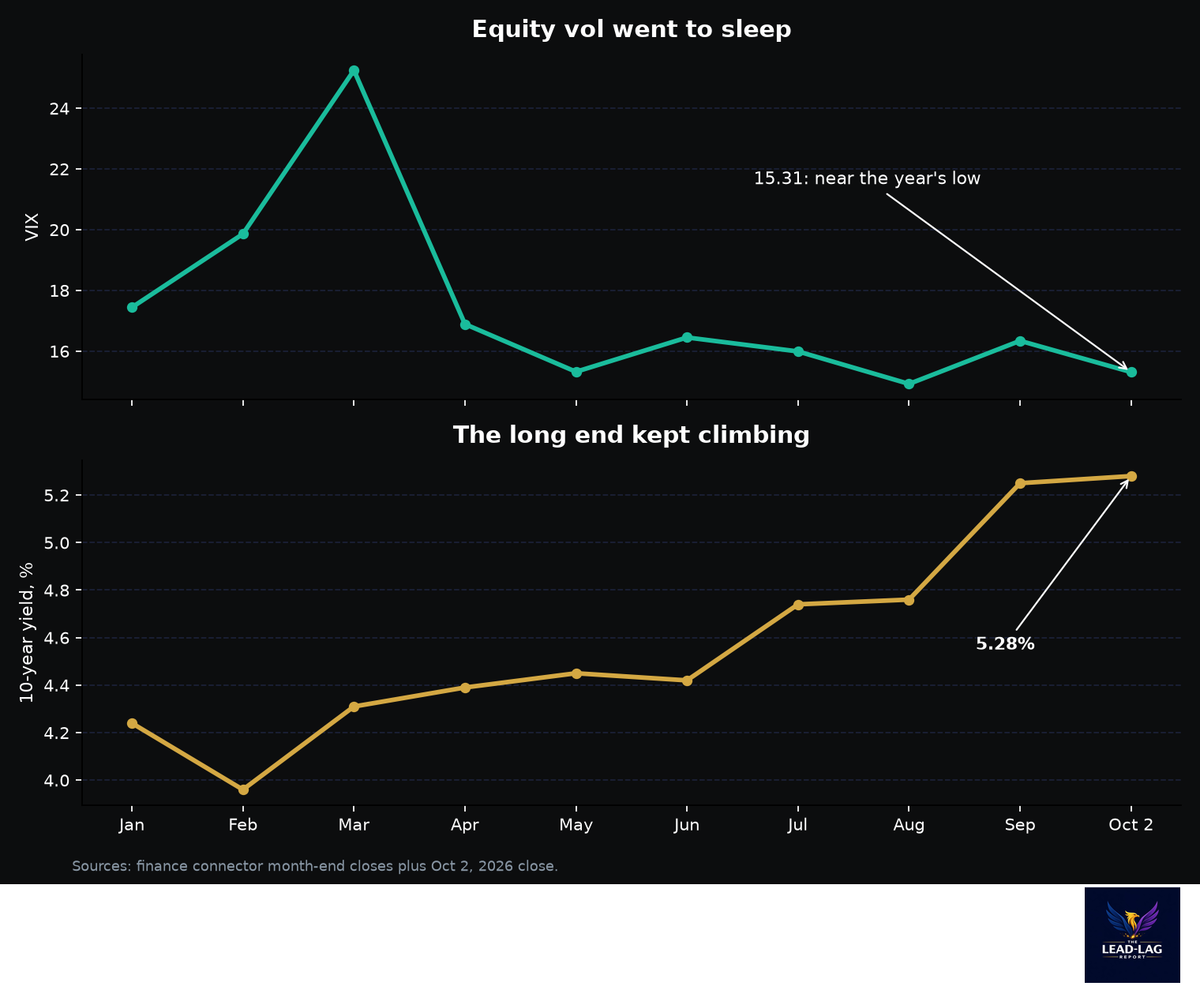
The VIX sleeps at 15.31 while the 10-year climbed 104 basis points this year and TLT fell 11.1 percent. Volatility is not a number, it is a location, and in 2026 the location is duration.

Today’s Lead-Lag Report post is sponsored by SanJac Alpha
A smarter approach to fixed income investing
SanJac Alpha offers actively managed fixed income ETFs designed to pursue opportunities while also managing risk across today’s fixed income landscape.
The SanJac Alpha Low Duration ETF (SJLD) seeks current income and capital preservation through short-term, high-grade credit markets.
The SanJac Alpha Core Plus Bond ETF (SJCP) seeks to maximize total returns while maintaining a moderate risk profile by providing exposure to a diverse range of Treasury, Agency, and Investment-Grade Bonds, Mortgage-Backed Securities (MBS), mREITs, and Preferred Stocks. Seeks to maximize total return while balancing risk by providing exposure to a broad range of bond products with a bias toward high-grade credits.
Markets change. Volatility is here.
It’s time for active management.
IMPORTANT INFORMATION
SanJac Alpha offers two exchange-traded funds. The funds’ investment objectives, risks, and expenses must be considered carefully before investing. The prospectus contains this and other important information about the investment company. Please read it carefully before investing. A copy of the prospectus can be found by visiting www.sanjacalpha.com or by calling 1-800-617-0004.
Investing involves risk, including loss of principal.
ETFs are subject to additional risks that do not apply to conventional mutual funds, including the risks that the market price of an ETF’s shares may trade at a premium or discount to its net asset value, an active secondary trading market may not develop or be maintained, or trading may be halted by the exchange in which they trade, which may impact an ETF’s ability to sell its shares.
Shares of any ETF are bought and sold at market price (not NAV) and are not individually redeemed from the ETF. Brokerage commissions will reduce returns.
The SanJac Alpha exchange-traded funds are distributed by Quasar Distributors, LLC.
DISCLAIMER – PLEASE READ: This is sponsored advertising content for which Lead-Lag Publishing, LLC has been paid a fee. The information provided in the link is solely the creation of SanJac Alpha. Lead-Lag Publishing, LLC does not guarantee the accuracy or completeness of the information provided in the link or make any representation as to its quality. All statements and expressions provided in the link are the sole opinion of SanJac Alpha, and Lead-Lag Publishing, LLC expressly disclaims any responsibility for action taken in connection with the information provided in the link.
The VIX is asleep at 15.31. The bond market is having the equivalent of a 40-point year. The risk did not leave markets. It changed addresses, and almost nobody has updated their address book.
By Michael A. Gayed, CFA · October 3, 2026
Key Highlights
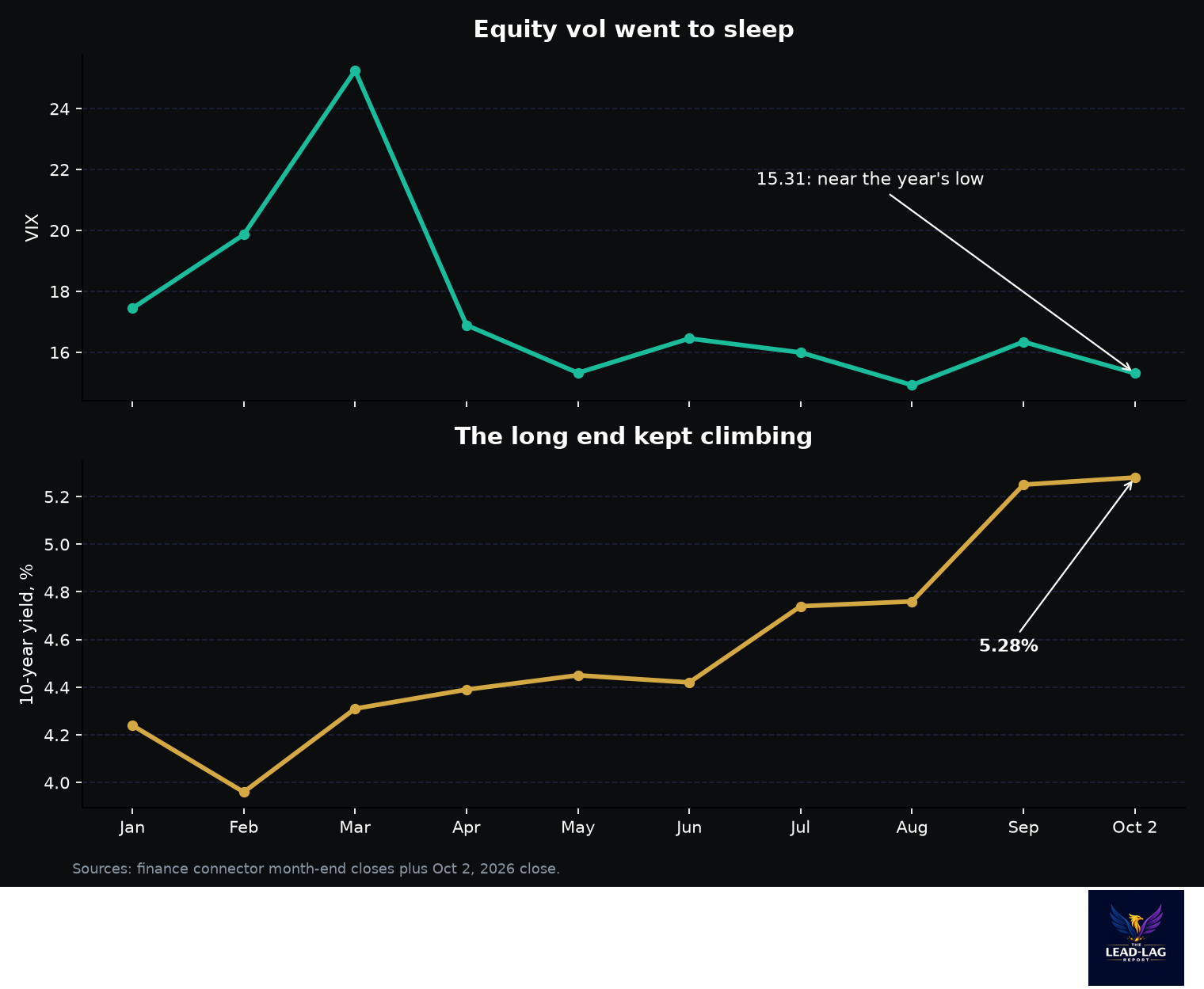
The VIX closed Friday at 15.31, down 6.59 percent on the day and near its low for the year. Equity investors are paying almost nothing for protection.
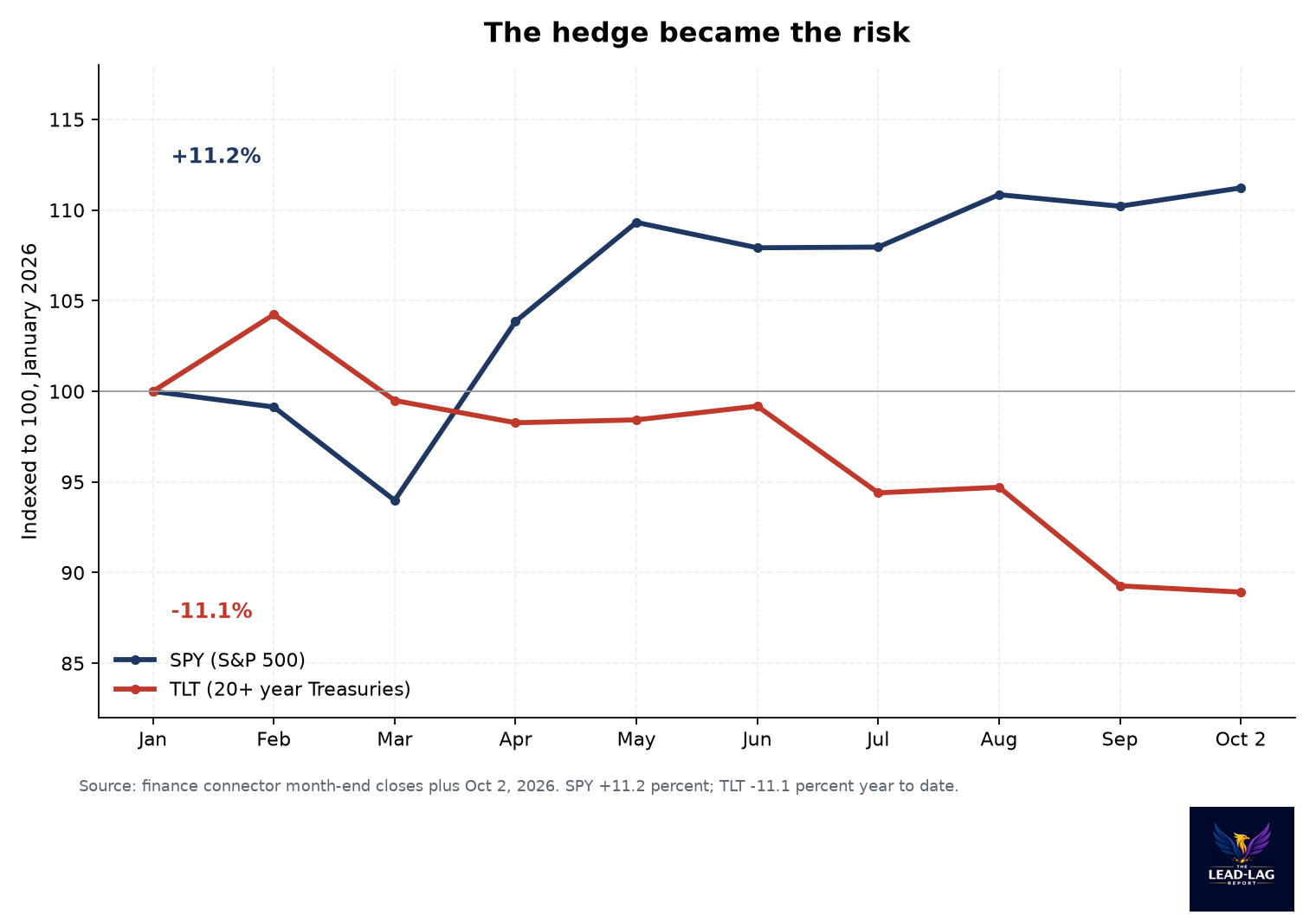
The 10-year Treasury yield has climbed from 4.24 to 5.28 percent this year, moving 35, 32 and 49 basis points in single months. TLT is down 11.1 percent while SPY is up 11.2 percent, a near mirror image.
Friday distilled it: the weakest jobs report of the year crushed equity volatility and still closed the 10-year higher. The volatility has migrated from stocks to duration, and the gauge everyone still watches is pointed at the empty building.
The risk gauge everyone reads is aimed at the wrong market
Ask most investors where risk lives and they will point at the VIX. The index closed Friday at 15.31, down 6.59 percent on the day, after a September in which it never printed a monthly close above 17. Its March peak this year was 25.25; its August low was 14.92. By that gauge, the second half of 2026 is one of the calmest equity stretches in recent memory, and the price of equity insurance has fallen to a level that historically signaled complacency, not safety.
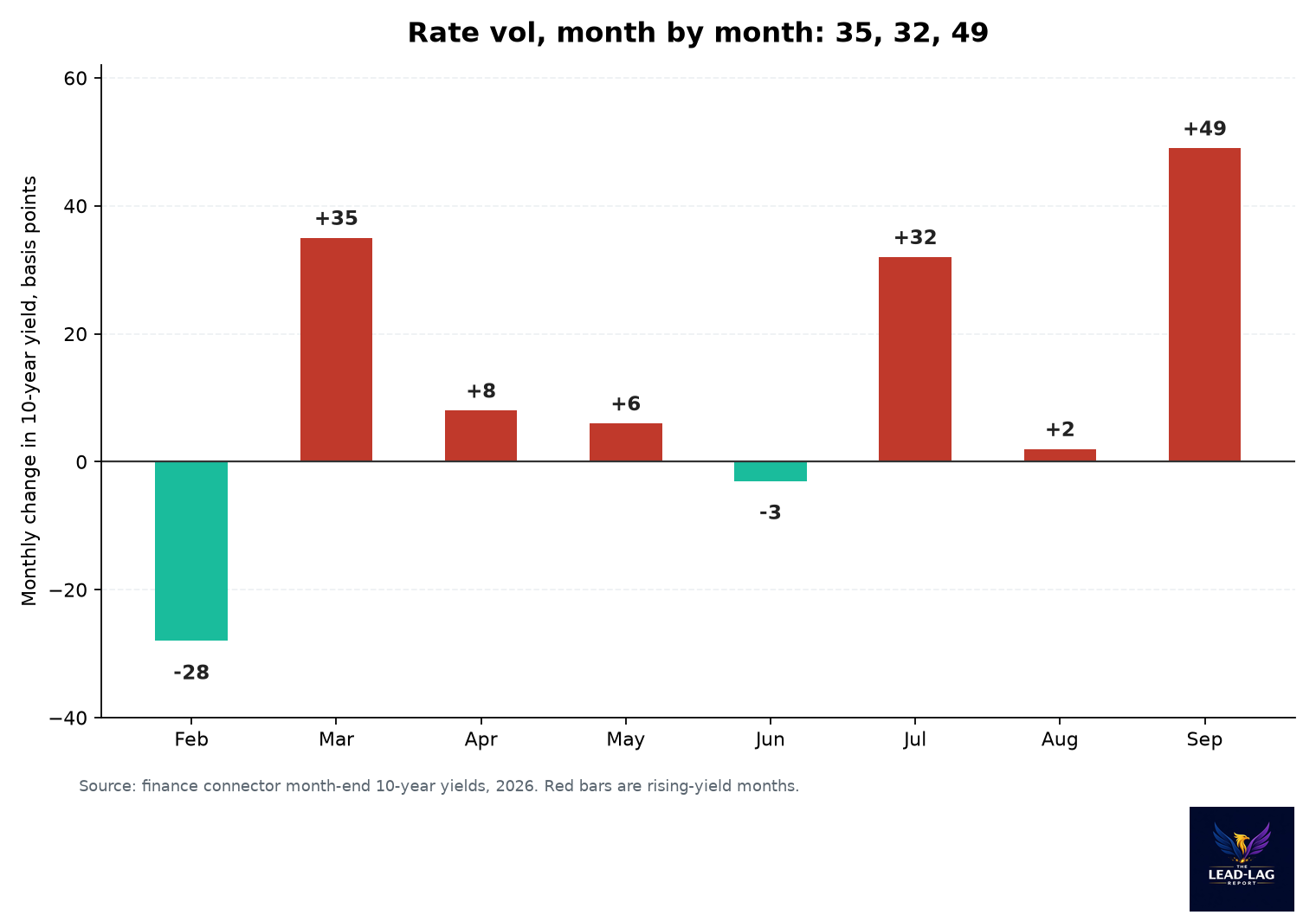
Now look one market over. The 10-year Treasury opened the year at 4.24 percent and closed Friday at 5.28 percent, a rise of 104 basis points, with single months of plus 35 basis points in March, plus 32 in July, and plus 49 in September. The long bond ETF that a generation of advisors was trained to call the safe part of the portfolio, TLT, is down 11.1 percent this year, nearly a mirror image of the S&P 500's plus 11.2 percent. The volatility did not disappear in 2026. It moved out of equities and into duration, and the instrument everyone still consults for risk is measuring a market where, for now, there is very little of it.
Friday was the whole thesis in one session
The September jobs report provided the cleanest demonstration available, because it was the kind of event that historically moves both markets in textbook directions. Payrolls rose 29,000 against a 90,000 consensus, the prior two months lost 60,000 jobs to revision, with July revised to a negative 10,000, and the unemployment rate ticked to 4.2 percent. The script says: fear spikes, the VIX rises, money floods into Treasuries, yields fall, and the duration hedge earns its keep in real time.
None of that happened. The VIX fell 6.6 percent to 15.31. The S&P 500 rose 0.73 percent to 7,722.72. And long Treasuries closed lower, with TLT down 0.30 percent and the 10-year up 4 basis points at 5.28 percent. The initial move toward lower yields, reported toward 5.15 in the opening minutes, did not survive the session. When bad news cannot make the bond market rally, the bond market is not pricing news at all. It is pricing supply, term premium, and the fiscal calendar, none of which respond to a payroll count, and all of which the BIS identified as the actual drivers of this year's long-end climb.
Why the migration matters more than the level
The point is not that bonds are risky and stocks are safe, a sentence that would have sounded illiterate for most of the last forty years. The point is that the asset portfolios were built to hedge equity risk with has become a source of risk in its own right. The classic 60/40 construction assumes the two legs are negatively correlated in stress: stocks fall, bonds catch. In 2026 the bond leg has been the stress. A portfolio hedged with long duration this year owned a double-digit drawdown, not a hedge, while the equity it was meant to insure kept climbing to 7,722.
The arithmetic is unforgiving and worth writing out. TLT is down 11.1 percent this year while the 10-year rose 104 basis points. That is roughly a 1.1 percent loss per 10 basis points of yield rise, which is the profile of an instrument carrying long-duration risk, because it is one. An asset that loses 11 percent in a year when the economy did not enter a recession is not a safe asset in any meaning of the word that survives contact with the numbers. It is a volatility asset wearing a conservative label, and the label is what most risk budgets are still keyed to.
The transmission channel nobody hedges
Here is why cheap equity volatility is not the comfort it appears to be. Volatility is not a number, it is a location, and the location determines where the next shock enters the system. A shock that originates in equities transmits to portfolios through equity exposure, which the VIX measures and equity hedges cover. A shock that originates in duration transmits through the discount rate, which reaches equities, credit, real estate, and every private-market valuation built on comparable yields. The 104 basis points the 10-year added this year did not stay in the bond market; it repriced every asset discounted against it, and it did so quietly enough that the VIX never registered the process as a risk event at all.
That is the trap in a low VIX. It is not that equity investors are wrong about equity risk. It is that the equity risk gauge is silent about the risk that actually moved, because the risk moved through a market the gauge does not watch. Cheap equity insurance against a shock that arrives through the discount rate is not cheap. It is beside the point, and paying 15.31 for it while the real source of instability swings 30, 40, 50 basis points a month is the definition of measuring the wrong thing precisely.
The behavioral anchor
There is a reason this persists, and it is not stupidity. The VIX spent four decades earning its reputation. Every risk desk, every margin model, every target-date glidepath, and half the retail commentary industry is calibrated to it, because for most of that period equities genuinely were where the volatility lived. Institutional risk systems update slowly because they are built for stability, and the instinct to treat a 15 VIX as an all-clear is trained into the industry by decades of data that supported it. The migration of volatility out of equities breaks the training data, and systems do not retrain on one year of evidence. They retrain on the year that hurts.
This is also why the migration will not be priced until it is obvious. The 60/40 framework, the risk-parity overlay, the bond-tent allocation, the duration hedge inside every model portfolio, all of it is anchored to a correlation regime that 2026 has quietly inverted. TLT down 11.1 percent against SPY up 11.2 percent is not a noisy data point in an intact relationship. It is the relationship failing, at scale, for a full year, with the VIX asleep the whole time.
The fixed-income response, honestly framed
None of this argues for abandoning bonds, and the contrarian case deserves its own paragraph rather than a punchline. A 5.28 percent yield is the highest entry income a Treasury buyer has been offered in years, and if the term premium is compensation for absorbing supply, it is at least compensation now rather than the near-zero alternative of the last decade. The problem is not owning bonds. It is owning them under the old job description. The 2026 version of fixed income is an asset class where the volatility is explicit, the drawdowns are front-loaded, and the difference between the managers who compound and the ones who get carried out is not the exposure, it is the discipline around duration, credit selection, and the willingness to be paid for the actual risk rather than the remembered one.
That distinction is also why the passive-versus-active question in fixed income stopped being a style preference and became a risk decision. An index-hugging bond portfolio owns the duration the index owns, at the weight the index sets, regardless of where the yield is going, and in a market that moves 49 basis points in a month the index's duration is a decision made by arithmetic rather than by anyone looking at the calendar. Managing around that, shortening when the term premium climbs, extending when it exhausts, is no longer a nice-to-have layered on top of a stable asset class. It is the mechanism through which bond exposure earns its yield at all.
The uncomfortable summary for anyone allocating today: equities are calm, and the calm is real, and it is also incomplete information. The bond market is where the year's volatility actually went, and the portfolios that will feel it most are the ones whose risk models are still reading the equity gauge with satisfaction.
What to watch
Three checkpoints will force the update. First, the October 27-28 Fed meeting: the market spent Friday pricing rate relief into equities while duration refused to confirm it, and a Fed that holds patient given wage growth of 3.0 percent against 2.4 percent core inflation would leave the equity rally priced off a premise the bond market never endorsed. Second, the Treasury refunding calendar: supply is the long end's driver this year, and the auction schedule does not pause for a policy meeting. Third, and closest to the point: the day the VIX wakes up and bond volatility does not fall with it. That is the day the migration is confirmed for everyone, the day every portfolio still built on the old address has to be rebuilt, and the day the year of quiet 15s turns out to have been the warning rather than the comfort.
The takeaway is simple and mostly ignored. Volatility is not a number, it is a location, and in 2026 the location is duration. The markets that feel calm are the ones being measured, not the ones that are safe, and the portfolios that feel hedged are the ones whose hedge has been the risk. Few understand this.
The Lead-Lag Report is provided by Lead-Lag Publishing, LLC. All opinions and views mentioned in this report constitute our judgments as of the date of writing and are subject to change at any time. Information within this material is not intended to be used as a primary basis for investment decisions and should also not be construed as advice meeting the particular investment needs of any individual investor. Trading signals produced by the Lead-Lag Report are independent of other services provided by Lead-Lag Publishing, LLC or its affiliates, and positioning of accounts under their management may differ. Please remember that investing involves risk, including loss of principal, and past performance may not be indicative of future results. Lead-Lag Publishing, LLC, its members, officers, directors and employees expressly disclaim all liability in respect to actions taken based on any or all of the information on this writing.