Fusion Gold Is a Headline Today and a Price Ceiling Someday
A start-up says it turned mercury into gold. The claim is unverified, the economics are unpublished, and gold was falling on real yields long before. A look at production, cost, scale and the lab-grown diamond analogy.


Today’s Lead-Lag Report post is sponsored by Sparkline

Looking for a fresh take on value investing? ITAN helps investors modernize their U.S. value allocations, providing exposure to innovative, intangible-rich companies at attractive prices.
Learn more by visiting the ITAN Website or contacting the Sparkline Team.
DISCLAIMER – PLEASE READ: This is sponsored advertising content for which Lead-Lag Publishing, LLC has been paid a fee. The information provided in the link is solely the creation of Sparkline Capital. Lead-Lag Publishing, LLC does not guarantee the accuracy or completeness of the information provided in the link or make any representation as to its quality. All statements and expressions provided in the link are the sole opinion of Sparkline Capital and Lead-Lag Publishing, LLC expressly disclaims any responsibility for action taken in connection with the information provided in the link.
Fusion Gold Is a Headline Today and a Price Ceiling Someday
Marathon Fusion says it turned mercury into gold, without saying how much or at what cost. Gold was already 26% below its January peak, and the data point to real yields, not alchemy. The lab-grown diamond analogy fits less well than it seems.
MICHAEL A. GAYED, CFA
A San Francisco start-up says it turned mercury into gold, and gold fell 3.3% in the three sessions that followed. The start-up has not said how much gold it made or what it cost. Gold was already 26% below its January peak before the announcement, and the data say the real reason is the one that has moved gold all year: the price of money. Still, the question the headline raised is a good one, and it deserves a serious answer.[1][2]
Key Highlights
- Marathon Fusion announced on October 21 that it had converted mercury into stable gold the month before, "beating CERN's record by a factor of 10." The claim has not been independently verified, and the company has not published the amount of gold produced or its cost.[1]
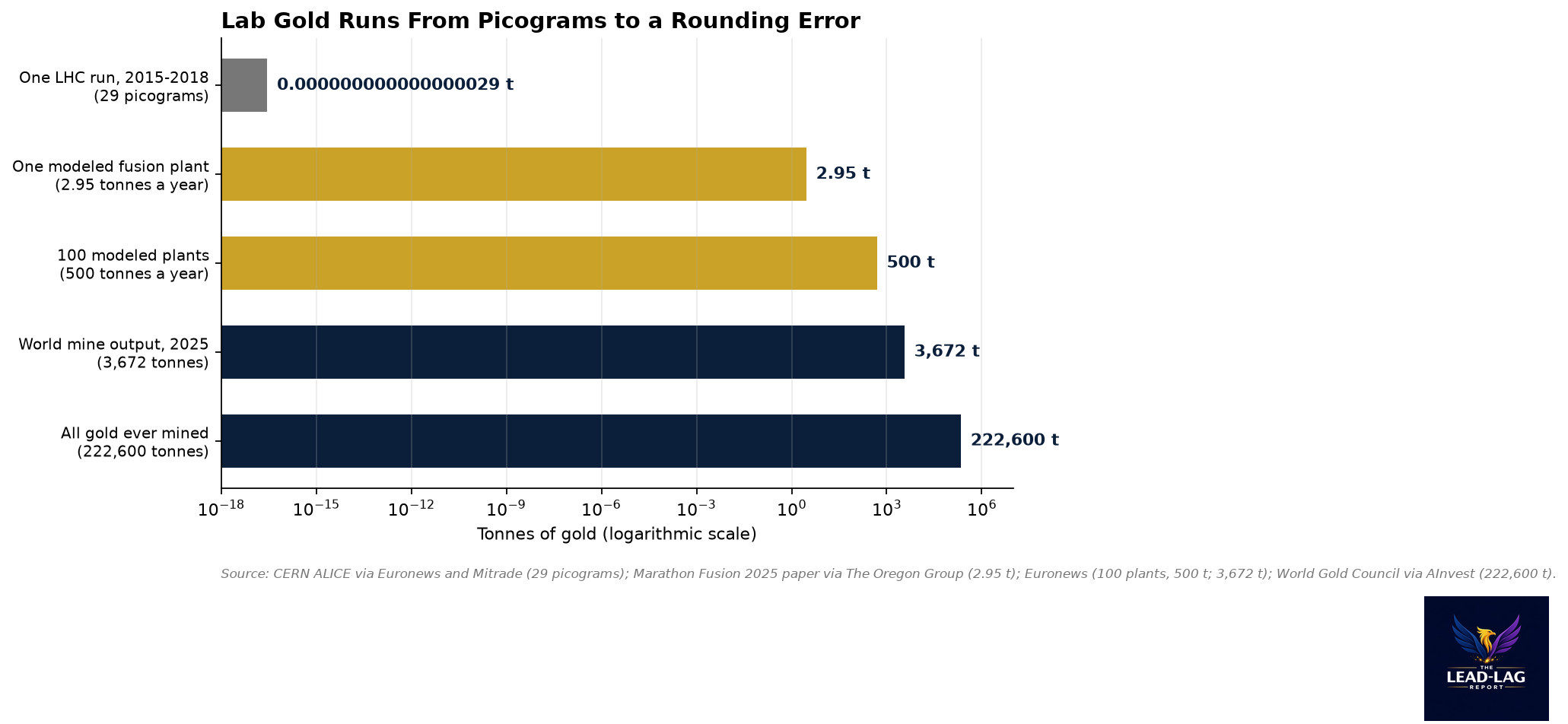
- CERN's record is 29 picograms, 29 trillionths of a gram, created during the Large Hadron Collider's 2015 to 2018 run.[1] Marathon's own reactor produces about 1 kilowatt of fusion power, a millionth of a gigawatt.[3]
- Marathon's 2025 paper models about 2 tonnes of gold a year per gigawatt of thermal power, which is 2.95 tonnes for a 1.5 gigawatt plant. The company's own estimate for 100 plants is 500 tonnes a year, or 14% of 2025 mine output of 3,672 tonnes.[4][5][1]
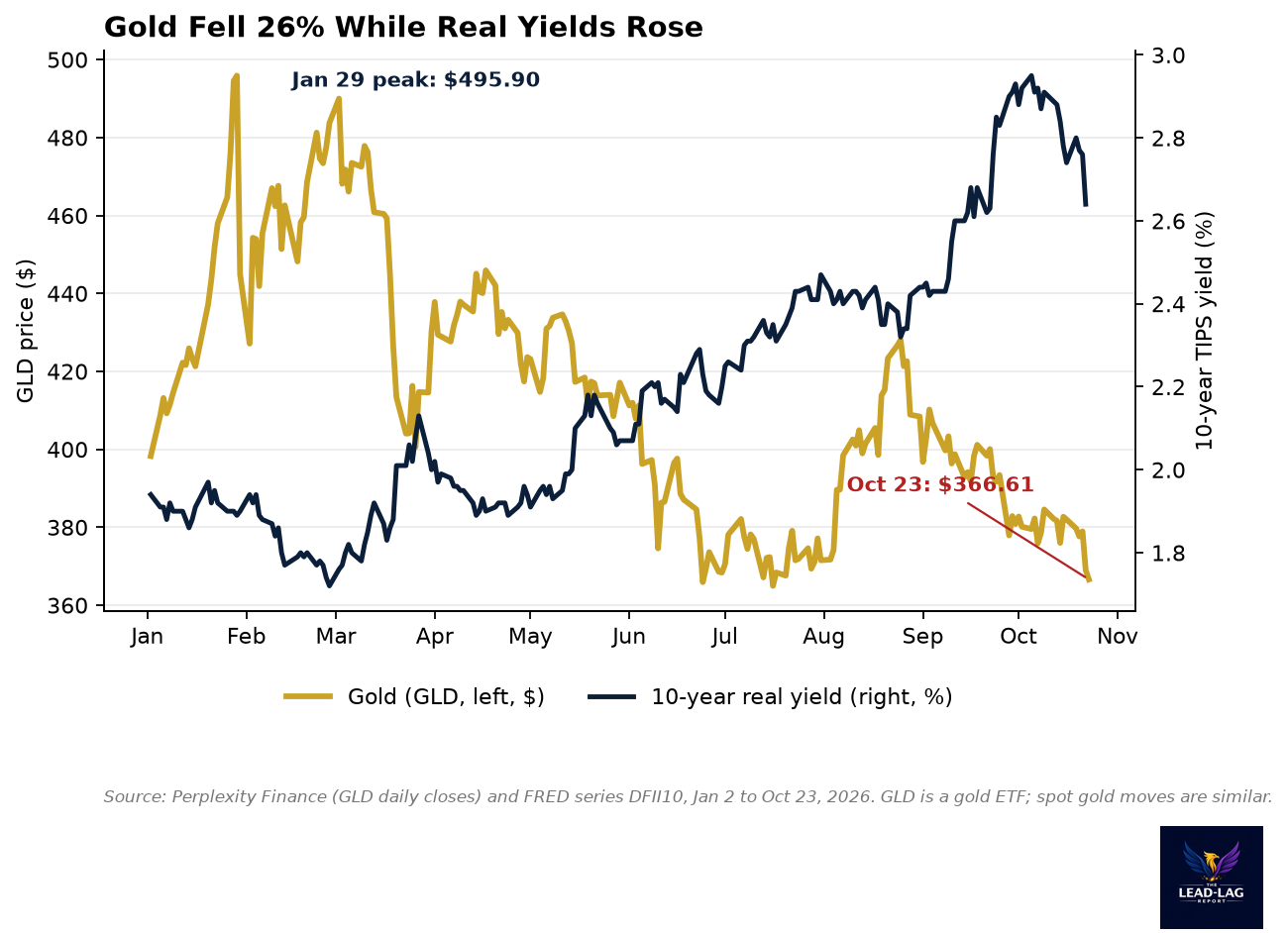
- Gold (GLD) is 26.1% below its January 29 peak while the 10-year real yield rose from 1.89% to 2.64%. On October 22, when gold fell, silver fell more, the dollar did not move, and real yields fell.[2][6]
What Was Claimed, And What Was Not
Here is what we know. Marathon Fusion, backed by Breakthrough Energy and Anglo American, posted on Wednesday that it had turned mercury into stable gold the previous month.[1] The method fires neutrons from fusion reactions at mercury. The mercury becomes an unstable isotope that decays into gold.[1]
Here is what we do not know. The company has not disclosed the mass of gold, the purity, the recovery rate or the cost. The company shared no experimental data.[3] The Oregon Group's review makes the same point: the evidence released does not establish the quantity or purity of the gold, or whether the process can scale.[5]
Two things can be true at once. The physics is real. The headline is not evidence of anything commercial. The underlying idea comes from a 2025 preprint by Adam Rutkowski and colleagues. It describes placing mercury-198 in the blanket of a deuterium-tritium fusion reactor, where fast neutrons knock one neutron out of the nucleus, make mercury-197 and let the product decay into stable gold-197.[4][7] That preprint is a simulation. It says a tokamak could make gold at about 2 tonnes per gigawatt of thermal power per year, which the authors say could double the revenue generated by the system.[4]
Why It Is Not Cheap, Yet
"Gold from mercury" suggests a cheap trick. It is not. The process rides on a machine that does not yet exist.
- The reactor. No commercial fusion plant sells electricity. The earliest targets are Helion in 2028 and Commonwealth Fusion's ARC in the early 2030s. ITER does not plan deuterium-tritium runs until 2039.[5] Marathon's own reactor is about 1 kilowatt.[5]
- The feedstock. Mercury-198 is about 10% of natural mercury. The reference plant would need 622 tonnes of it, enriched to roughly 90% purity. A Max Planck physicist calls the enrichment technically demanding.[7]
- The wait. The gold comes out radioactive. The paper estimates about 6.8 years to the least hazardous waste class, 13.7 years before it no longer needs to be labeled radioactive, and 17.7 years to fall to very low radioactivity.[5]
- The capital. The reference plant is a $3 billion, 1,500 megawatt thermal reactor selling gold at $100,000 a kilogram. The paper models revenue, not cost. No one, including Marathon, has yet published a production cost per ounce for fusion gold.[5]
Accelerators are worse. One analysis cited by AInvest estimated that making a gram of gold the way the LHC did would take the machine about a hundred billion years.[7] A route that costs a fortune per atom is a physics demonstration, not a supply source.
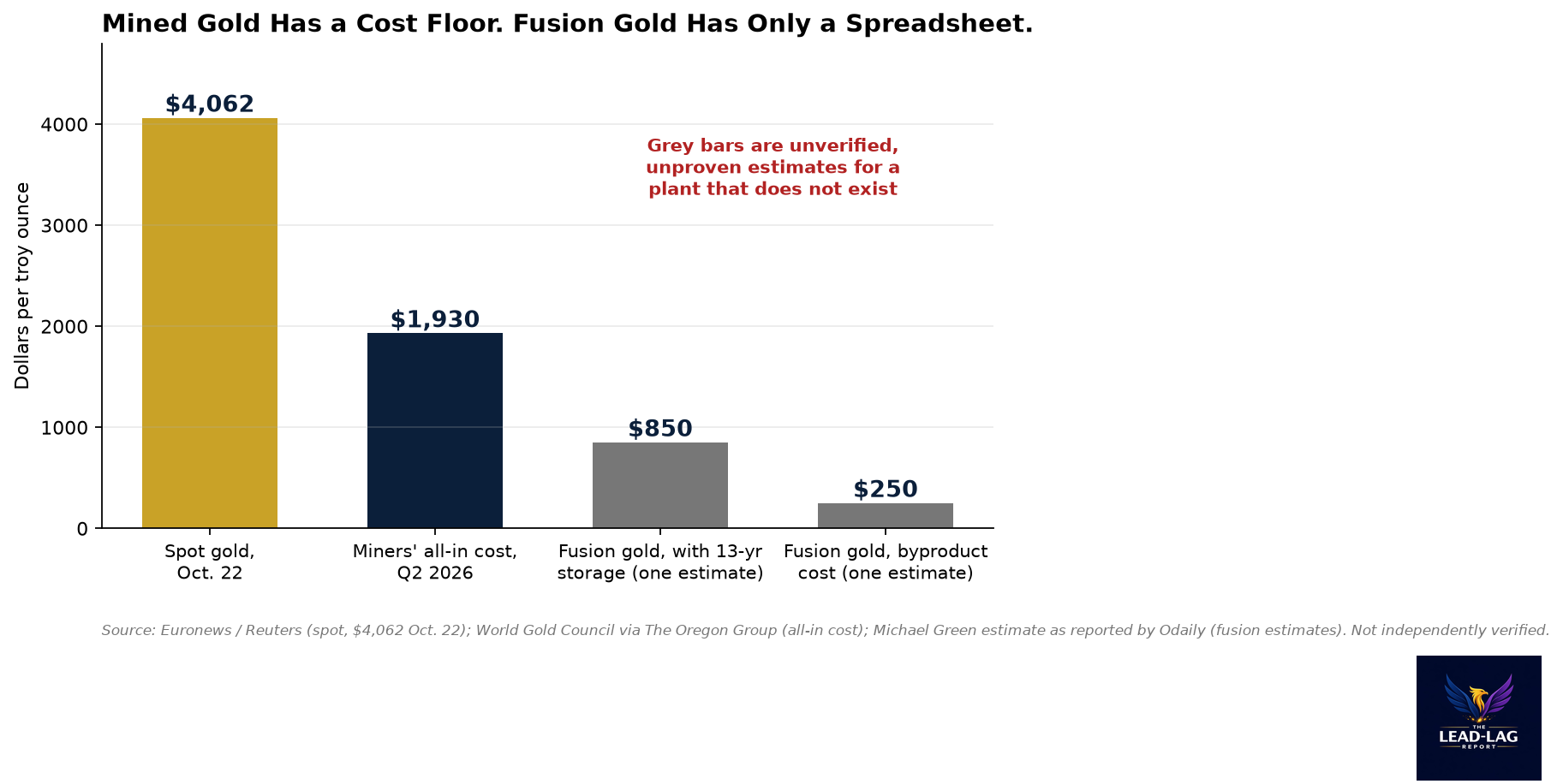
Not everyone is that gloomy. The Odaily summary of a back-of-envelope calculation by macro investor Michael Green estimates the initial cost of fusion gold at about $250 an ounce as a byproduct of radioactive isotope production, and about $850 an ounce after 13 years of storage at a 10% cost of capital.[8] I have no way to verify those numbers, and they assume the plant exists. They are a reason to take the question seriously. They are not a measurement.
Why Gold Is Falling
Gold is not falling because of a start-up in San Francisco. It was falling long before.
Spot gold traded at $4,062 an ounce on Thursday, more than 27% below its record high of $5,598 in January.[1] The gold ETF peaked at $495.90 on January 29 and fell 10.3% on January 30 alone, its worst day of the year. It closed Friday at $366.61.[2] Over the same stretch the 10-year TIPS real yield rose from 1.89% on January 29 to 2.64% on October 22, with a peak of 2.95% on October 5. Across the past year the correlation between the two series, in levels, is -0.75 by my calculation.[6][2] Gold pays nothing. When a safe bond pays 2.6% above inflation, holding gold costs more.
Now check October 22, the day after the announcement. Spot gold fell 2.8% to $4,025.40.[9] The gold ETF fell 2.6%, the gold miners ETF (GDX) fell 5.8%, and the silver ETF (SLV) fell 5.6%.[2] Silver has nothing to do with mercury transmutation. The dollar fund (UUP) was flat, down 0.1%, so it was not a currency move. The 10-year real yield fell that day, from 2.76% to 2.64%, which normally helps gold.[6]
What did happen that day was a 2.9% fall in the Nasdaq 100 and the largest Treasury rally in more than a year.[9][10] My reading: when stocks fall hard, investors sell what has gains and what is liquid, and gold qualifies. The headline may have helped a nervous market make the decision. The tape does not isolate it. Reuters, as relayed by The Oregon Group, pointed to interest rates, geopolitics and inflation as the more tangible drivers of those moves.[5]
The Diamond Analogy
The comparison to lab-grown diamonds is the reason the story caught on, so test it.
Lab-grown diamonds are chemically identical to mined stones. Wholesale prices for lab-grown stones fell 90% to 95% from 2015 levels, according to diamond analyst Paul Zimnisky. De Beers launched its lab-grown brand Lightbox in 2018 at $800 a carat and shut it down in 2025 to focus on natural diamonds. De Beers made an underlying loss of $511 million in 2025, and Anglo American has been working on a sale of its stake worth about $1 billion.[1] Anglo American is also a backer of Marathon Fusion.[1]
What made the diamond collapse possible? Factories could scale quickly with cheap inputs. And natural diamonds could survive in a niche, because specialists can tell the two apart. Neither holds for gold. A fusion plant is a decade away and costs billions. And, as Euronews notes, transmuted gold, once its radioactivity fades, "would be impossible to tell apart from mined gold."[1] There is no natural-gold niche to retreat to. If fusion gold ever became cheap and abundant, the price of every ounce would follow it.
The question is "how abundant?" Three constraints say not very, for a long time.
- The stock is enormous. About 222,600 tonnes of gold have been mined in history, worth on the order of $29 trillion. About 3,672 tonnes were mined in 2025.[1][7] Marathon's own estimate of 500 tonnes a year from 100 plants is 14% of annual mine output but 0.22% of the stock, by my arithmetic. Gold is priced off a stock that large, not off one year's flow.
- The mercury is limited. Karl Lackner estimates that even all the mercury in the Earth's crust would yield only about 600 tonnes of gold a year, and about 20 tonnes a year from the 20,000 tonnes of mercury now stored as waste. He added that "gold would therefore not become worthless, contrary to some media claims."[5]
- The time is long. One estimate is that the world would need 1.65 terawatts of fusion capacity to match one year of mine output.[5] The first plants are years away, and the gold needs years of storage after that.
For scale, the World Gold Council's rule of thumb is that every 25 tonnes of extra supply moves the price about 1%.[5] On that rule, 500 tonnes a year would be a roughly 20% price effect by my arithmetic. That is large. It is also a hypothetical built on 100 fusion plants that do not exist.
What Scarcity Is Worth
This is the part I find more interesting than the headline. People say gold is valuable because it is scarce. The record suggests scarcity is necessary and not sufficient.
Gold's price has not tracked its supply schedule. It has tracked real yields, deficits and the willingness of central banks to hold it as a reserve. The price fell 26% in 2026 without any change in the physical scarcity of the metal. A good test of a scarcity story is whether the price responds to scarcity. This year it has not.
Miners offer another test. Their average all-in sustaining cost was about $1,930 an ounce in the second quarter, and their average margin reached a record $3,076 an ounce in the first quarter.[5] At $4,062, the cushion is $2,132 an ounce, or 52% of the price, by my arithmetic. A new source of gold would need to cost less than that cushion to matter, and it would need to arrive at scale.
So here is how I would frame it. If fusion gold works at $850 an ounce, the long-run price of gold has a ceiling set by the cost of the new supply, and that ceiling sits below today's price. That is the bearish case, and it is not zero. But the quantity matters as much as the cost: a ceiling that applies to 20 to 600 tonnes a year does not cap a market of 3,672 tonnes plus central-bank demand. In the near term the price will keep following the price of money.
What Would Change The Picture
- A measurement. A published mass of gold, its purity, and the cost per gram, reviewed by someone outside the company.
- A cost. Any reactor operator signing a contract to sell blanket-made gold, with a price.
- Feedstock. Evidence that mercury-198 can be enriched in volume. The paper estimated the energy cost of one separation stage at about $2.4 per kilogram, but said scalable separation still needs to be fully defined.[5]
- The reactors. Helion's 2028 start-up target, Commonwealth Fusion's early-2030s ARC, and ITER's 2039 deuterium-tritium runs.[5]
- The real yield. The near-term driver. A 10-year TIPS yield falling back toward 2% has historically been what gold needed, and this week's fall to 2.64% was not enough.[6]
The headline will fade. The question will not. Gold's scarcity story is now something investors must price, and for the first time it has a testable condition attached to it. For now, nothing has been tested.
Few understand this.
— — —
Notes
- [1] Marathon Fusion claim, CERN record, 100-plant scenario, spot gold, lab-grown diamond price and De Beers data: Euronews, October 23, 2026.
- [2] Daily closes and returns for TLT, SPY, HYG, USO, GLD, GDX, SLV and UUP; correlations are my calculations: Perplexity Finance.
- [3] No experimental data shared; 1 kilowatt reactor; 29 picograms: Mitrade, October 22, 2026.
- [4] Rutkowski, Harter and Parisi, Scalable Chrysopoeia via (n,2n) Reactions Driven by D-T Fusion Neutrons, about 2 tonnes per gigawatt thermal per year: arXiv:2507.13461.
- [5] Reference plant economics, storage times, feedstock, reactor timelines, Karl Lackner comments, all-in sustaining cost and World Gold Council rule of thumb: The Oregon Group.
- [6] Treasury yields, TIPS real yield, breakevens and ICE BofA credit spreads (series DGS10, DGS30, DFII10, T10YIE, BAMLH0A0HYM2, BAMLH0A3HYC, BAMLC0A0CM): Federal Reserve Bank of St. Louis (FRED).
- [7] Mercury-198 abundance, enrichment difficulty, accelerator-route cost, size of the above-ground gold stock: AInvest.
- [8] Michael Green back-of-envelope estimate of about $250 an ounce, $850 with 13-year storage (unverified): Odaily, October 23, 2026.
- [9] S&P 500 and Nasdaq 100 moves, Treasury haven status, fading Fed hike bets, spot gold: Bloomberg markets wrap via Swissinfo, October 22, 2026.
- [10] Best Treasury day in over a year, yields down up to 20 basis points, short covering, Kenneth Crompton quote, energy as a growth drag: Bloomberg via The Straits Times, October 22, 2026.