The 11% Yield That Lends To The Companies Building The AI Era
Hercules Capital pays $0.47 a quarter from a 12.8% yielding book of venture loans to software and biotech startups, with 0.1% non-accruals and a 43% premium to net asset value

Today’s Lead-Lag Report post is sponsored by Market Ontology
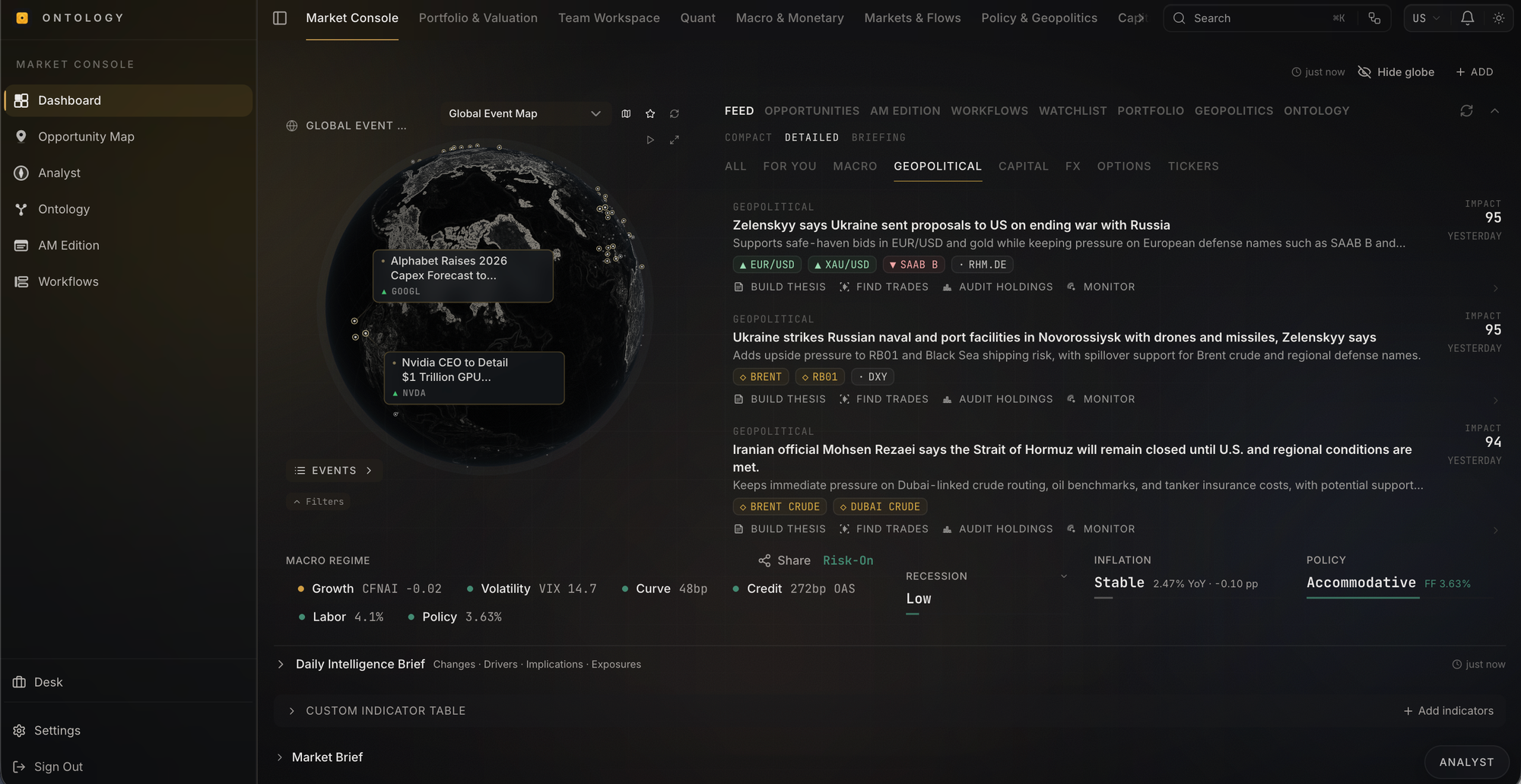
The first move is rarely the whole move. Map what a geopolitical shock touches next. Market Ontology maps conflicts, sanctions, trade policy and supply-chain events to affected stocks, ETFs, commodities, rates and FX. Trace transmission paths, second-order exposure and scenario risks across the market. $79/month. See the impact.
DISCLAIMER – PLEASE READ: This is sponsored advertising content for which Lead-Lag Publishing, LLC has been paid a fee. The information provided in the link is solely the creation of Market Ontology. Lead-Lag Publishing, LLC does not guarantee the accuracy or completeness of the information provided in the link or make any representation as to its quality. All statements and expressions provided in the link are the sole opinion of Market Ontology, and Lead-Lag Publishing, LLC expressly disclaims any responsibility for action taken in connection with the information provided in the link.
KEY HIGHLIGHTS
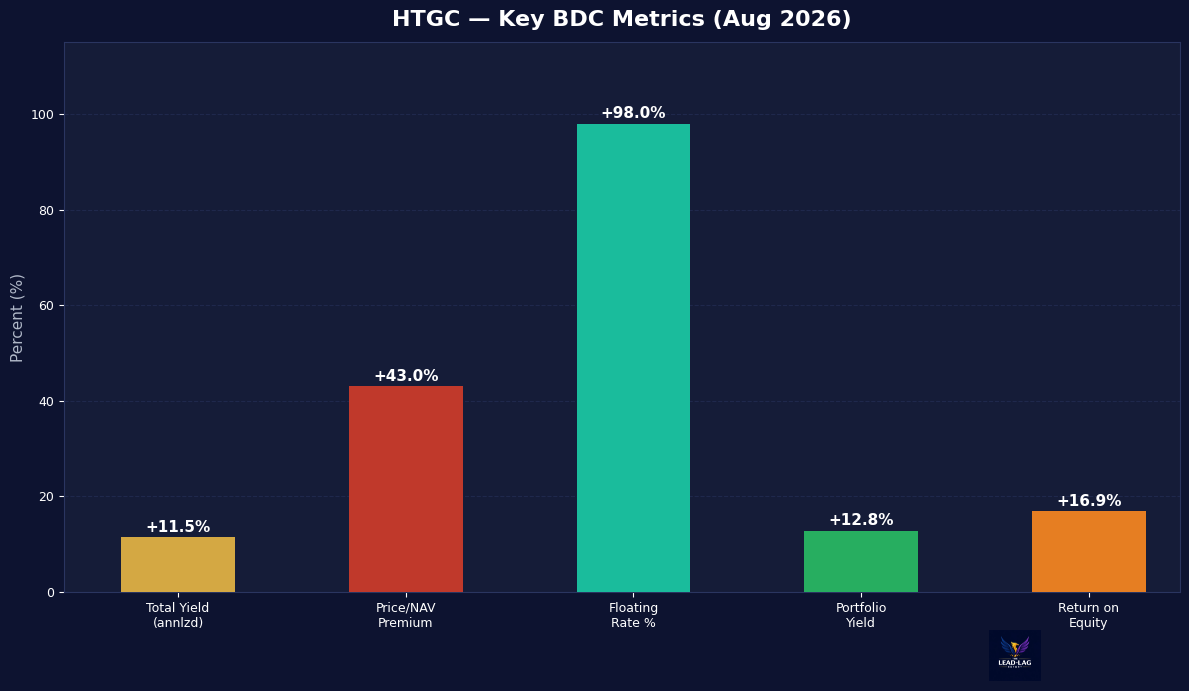
Yield: ~11-12% annualized | Q2 2026: $0.40 base + $0.07 supplemental = $0.47/quarter
AI tailwind: 23.6% application software + 23.1% drug discovery = pure venture lending to the companies building the AI era
Premium: Trades at ~1.43x NAV -- historically normal for HTGC (range 0.7x-1.9x); premium sustained by internally managed structure + consistent performance
Portfolio quality: 98% floating rate | 0.1% non-accrual | 16.9% return on equity vs 10.6% peer average
AUM: $4.77B | 139 portfolio companies | $149.1M spillover income buffer
Every week, we'll profile a high yield investment fund that typically offers an annualized distribution of 6-10% or more. With the S&P 500 yielding less than 2%, many investors find it difficult to achieve the portfolio income necessary to meet their needs and goals. This report is designed to help address those concerns.

There are two ways to own the technology cycle. You can buy the equity and accept that most of your return arrives as multiple expansion, which is another way of saying it arrives on someone else's schedule and can leave the same way. Or you can lend to the same companies, take a senior secured claim ahead of the venture capital that funded them, and get paid a double-digit coupon every quarter regardless of what the multiple does.
Almost nobody does the second thing at scale in public markets. Business development companies are supposed to be middle-market lenders of the boring kind. Venture lending is a different animal. The borrowers are pre-profitability, backed by institutional venture sponsors, burning cash to grow into their markets, and the credit case rests less on cash flow coverage than on the sponsor's willingness to keep writing checks.
Hercules Capital (HTGC) has been doing exactly that since 2005, and it has built the largest publicly traded venture growth lender in the market. The portfolio runs $4.77 billion in total investments across 139 companies, with a $4.56 billion debt book that is 98% floating rate and better than 90% first lien senior secured, earning an effective yield of 12.8% as of the first quarter of 2026, per the company's [first quarter results presentation](https://www.investing.com/news/company-news/hercules-capital-q1-2026-slides-record-earnings-128-yield-93CH-4661510). Non-accruals sit at 0.1% of fair value. Return on average equity was 16.9% against a peer group average of 10.6%. The stock pays $0.40 a quarter in base distributions plus a $0.07 supplemental, or $1.88 annualized, which is roughly 11% to 12% at the current $17.05 price.
The catch is the price. Net asset value was $11.90 at the end of March, so buyers today are paying about 1.43 times book. That is a 43% premium, and no amount of goodwill toward management makes a 43% premium a small detail.
Fund Background
Structure. Hercules is a business development company listed on the NYSE, and critically it is internally managed. There is no external adviser collecting a base management fee on gross assets plus an incentive fee on income. In a category where 1.5% on assets plus 17.5% over a hurdle is standard, removing that fee layer is worth several hundred basis points of shareholder return over a cycle, and it is the single most defensible reason HTGC trades where it does. It is the same structural advantage that has kept Capital Southwest trading at a premium for years.
Mandate. The firm lends to venture growth-stage technology and life sciences companies. These are businesses that have raised institutional venture capital, have a product in market, and want debt rather than another dilutive equity round. Hercules provides senior secured term loans, frequently with warrants attached, and structures around milestones and cash runway rather than leverage multiples.
Scale and history. Twenty-one years of operating history covers the financial crisis, the 2015-2016 biotech drawdown, the 2020 shutdown, the 2022 rate shock, and the venture funding winter that followed. That matters, because the loudest objection to venture lending is that nobody has seen it work through a real downturn. Hercules has, more than once, and the portfolio is still marking non-accruals at a tenth of a percent.
Pricing. The stock has traded between roughly $14.77 in March and $17.05 in August of this year. Against $11.90 in net asset value, the current multiple is about 1.43 times, and the ratio was near 1.35 times at the end of April. Historically HTGC has ranged between 0.7 and 1.9 times book, per the [company's investor materials](https://investor.htgc.com/). Today's valuation is elevated but sits well inside a range this stock has occupied for most of its life.
Portfolio Composition
Sector exposure as of March 31, 2026 is led by application software at 23.6%, drug discovery and development at 23.1%, biotechnology tools at 18.9%, and medical devices and equipment at 10.7%. Add those four and you have roughly three quarters of the book in software and life sciences.
This is the whole argument in one number set. Nearly a quarter of the portfolio lends to application software companies at a moment when artificial intelligence is pulling forward enterprise software spending faster than any platform shift since cloud migration. Another 42% lends to drug discovery and biotech tools, the two corners of life sciences where machine learning is actually changing unit economics rather than being mentioned on earnings calls. Hercules is not making a thematic AI bet through equity. It is financing the companies executing it and taking a first lien on the assets.
The credit structure is conservative in a way that is easy to underrate. Ninety percent or more of the debt book is first lien senior secured, sitting ahead of every dollar of venture equity that came before it. The collateral is frequently intellectual property and enterprise value rather than hard assets, which sounds thin until you remember the equity cushion beneath a Hercules loan is often several times the loan amount, funded by sponsors with strong incentives to protect their position.
The effective portfolio yield of 12.8% in the first quarter, up from 12.3% a year earlier, tells you Hercules is being paid properly for that risk, and the 0.1% non-accrual figure tells you the underwriting has so far held. Those two facts sitting together are unusual, because most lenders earning 12.8% are earning it because something in the book is broken.
What you cannot escape is concentration. With 139 borrowers across four dominant sectors, this is not a diversified credit fund that happens to own some tech. It is a bet on the venture economy with a coupon attached.

Performance Analysis
First quarter 2026 net investment income was $88.1 million, up 14% year over year, or $0.48 per share against a $0.47 distribution. Coverage is there, with a small margin, and it is coming from earned income rather than realized gains.
Return on average equity of 16.9% versus a 10.6% peer group average is the number that explains the premium, a gap also highlighted in recent [independent analysis of the name](https://seekingalpha.com/article/4913143-hercules-capital-bdc-attractive-valuation-and-growth-potential). Book value compounding at high teens returns while paying out most of what it earns is the profile investors will pay above book for, and the internally managed structure is what lets more of the portfolio yield reach shareholders rather than being absorbed by fees.
Spillover income stands at $149.1 million. For a business development company, spillover is undistributed taxable income carried forward, and it functions as a distribution reserve. Against a $1.88 annual payout, that buffer gives Hercules the capacity to sustain the supplemental for multiple quarters even if net investment income softens, a materially better cushion than most BDCs carry.
The share price itself has done the work in 2026, running from under $15 in March to $17.05 in August. Some of that is earnings, and some of it is multiple expansion on a stock that already traded above book.


Macro Environment
Two forces drive HTGC from here, and they do not move together.
The first is the rate path. With 98% of the debt book floating, every cut the Federal Reserve delivers pulls the 12.8% effective yield lower, and unlike a fixed-rate lender Hercules cannot ride out an easing cycle on locked-in coupons. The offset is partial, since cuts also reduce Hercules' own borrowing costs and its loans typically carry rate floors. But a 100 basis point easing cycle is a genuine headwind to net investment income, and the supplemental distribution is the first thing that would absorb it.
The second is the venture cycle, and it matters more. Hercules underwrites to the expectation that when a borrower needs more runway, its sponsors will provide it. That assumption held through 2022 and 2023 because venture funds were sitting on record dry powder, and it holds today because AI has made technology the most fundable sector in private markets. If venture funding contracts sharply, borrowers do not fail because rates moved. They fail because the next round never arrives, and non-accruals move from 0.1% to something far less comfortable with very little warning.
The bull case is the mirror image. Continued AI-driven investment keeps enterprise software growing and biotech capital flowing, portfolio companies hit milestones, warrants convert into realized gains, and Hercules keeps originating at double-digit yields into a market where its scale gives it first look at the best paper.
Distribution Policy
The second quarter 2026 distribution is $0.40 base plus $0.07 supplemental, for $0.47 per share, annualizing to $1.88 and yielding roughly 11% at $17.05.
The split matters. The $0.40 base is what management is signaling it can pay through a cycle. The $0.07 supplemental is a variable top-up funded from earnings above the base and from the spillover balance, and it is explicitly designed to be adjusted. Underwrite $1.60 annualized as the durable number and treat the additional $0.28 as a bonus reflecting current conditions.
On coverage, first quarter net investment income of $0.48 against a $0.47 payout is adequate rather than generous. Add the $149.1 million spillover reserve and the total distribution looks well supported near term. What it is not is a payout with a large cushion. If the portfolio yield compresses 100 basis points, the supplemental is the release valve and the base holds. That is the right design, and also a reminder that the headline 11% is not a fixed 11%.

Advantages
The internally managed structure is the foundation of the case. No external adviser is extracting a management fee on gross assets and an incentive fee on income, so the spread between a 12.8% portfolio yield and what shareholders receive is far narrower than at a typical externally managed BDC. Over a decade that difference compounds into a very large number, and it is the most durable justification for a premium multiple.
The credit metrics are excellent and they are not a recent development. Non-accruals at 0.1% of fair value, a book that is over 90% first lien senior secured, and a 12.8% effective yield that has been rising rather than falling together describe a lender getting paid well without loosening standards. Return on average equity of 16.9% against a 10.6% peer average quantifies the gap between Hercules and the category.
The sector exposure is a genuine tailwind rather than a marketing angle. Application software at 23.6% and drug discovery at 23.1% put nearly half the portfolio in the areas where capital formation is most active, and doing it through senior secured debt means you collect a coupon whether or not the equity multiples cooperate. A 98% floating rate book has also let the portfolio yield expand with rates rather than sit on stale coupons.
Finally, the spillover balance of $149.1 million is real optionality. It gives management room to smooth distributions through a soft patch rather than cutting into a weak tape, which is exactly when a cut does the most damage to the share price.
Disadvantages
The premium is the dominant risk. At roughly 1.43 times net asset value, buyers are paying $17.05 for $11.90 of book, and every dollar of that gap depends on Hercules continuing to earn 16.9% on equity with 0.1% non-accruals. HTGC has traded as low as 0.7 times book in its history, and getting from 1.43 to 1.0 is a 30% price decline before the portfolio does anything wrong. Multiple compression, not credit losses, is the most likely source of a bad outcome here.
Sector concentration cuts both directions. Three quarters of the book in software and life sciences means no offsetting exposure when technology funding tightens. Venture borrowers are pre-profitability by design, they depend on sponsor support for survival, and that support is correlated across the entire portfolio because it comes from the same set of venture funds. A 0.1% non-accrual rate in a concentrated venture book is not a statement about how bad things can get. It is a statement about how good conditions currently are.
Rate cuts compress the earnings power directly. With 98% of loans floating, an easing cycle pulls the 12.8% yield down, net investment income follows, and the $0.07 supplemental is the first casualty. The 11% headline yield is the top of the range, not the middle. Net investment income of $0.48 against a $0.47 total payout is coverage, not comfort, and the buffer sits in spillover rather than in current earnings power.
Venture credit is also harder to value than it looks. Loans to pre-profitability companies with intellectual property collateral are marked using models and sponsor round pricing rather than observable trading levels, which makes net asset value inherently more of an estimate here than in a broadly syndicated loan book. In a stressed market, marks can move quickly once the reference points move.
Final Thoughts
Hercules is the highest-quality operator in a genuinely difficult lending niche, offered at a price that assumes it stays that way.
The bull case is straightforward and I take it seriously. This is an internally managed lender compounding equity at 16.9% with a 12.8% portfolio yield, essentially no non-accruals, $149.1 million of distribution reserve, and roughly half its book pointed at the sectors absorbing the most capital in the economy right now. If you believe AI-driven technology and life sciences investment continues, financing those companies with a first lien and an 11% coupon is a smarter expression of that view than owning the equity at forty times earnings.
The restraint case is about the entry price and the tail. A 43% premium gives you no protection if venture funding tightens, and the mechanism by which this position loses money is not gradual. It is a funding market that closes, sponsors that stop supporting weaker portfolio companies, non-accruals that move from 0.1% to several percent over two or three quarters, and a multiple that goes from 1.43 to 1.0 while that happens. The 0.1% non-accrual figure is the strongest argument for owning it and the weakest data point for underwriting the downside, because it tells you nothing about behavior under stress.
So I treat this as a high-conviction position rather than a core income holding. If you want exposure, size it as a technology allocation that happens to pay you rather than as a bond substitute, and be honest that you are underwriting the venture cycle. If you are buying purely for the yield, the premium is doing you no favors, and HTGC has historically given patient buyers better entries, including a $14.77 print earlier this year. The 11% is real and well covered today. What you are paying 1.43 times book for is the assumption that it stays that way.
The Lead-Lag Report is provided by Lead-Lag Publishing, LLC. All opinions and views mentioned in this report constitute our judgments as of the date of writing and are subject to change at any time. Information within this material is not intended to be used as a primary basis for investment decisions and should also not be construed as advice meeting the particular investment needs of any individual investor. Trading signals produced by the Lead-Lag Report are independent of other services provided by Lead-Lag Publishing, LLC or its affiliates, and positioning of accounts under their management may differ. Please remember that investing involves risk, including loss of principal, and past performance may not be indicative of future results. Lead-Lag Publishing, LLC, its members, officers, directors and employees expressly disclaim all liability in respect to actions taken based on any or all of the information on this writing.