The Index Stopped Buying Itself. Now It Borrows to Build.
AI spenders are cutting buybacks and borrowing at record pace. Investment-grade spreads are at their widest since March. Why the marginal buyer of the largest stocks has changed and what credit is saying about the AI build.


Today’s Lead-Lag Report post is sponsored by DeFi Development Corp.
Meet CHAD: A Nasdaq-Listed Preferred Stock With a 14% Annualized Dividend Rate
Meet CHAD (Nasdaq: CHAD), DeFi Development Corp.’s variable-rate perpetual preferred stock. CHAD currently offers a 14% annualized dividend rate, paid each business day when declared. Based on its current balance sheet, DFDV estimates over 140 years of dividend coverage.
DISCLAIMER – PLEASE READ: This is sponsored advertising content for which Lead-Lag Publishing, LLC has been paid a fee. The information provided in the link is solely the creation of DeFi Development Corp. Lead-Lag Publishing, LLC does not guarantee the accuracy or completeness of the information provided in the link or make any representation as to its quality. All statements and expressions provided in the link are the sole opinion of DeFi Development Corp., and Lead-Lag Publishing, LLC expressly disclaims any responsibility for action taken in connection with the information provided in the link.
Today’s Lead-Lag Report post is sponsored by Groundfloor
Add a Fixed-Rate Allocation Outside the Equity/Rate Correlation Matrix — Up to 9% Fixed, Plus a Rare Bonus Up to 2% Through October 31.
Groundfloor offers first-lien, real estate-backed Notes — a fixed-rate alternative uncorrelated to equities or rate cycles. Accredited investors access up to 9% fixed + a 2% bonus; all investors access 8% fixed + a 1% bonus this October. $39M+ paid to Notes investors since 2018.
DISCLAIMER – PLEASE READ: This is sponsored advertising content for which Lead-Lag Publishing, LLC has been paid a fee. The information provided in the link is solely the creation of Groundfloor. Lead-Lag Publishing, LLC does not guarantee the accuracy or completeness of the information provided in the link or make any representation as to its quality. All statements and expressions provided in the link are the sole opinion of Groundfloor, and Lead-Lag Publishing, LLC expressly disclaims any responsibility for action taken in connection with the information provided in the link.
The Index Stopped Buying Itself. Now It Borrows to Build.
The biggest AI spenders cut buybacks 32% while AI-related borrowing ran at four times last year. Corporate bond spreads just hit their widest since May 2025. What the shift from buybacks to bonds means for the largest stocks and for credit.
MICHAEL A. GAYED, CFA
For a decade the most reliable buyer of America's biggest stocks was the companies themselves. That buyer is stepping back. The companies spending the most on artificial intelligence cut their buybacks 32% over the year to June, while AI-related borrowing ran at more than four times last year's pace. On October 22 global corporate bond spreads hit their widest since May 2025, and money managers said why: the debt needed to fund the AI build. The index used to buy itself. Now its largest members borrow to build, and the credit market is starting to set the price.[1][2][3]
Key Highlights
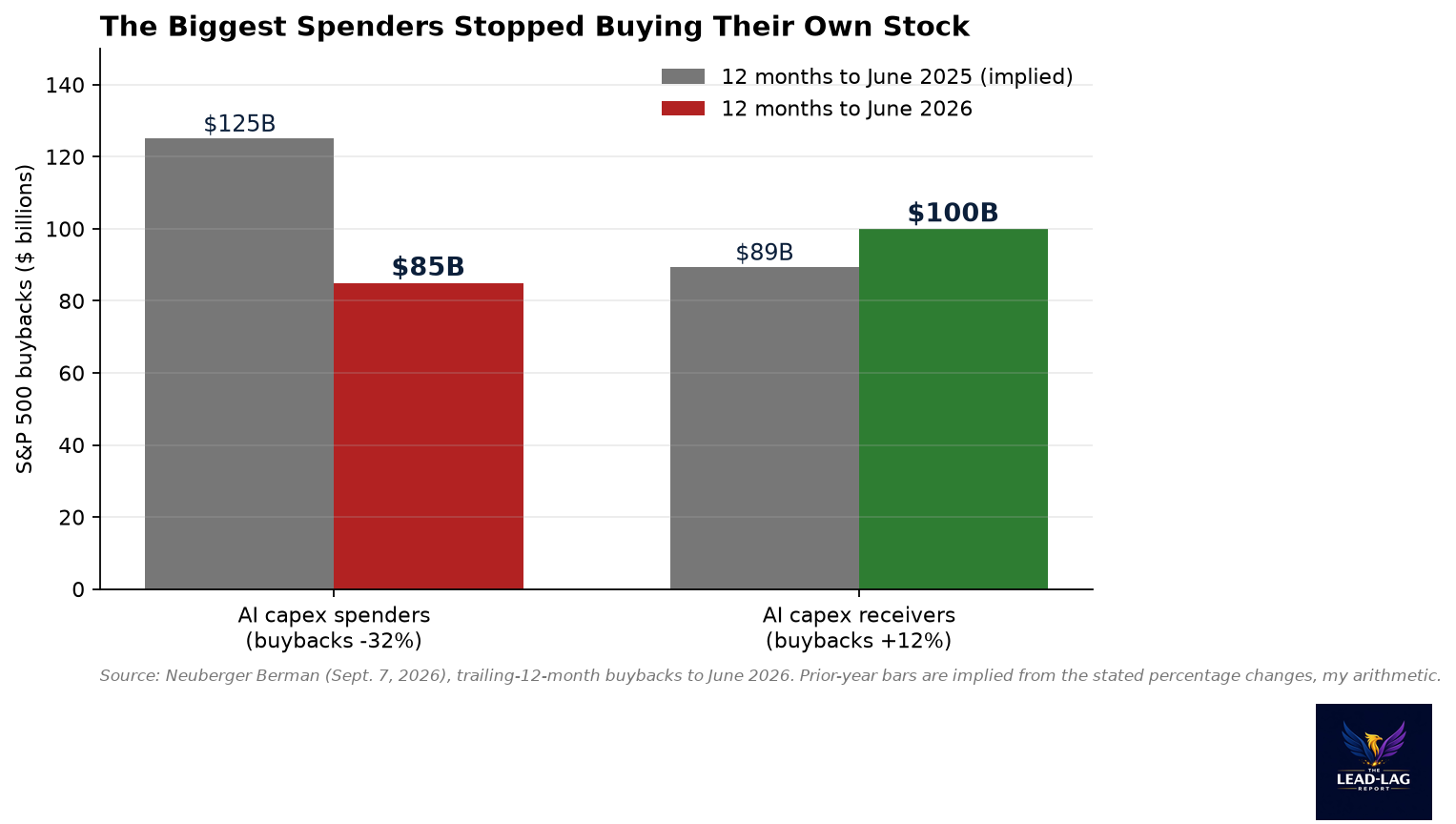
- S&P 500 buybacks hit a record $1.10 trillion in the 12 months to June 2026, but the group Neuberger Berman calls AI capex spenders cut theirs 32% to $85 billion, while AI capex receivers raised theirs 12% to $100 billion.[1]
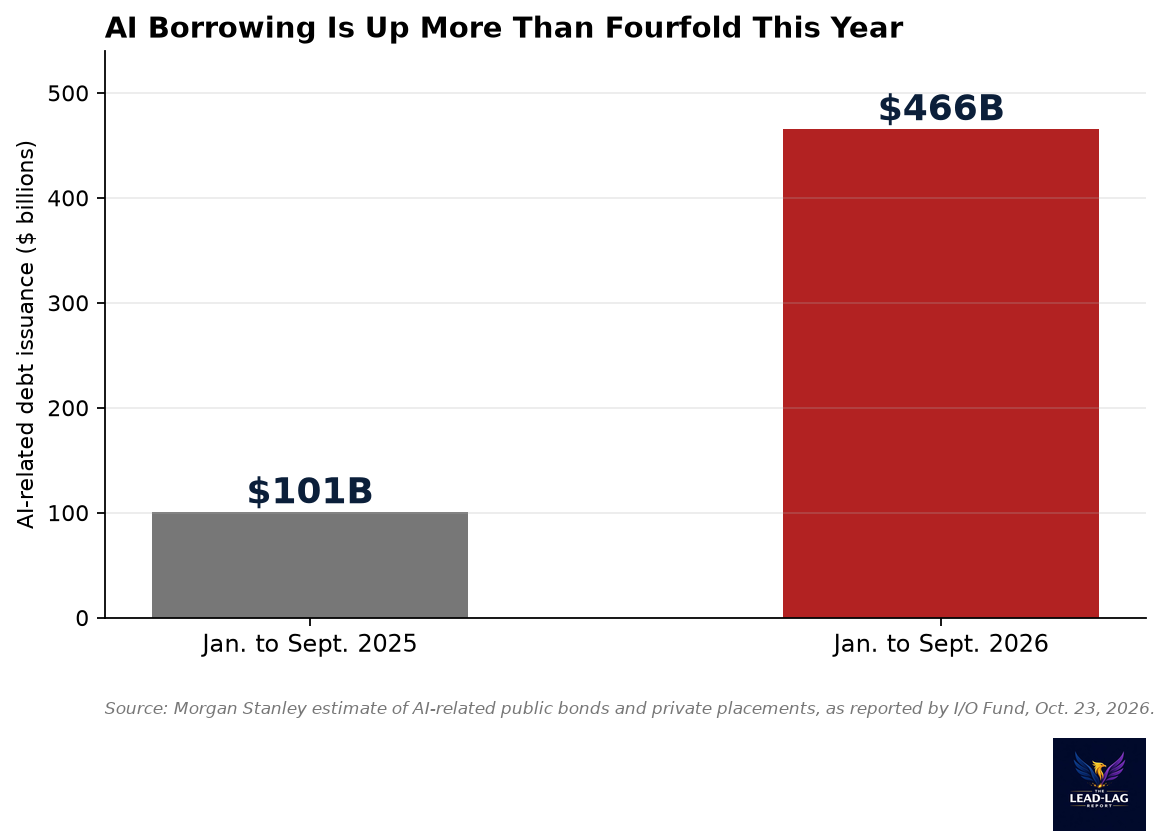
- Morgan Stanley estimates AI-related debt issuance reached $466 billion through September 2026, more than four times the $101 billion raised in the same period of 2025.[2]
- The IMF says Alphabet, Amazon, Meta, Microsoft and Oracle accounted for almost 10% of global investment-grade bond issuance in 2026, up from 0.5% in 2024.[2]
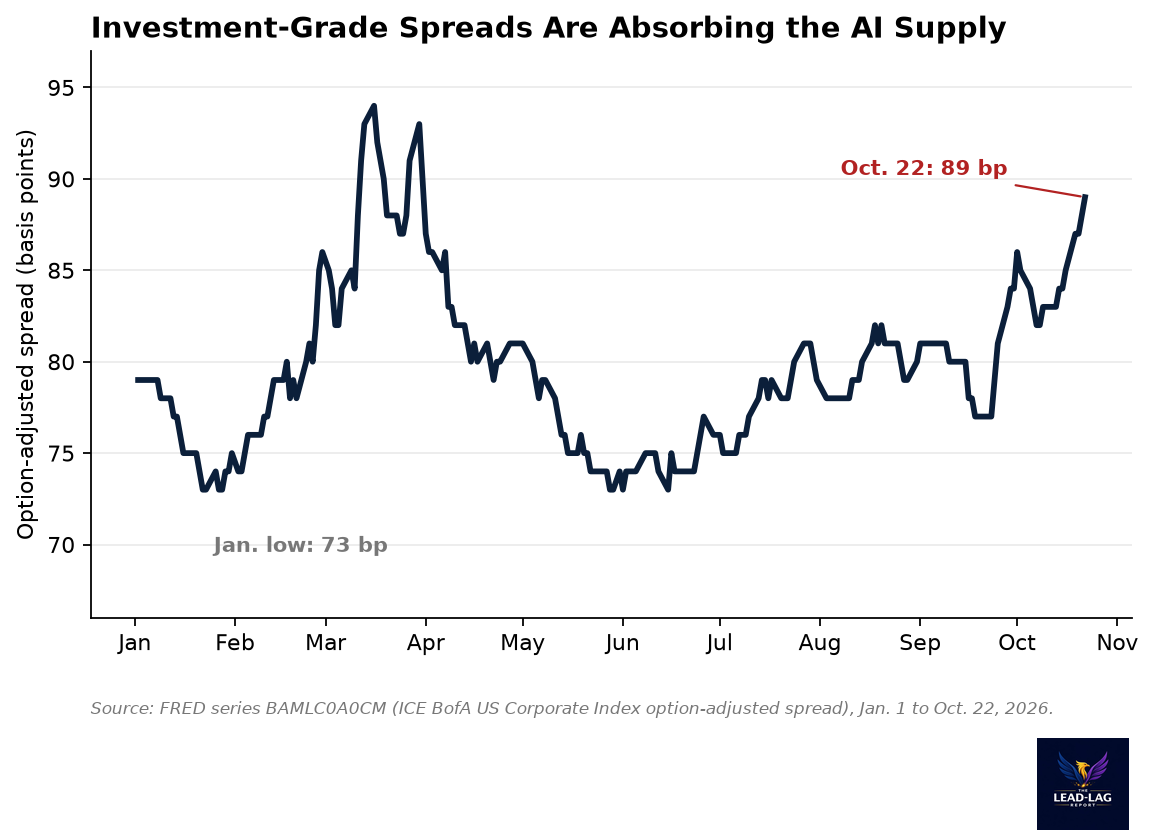
- The ICE BofA US Corporate Index spread widened to 0.89% on October 22, from 0.73% in January and its widest since March 31. A Bloomberg global corporate index reached 129 basis points, its widest since May 2025.[4][3]
- CoreWeave's five-year credit default swap spread passed 1,100 basis points in mid-October and some of its bonds trade below 75 cents on the dollar.[5][6]
The Buyer That Left
Start with the headline number, because it hides the story. Total S&P 500 buybacks reached $1.10 trillion in the 12 months to June, an all-time high.[1] On its face, that looks like the bid is as strong as ever. It is not the same bid.
Neuberger Berman split the index into the companies spending heavily on AI and the companies selling to them. The spenders cut repurchases 32% to $85 billion as their capital intensity rose. The receivers lifted theirs 12% to $100 billion. Financials hit a trailing record of $287 billion, and communication services, home to two of the largest hyperscalers, posted the biggest sector decline at $53 billion.[1] J.P. Morgan Asset Management's David Kelly put the hyperscaler figure more starkly this month: their repurchase activity is down 64% from a year earlier.[7]
The aggregate tells you the same thing from the other side. Bank of America noted that S&P 500 buybacks as a share of market value fell to the lowest since late 2023 in a recent week.[7] Goldman Sachs projects S&P 500 capital spending to grow 33% in 2026 while gross buybacks grow just 3%.[8]
This matters for a simple reason. Buybacks were a price-insensitive bid concentrated in the largest stocks. They reduced share counts, lifted earnings per share and supported the names that dominate the index. When the biggest buyers redirect cash to data centers, that support weakens at the top of the market, exactly where the index is most concentrated. Neuberger Berman's own conclusion is that this means "a fading EPS tailwind at the index's largest names" and a buyer that has "become more cyclical and credit-sensitive."[1]
Where The Money Comes From Now
The spending did not slow. The funding changed. Goldman Sachs estimates that about one-third of hyperscaler capital spending in 2026 is funded with debt, and two-thirds with operating cash flow.[2] That one-third is a large number when the capex budget is this size.
Morgan Stanley estimates AI-related debt issuance, public bonds plus private placements, at $466 billion through September, against $101 billion in the first nine months of 2025. Monthly issuance peaked at $113 billion in June before slowing to $23 billion in September.[2] Barclays counts $346 billion of investment-grade debt, high-yield debt and equity raised by hyperscalers, data center vehicles and neo-clouds so far in 2026, up from $172 billion in all of 2025.[9]
The deals have been enormous. Meta sold a record $30 billion bond in October, the largest investment-grade deal ever not tied to an acquisition.[10] Alphabet sold a 100-year sterling bond in February.[10] And this week Meta said it is looking at raising "hundreds of billions of dollars" over several years, beginning this fall, according to Bloomberg.[3] The IMF's October Global Financial Stability Report puts the five largest hyperscalers at almost 10% of all global investment-grade issuance this year, up from 0.5% in 2024.[2]
The cash flow math explains the shift. Alphabet reported negative free cash flow of $5.9 billion in the second quarter, its first negative quarter since its 2004 IPO, on capital spending of $44.9 billion.[2] Its trailing 12-month free cash flow was still $53.3 billion.[2] This is not a solvency story for the strongest names. It is a story about cash that used to go to shareholders now going to concrete, chips and power, with bondholders filling the gap.
The Credit Market Has Noticed
Supply this large has a price. The ICE BofA US Corporate Index option-adjusted spread widened to 0.89% on October 22, from a low of 0.73% on January 22, its widest since March 31.[4] Globally, corporate bond spreads hit 129 basis points on October 22, the widest since May 2025, and the cost of protecting a basket of blue-chip U.S. company debt reached its highest since March on Friday.[3]
The managers who buy this debt were explicit. "Investment-grade spreads are weaker again this morning as the market grapples with the potential scale of issuance needed to fund the AI buildout," said David Del Vecchio of PGIM Credit. "Investors have little reason to step into the void."[3] Muzinich estimates U.S. technology credit has moved from about 10 basis points tighter than the investment-grade market in September 2025 to about 15 basis points wider now.[11]
The weaker borrowers are under real stress. CoreWeave's five-year credit default swap spread passed 1,100 basis points in mid-October and the yield on its 2031 bond rose as high as 16%.[5] Bonds that fund big data center projects, including the Meta and Blue Owl Hyperion vehicle, have fallen below par, and some CoreWeave bonds have dropped below 75 cents on the dollar.[6] Oracle's five-year default swap spread was near 300 basis points.[5]
I want to be clear about scale. Investment-grade spreads at 0.89% are not a crisis. They are where they were in late March. But the direction is set by supply, and supply is set by capital spending plans that keep rising. Goldman Sachs projects hyperscaler bond issuance of about $250 billion for 2026 and $400 billion in 2027.[9]
The Money Is Starting To Circle
The newer financing structures are the part I watch most closely, because they blur the line between supplier and lender. The IMF's report highlighted 14 circular financing arrangements across the broader GPU ecosystem.[2] Broadcom is reportedly arranging more than $50 billion of private credit so OpenAI can finance custom silicon purchases, and in a similar Anthropic financing it reportedly guarantees up to $42 billion of senior notes, paying only if the borrower defaults and the chips' resale value falls below a set level.[2] Nvidia CEO Jensen Huang has said the company retains the option to backstop up to $125 billion across its financing structures.[2]
When the company selling the chips also guarantees the debt that pays for them, the customer's credit risk becomes the supplier's earnings risk. That does not make the arrangements improper. It does mean the line between the AI receivers, who are still raising buybacks, and the AI spenders, who are cutting them, is thinner than the buyback data suggests.
Oracle shows how quickly leverage builds at a company that is spending ahead of its cash flow. It ended its fiscal first quarter with $125.3 billion of notes payable and borrowings against $37.1 billion of cash and securities, and quarterly interest expense of $1.43 billion, up 55% from a year earlier and more than 7% of revenue.[2] It also has $288 billion of data center leases that have not yet started, with terms of 15 to 19 years.[2] Those obligations arrive on the balance sheet as the leases begin.
The receivers are the other half of the story. Technology sector buybacks hit a record $301 billion in the 12 months to June, and at least three-quarters of that sector's increase came from companies outside both AI groups.[1] The buyback bid has not disappeared. It has moved down the index and across sectors, toward the banks and the companies that are collecting the capex rather than paying it.
Why Equity Investors Should Care
An S&P 500 investor might think this is a bond market story. I think it is the most important equity story of the year, for three reasons.
First, the marginal buyer of the largest stocks has changed. When the hyperscalers bought back their own shares, they provided a steady bid regardless of the macro backdrop. Now that cash goes to capital spending, and the incremental support for those stocks has to come from outside investors, who are more sensitive to price, rates and sentiment. Last week showed what that looks like: the Nasdaq 100 fell 2.9% in a single day on October 22.[12]
Second, the cost of capital for the AI build is now visible in real time. Every new deal tests demand, and every widening in spreads raises the hurdle the investment has to clear. Equity holders own the residual. If the return on all that capex disappoints, bondholders are paid first.
Third, it changes what diversification means inside the index. Neuberger Berman's read is that broader buyback support further down the market "favours a more equal-weighted approach."[1] I do not tell anyone what to own. But it is a fact that the buyback bid has moved from the very top of the index to the companies selling picks and shovels, the banks and the rest of the market.
The Other Side Of The Argument
The bull case deserves a fair hearing. The strongest borrowers are AA-rated with enormous cash flows, and Goldman Sachs estimates the hyperscalers could borrow another $2 trillion while keeping investment-grade ratings.[2] Meta's April deal drew $96 billion of peak orders for $25 billion of bonds.[13] Demand has been there every time it has been tested. And debt is cheaper than equity for a company with a strong balance sheet, so shifting from buybacks to borrowing can be a rational choice, not a desperate one.
I accept all of that. The concern is not that Alphabet cannot pay its bonds. It is that the index's largest companies are now the biggest issuers in the bond market at the same time the Treasury is borrowing heavily and the Federal Reserve has started hiking. Deutsche Bank warned in September that AI issuance would weigh more on U.S. investment-grade spreads than European ones, precisely because it competes with government borrowing for the same buyers.[14] That is a crowding problem, and it shows up in spreads before it shows up anywhere else.
The rate backdrop makes the crowding harder to ignore. The Fed raised its target range to 3.75% to 4.00% in September, and the 10-year Treasury yield was above 5% for most of October before falling to 4.972% on October 22.[15][16] Every hyperscaler bond is priced as a spread over that Treasury yield. When both the base rate and the spread rise together, the all-in cost of funding the AI build rises twice.
What Would Change My View
- Spreads tighten on new supply. If the next large hyperscaler deal prices and investment-grade spreads move back toward 0.80%, demand is deeper than I think.[4]
- Buybacks come back at the top. If the spenders' repurchases stabilize in the third-quarter data, the cash flow squeeze is easing.[1]
- Capex guidance gets cut. A credible slowdown in 2027 spending plans would reduce future supply and likely tighten spreads quickly, though it would hurt the receivers.
- Stress stays contained. If CoreWeave and the data center vehicles stabilize without spreading to the stronger names, the credit move is a repricing of weak borrowers, not of the build itself.[5][6]
The index spent a decade buying itself. It now borrows to build. The bond market decides the price of that bet before the stock market does.
Few understand this.
— — —
Notes
- [1] S&P 500 buybacks $1.10 trillion in the 12 months to June 2026; AI capex spenders -32% to $85B, receivers +12% to $100B; financials $287B; tech $301B: Neuberger Berman, Sept. 7, 2026.
- [2] Morgan Stanley AI debt estimates; IMF GFSR hyperscaler share of IG issuance; Goldman funding mix and borrowing capacity; Alphabet, Oracle, Broadcom and Nvidia financing figures: I/O Fund, Oct. 23, 2026.
- [3] Global corporate spreads at 129 basis points, widest since May 2025; Meta "hundreds of billions"; PGIM Del Vecchio quote: Bloomberg via Financial Advisor, Oct. 23, 2026.
- [4] ICE BofA US Corporate Index option-adjusted spread (BAMLC0A0CM): FRED.
- [5] CoreWeave five-year CDS above 1,100 basis points; 2031 bond yield up to 16%; Oracle CDS near 300: Charlotte Observer, Oct. 16, 2026.
- [6] Data center bonds below par; Hyperion near 91 cents; CoreWeave bonds below 75 cents: Financial Times via Yahoo Finance.
- [7] J.P. Morgan AM David Kelly: hyperscaler repurchases down 64% year over year; BofA buybacks as share of market cap lowest since late 2023: Interactive Brokers Traders Insight.
- [8] Goldman Sachs: S&P 500 capex +33% in 2026, gross buybacks +3%: Yahoo Finance, Oct. 2, 2026.
- [9] Barclays: $346 billion raised by hyperscalers, data center vehicles and neo-clouds in 2026; Goldman hyperscaler issuance $250B in 2026, $400B in 2027: Yahoo Finance, Oct. 24, 2026.
- [10] Meta record $30 billion non-acquisition bond; Alphabet 100-year sterling bond: Mawer Investment Management.
- [11] U.S. technology credit moved from about 10 bp tighter to 15 bp wider than IG: Muzinich & Co..
- [12] S&P 500 and Nasdaq 100 moves, Treasury haven status, fading Fed hike bets, spot gold: Bloomberg markets wrap via Swissinfo, October 22, 2026.
- [13] Meta $25 billion bond drew $96 billion of peak orders: Startup Fortune.
- [14] Deutsche Bank: AI issuance to weigh more on U.S. IG spreads than European: TokenPost, Oct. 23, 2026.
- [15] FOMC statement, Sept. 16, 2026: 25 basis point hike to 3.75% to 4.00%, 12 to 0 vote: Federal Reserve Board.
- [16] 10-year yield move, record one-day drop since March 2023, oil settlements and AI issuance comments: CNBC, October 22, 2026.