The First Hike Since 2023 Just Landed. The Nasdaq's Volatility Market Hasn't Repriced Yet. TDAX Seeks 130% of TDAQ's Daily Performance — With Weekly Distributions.
How TDAX, the TDAQ LIFT ETF, provides daily leveraged exposure to TappAlpha's Nasdaq-100 daily covered call strategy into a hiking cycle — and what a daily leveraged fund requires of the investor who uses it.

TDAX seeks daily leveraged investment results and is intended to be used as a short-term trading vehicle. It does not seek to achieve its stated investment objective over a period of time greater than a single trading day. It is not suitable for all investors and is intended for knowledgeable investors who understand the risks of daily leveraged investing and who actively monitor and manage their positions.
Key Highlights
- The Federal Open Market Committee (FOMC) raised the target range for the federal funds rate by a quarter point to 3.75–4.00% on September 16, 2026 — the first increase since 2023 — on a 12-0 vote. The Consumer Price Index (CPI) rose 0.4% in August 2026, with the gasoline index up 3.9%, according to the Bureau of Labor Statistics.
- The 10-year Treasury yield closed at 5.28% on October 2, 2026, up roughly half a percentage point in a month.
- The Cboe Volatility Index (VIX) closed at 16.39 on October 1, 2026, essentially unchanged from its September 30 close of 16.34, despite the hike. It is not possible to invest directly in an index.
- The TappAlpha Innovation 100 Growth & Daily Income ETF (TDAQ) holds Nasdaq-100 exposure and writes zero-days-to-expiration (0DTE) call options on that exposure each trading day. TDAQ now holds its underlying companies directly rather than through an index ETF, which lowered its total expense ratio from 0.83% to 0.68%. TDAQ commenced operations on September 4, 2025.
- TDAX — the TDAQ LIFT ETF, part of the T² Lift™ Series co-launched with Tuttle Capital Management — commenced operations on January 7, 2026. It seeks daily investment results, before fees and expenses, of 130% of the daily performance of TDAQ. TDAX does not run its own options strategy. It now holds TDAQ shares directly and uses swap agreements for the remaining exposure. Its total expense ratio is 0.98%.
- TDAX is designed to make distributions weekly. Net assets were $73.5 million as of October 15, 2026.
- The next scheduled FOMC meeting is October 27–28, 2026.
TDAX Distribution Rate: 18.56% (as of 9/30/26)
TDAX 30-Day SEC Yield: 1.50% (as of 9/30/26)
Standardized performance: TDAX: https://www.tappalphafunds.com/etfs/tdax | TDAQ: https://www.tappalphafunds.com/etfs/tdaq
Click here for the TDAX prospectus: https://docs.tappalphafunds.com/TDAX/prospectus.pdf
The performance data quoted represents past performance. Past performance does not guarantee future results. The investment return and principal value of an investment will fluctuate so that an investor's shares, when sold or redeemed, may be worth more or less than their original cost and current performance may be lower or higher than the performance quoted. Performance current to the most recent month-end can be obtained above. Returns less than one year are not annualized.
Short term performance, in particular, is not a good indication of the fund's future performance, and an investment should not be made based solely on returns. The Fund does not have a track record of reporting to investors or widely available research coverage which may result in price volatility.
There is no guarantee that the fund will pay distributions in the future, if any, and may vary from the current distribution.
The Hike the Tech Trade Hasn't Priced
The Fed's September 16 hike was the first in roughly three years. It was unanimous. The Committee's statement noted that inflation remains elevated, and its accompanying projections pointed to the possibility of one more increase before year-end.
Since that decision, two things have happened. The bond market tightened further — the 10-year yield closed at 5.28% on October 2, up roughly half a point in a month. And the equity market, including the rate-sensitive Nasdaq-100, has largely absorbed the move, with the VIX closing October 1 at 16.39, essentially unchanged from its September 30 close of 16.34.
That is the gap this article describes: a central bank that has started hiking, a rates market repricing quickly, and an equity volatility market still priced for relative calm. In our view, that gap tends to resolve one of two ways — the calm proves justified and option premium continues to be available at a compressed level, or volatility reprices and short-dated options become more expensive. We believe both outcomes can be constructive for a daily covered call strategy on the Nasdaq-100, though neither guarantees a positive result, and a sharp decline in the Nasdaq-100 would reduce the value of TDAQ — and, by a larger amount, TDAX.
The Strategy, and the Daily Leveraged Fund Built On It
TDAQ applies the same daily covered call approach as TappAlpha's S&P 500 fund to the Nasdaq-100: hold the index exposure, write out-of-the-money calls each morning that expire at that session's close, collect the premium, and reset the next trading day. As of this month, TDAQ holds its underlying companies directly rather than through an index ETF — same strategy, same management fee, with the underlying ETF's layer of expenses removed.
TDAX does not run a separate strategy and does not execute TDAQ's covered call program itself. It seeks 130% of TDAQ's daily performance, before fees and expenses, resetting its exposure each trading day. TDAQ's daily performance reflects both the movement of its Nasdaq-100 holdings and the results of its options overlay, so TDAX's daily result — positive or negative — is designed to be approximately 1.3 times TDAQ's for that day.
TDAX now owns TDAQ shares directly and uses swap agreements with dealers for a smaller portion of its exposure. Swap financing creates costs that reduce shareholder returns even though they are not included in the total expense ratio. By relying less on swap financing, TDAX has the potential to reduce that drag. Its investment objective, ticker and weekly distribution schedule are unchanged.
The mechanics of a daily-reset leveraged ETF must be understood before use. TDAX is a short-term trading vehicle, not a buy-and-hold allocation. Its performance over periods longer than one trading day will differ — in amount and possibly in direction — from 130% of TDAQ's performance over the same period, and higher volatility and longer holding periods can increase those differences. TDAX can lose money over a multi-day period even if TDAQ's performance is flat or positive. Leverage magnifies losses as well as gains: in a sharp Nasdaq-100 selloff on a hawkish surprise, a daily leveraged fund magnifies the decline. Investors should monitor positions daily.
Why consider a modest daily leverage factor in this setup? The VIX at 16.39 suggests the options market is pricing relatively little turbulence through the October 27–28 FOMC. In our view, a Fed that just hiked unanimously, with inflation still elevated, is a live candidate to surprise. If short-dated volatility reprices higher, TDAQ's strategy would write at the new premium level the next trading morning. For a knowledgeable, actively engaged investor with a short-term view, TDAX is one way to express that view with 130% daily exposure to TDAQ — accepting that the same leverage applies to every down day as well.
Weekly Distributions
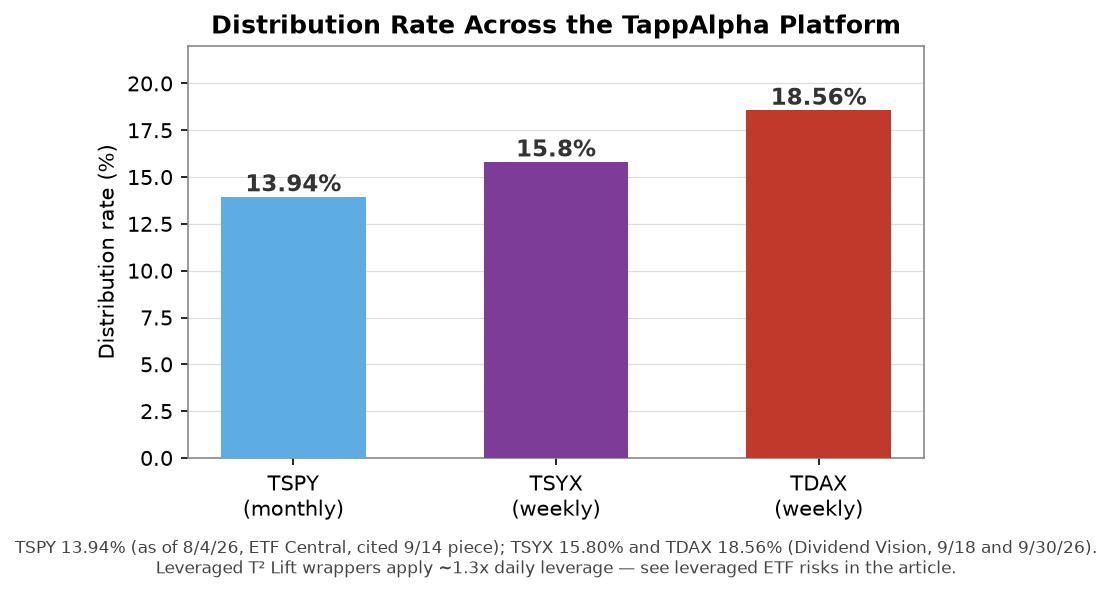
TDAX has made weekly distributions since its January 7, 2026 launch. Its distribution rate was 18.56% as of September 30, 2026. Past distributions are not indicative of future distributions. Distributions may include return of capital, which reduces an investor's cost basis and may decrease the Fund's NAV and trading price over time.
Weekly distributions describe the Fund's cash-flow schedule. They do not change the nature of the Fund: TDAX remains a daily leveraged product intended for short-term use by investors who monitor their positions daily, and it is not designed to fund a long-term income need.
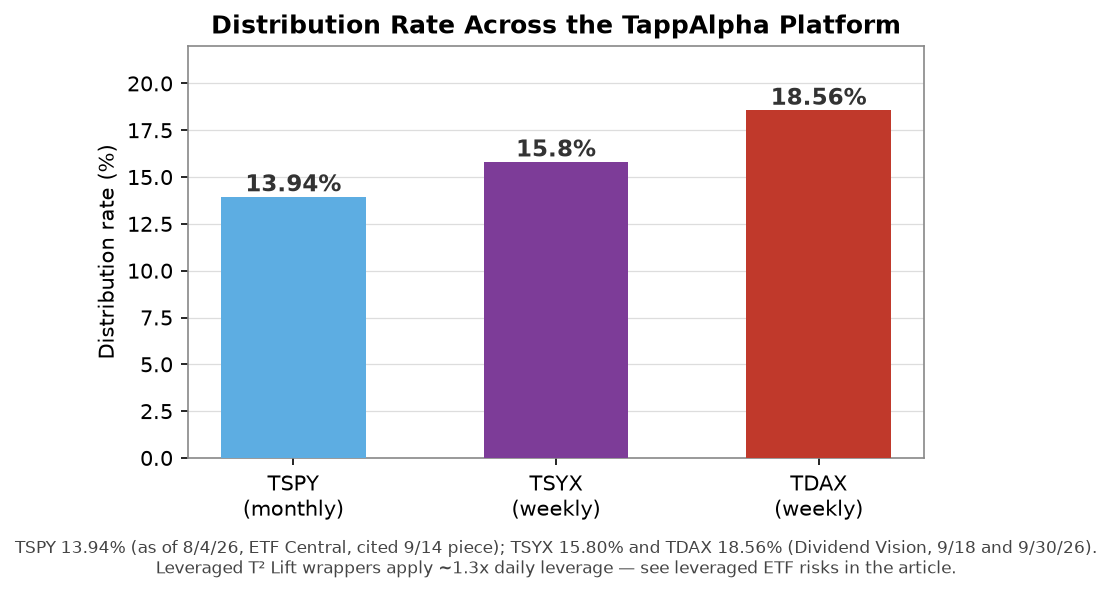
Figure 1. Distribution rates for TSPY (monthly distributions), TSYX and TDAX (weekly distributions). As-of dates differ by fund: TSPY 13.94% as of August 4, 2026; TSYX 15.80% as of September 18, 2026; TDAX 18.56% as of September 30, 2026. TSPY's distribution rate was 13.93% as of October 6, 2026. TSYX and TDAX are daily leveraged funds that seek 130% of the daily performance of TSPY and TDAQ respectively; higher distribution rates reflect leverage and carry greater risk, and the funds are not directly comparable to TSPY. There is no guarantee that the fund will pay distributions in the future, if any, and may vary from the current distribution. Sources: ETF Central; Dividend Vision; TappAlpha fund pages.
TSPY 30-Day SEC Yield: 0.38% (as of 9/30/26) | TSYX 30-Day SEC Yield: 1.78% (as of 9/30/26)
Standardized performance: TSPY: https://www.tappalphafunds.com/etfs/tspy | TSYX: https://www.tappalphafunds.com/etfs/tsyx
Click here for the TSPY prospectus: https://docs.tappalphafunds.com/TSPY/prospectus.pdf | TSYX prospectus: https://docs.tappalphafunds.com/TSYX/prospectus.pdf
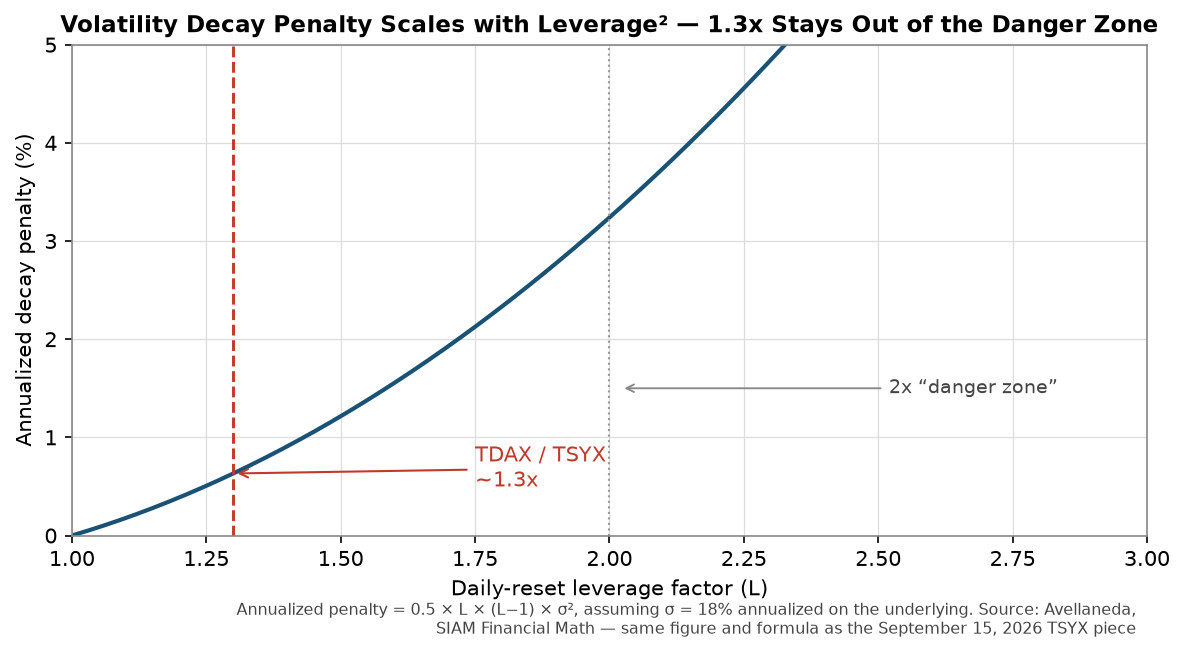
Figure 2. Illustrative volatility decay across daily-reset leverage factors, using the approximation 0.5 × L × (L − 1) × σ², where L is the leverage factor and σ is the annualized volatility of the reference asset (18% assumed). Hypothetical and illustrative only; not fund performance and not a prediction of any fund's results. Actual compounding effects depend on the path of returns and may be materially larger in volatile markets, and a lower leverage factor does not eliminate the risk of loss. Source: Avellaneda and Zhang, "Path-Dependence of Leveraged ETF Returns," SIAM Journal on Financial Mathematics (2010); same figure as the September 15, 2026 TSYX piece.
The Trade-Offs You Need To Understand
Daily leverage and compounding. TDAX seeks 130% of TDAQ's performance for a single day only. Over longer periods, compounding can cause returns to differ significantly from 130% of TDAQ's return. If TDAQ declines by approximately 77% or more in a single trading day, TDAX could lose substantially all of its value for that day.
Upside is capped at the TDAQ level. TDAQ's daily covered call strategy gives up the portion of any session's rally above the strike on the written exposure. TDAX inherits that limit.
Downside is not capped — and it is amplified. Option premium may offset part of a decline in TDAQ; it does not eliminate it, and TDAX magnifies TDAQ's daily losses.
Swap and counterparty risk. TDAX uses swap agreements for part of its exposure. These involve financing costs, counterparty risk and the risk they may not perform as expected. Financing costs may rise in a rising-rate environment.
Distribution rate is not yield. Option premium is generally not captured in the 30-day SEC yield, which is why the two figures can differ widely.
The tax character is not simple. Distributions may include return of capital. The final tax character is determined after year end.
The Setup Into October 27–28
Where the market stood as of early October 2026:
- Fed funds at 3.75–4.00%, raised September 16 on a 12-0 vote, with projections pointing to the possibility of one more increase this year.
- 10-year Treasury at 5.28% (October 2).
- VIX at 16.39 (October 1) — essentially unchanged since before the hike.
- August CPI +0.4% on the month; gasoline index +3.9%.
- TDAQ: now holds its underlying companies directly; total expense ratio 0.68%.
- TDAX: 18.56% distribution rate (September 30, 2026) and $73.5 million in net assets (October 15, 2026); weekly distributions since January 7, 2026; now holds TDAQ shares directly.
- Next FOMC meeting: October 27–28.
For a knowledgeable investor who wants short-term, amplified exposure to TappAlpha's Nasdaq-100 daily covered call strategy into that specific setup — and who understands daily-reset mechanics, monitors positions daily, and accepts that leverage magnifies losses — TDAX seeks 130% of TDAQ's daily performance, with weekly distributions.
The Fed ended the three-year wait. In our view, the volatility market has not fully reflected it yet. If and when it does, TDAQ's strategy is designed to re-strike at the new level the next trading morning — and TDAX seeks 130% of whatever that day brings, in either direction.
Disclosure
This content is sponsored by TappAlpha. The Lead-Lag Report has been compensated for the publication of this material. The views and opinions expressed herein are those of the author and do not necessarily reflect the views of TappAlpha or its affiliates.
This material is for informational and educational purposes only and should not be construed as investment advice or a recommendation to buy, sell, or hold any securities, including TDAX or TDAQ.
The Fund currently expects, but does not guarantee, to make distributions on a weekly basis. If the Fund does make distributions, the amounts of such distributions will likely vary greatly from one distribution to the next. These distributions may exceed the Fund's income and gains for the Fund's taxable year. Distributions in excess of the Fund's current and accumulated earnings and profits will be treated as a return of capital. Weekly distributions, if any, may consist of returns of capital, which would decrease the Fund's NAV and trading price over time. As a result, an investor may suffer significant losses to their investment. There is no guarantee that the fund will pay distributions in the future, if any, and may vary from the current distribution.
Return of capital reduces an investor's tax basis and may result in a higher capital gain or lower capital loss when shares are sold. The final tax character of distributions is determined after year end. While TDAQ's adviser intends to manage TDAQ in a tax-efficient manner, there can be no assurance that it will do so or that TDAX shareholders will realize any tax benefits. Prospective investors should not invest in the Fund with an expectation that they will realize any tax benefits. Nothing in this communication constitutes tax advice. Investors are urged and advised to consult their own tax adviser with respect to the tax consequences of an investment in the Fund.
INVESTORS SHOULD CAREFULLY CONSIDER THE INVESTMENT OBJECTIVES, RISKS, CHARGES AND EXPENSES OF THE ETFs IDENTIFIED ON THIS SITE. THIS AND OTHER IMPORTANT INFORMATION ABOUT THE FUND ARE CONTAINED IN THE PROSPECTUS, WHICH CAN BE OBTAINED ON THIS SITE OR BY CALLING (844) 403-2888. THE PROSPECTUS SHOULD BE READ CAREFULLY BEFORE INVESTING.
Please click here for the prospectus: https://docs.tappalphafunds.com/TDAX/prospectus.pdf. Information on TDAQ, the Fund's reference asset, is available at https://www.tappalphafunds.com/etfs/tdaq.
The performance data quoted represents past performance. Past performance does not guarantee future results. The investment return and principal value of an investment will fluctuate so that an investor's shares, when sold or redeemed, may be worth more or less than their original cost and current performance may be lower or higher than the performance quoted. Performance current to the most recent month-end can be obtained above. Returns less than one year are not annualized.
Short term performance, in particular, is not a good indication of the fund's future performance, and an investment should not be made based solely on returns. The Fund does not have a track record of reporting to investors or widely available research coverage which may result in price volatility.
Market performance is the price at which shares in the ETF can be bought or sold on the exchanges during trading hours, while the net asset value (NAV) represents the value of each share's portion of the fund's underlying assets and cash at the end of the trading day.
Click here for standardized performance: https://www.tappalphafunds.com/etfs/tdax
TDAX seeks daily investment results, before fees and expenses, of 130% of the daily performance of TDAQ. The Fund does not seek to achieve this objective over periods other than a single trading day. Due to daily compounding, returns over longer periods may differ significantly from 130% of TDAQ's return for the same period. Higher volatility and longer holding periods can increase these differences. Leverage magnifies losses as well as gains. For periods longer than a single day, the Fund will lose money if TDAQ's performance is flat, and it is possible that the Fund will lose money even if TDAQ's performance increases over a period longer than a single day. Investors should monitor their Fund holdings on a daily basis.
The Fund is not suitable for all investors. It is intended for knowledgeable investors who understand the risks of seeking daily leveraged (1.3X) investment results and who actively monitor and manage their investments. The Fund is not intended to be used by, and is not appropriate for, investors who do not intend to actively monitor and manage their portfolios.
Leverage Risk. The Fund obtains investment exposure in excess of its net assets by utilizing leverage and may lose more money in market conditions that are adverse to its investment objective than a fund that does not utilize leverage. An investment in the Fund will be reduced by an amount equal to 1.3% for every 1% daily decline in TDAQ, not including the costs of financing leverage and other operating expenses, which would further reduce its value. If TDAQ declines by approximately 77% or more in a single trading day, the Fund could experience a total loss of its value for that day. The cost of maintaining leveraged exposure (e.g., swap financing, collateral and related fees) may increase, particularly in rising interest rate environments, which can adversely affect performance.
Rebalancing Risk. If for any reason the Fund is unable to rebalance all or a part of its portfolio, or if all or a portion of the portfolio is rebalanced incorrectly, the Fund's investment exposure may not be consistent with its investment objective. Intraday market movements may cause the Fund's actual exposure to drift from 130% between rebalancing times.
The Fund holds TDAQ shares directly and uses swap agreements with dealers to obtain additional exposure to TDAQ. These agreements involve financing costs, counterparty risk and the risk that they may not perform as expected. A counterparty's failure to meet its obligations could result in losses to the Fund. TDAX bears its proportionate share of TDAQ's expenses on the TDAQ shares it holds. A contractual management fee waiver offsets those acquired fund expenses, as described in the Fund's prospectus. The waiver remains in effect for at least one year; without the waiver, total annual fund operating expenses would be higher. Swap financing costs are separate from total annual fund operating expenses and reduce the Fund's returns.
TDAX is exposed to the investment risks of TDAQ. TDAQ's daily covered call strategy may limit participation in market gains, and option income may not offset losses from declines in its underlying investments. TDAX does not independently execute TDAQ's covered call strategy. TDAQ invests in options contracts based on the value of the Nasdaq-100 Index, including NDX options. Through its exposure to TDAQ, TDAX is subject to risks associated with declines in the Index and TDAQ's options strategy. TDAQ may incur high portfolio turnover in managing its investment exposure.
Due to the short time until expiration, 0DTE options are particularly sensitive to sudden price movements and market volatility. Execution delays, limited liquidity and wider bid-ask spreads may increase transaction costs and negatively affect TDAQ's performance and, consequently, TDAX's performance.
Investing in securities involves risk, including the potential loss of principal. The Fund may not achieve its investment objective. The Fund is classified as "non-diversified" under the Investment Company Act of 1940 and may be more sensitive to losses in particular investments than a diversified fund. The Fund has a limited operating history and currently has fewer assets than larger funds. Like other new funds, large inflows and outflows may impact the Fund's market exposure for limited periods of time.
ETFs are subject to additional risks that do not apply to conventional mutual funds. Shares may trade at a premium or discount to net asset value, an active secondary market may not develop or be maintained, and trading may be halted. ETF shares are bought and sold at market price, not NAV, and are not individually redeemed from the Fund. Brokerage commissions reduce returns.
Nasdaq-100® and NDX® are trademarks of Nasdaq, Inc. TDAX is not sponsored, endorsed, sold or promoted by Nasdaq, Inc. or its affiliates.
Distributor: Foreside Fund Services, LLC, Member FINRA.
Definitions
The following plain-language definitions are provided for terms used above, in alphabetical order. They are general descriptions and are not part of the Fund's offering documents.
0DTE (zero-days-to-expiration) options — Options contracts that expire on the same trading day they are written. Because they expire within hours, they carry the fastest rate of time decay and are highly sensitive to intraday price movements.
10-year Treasury yield — The market yield on U.S. Treasury securities at a ten-year constant maturity. It is the benchmark nominal interest rate for long-dated U.S. government debt and moves inversely to the price of those bonds.
30-Day SEC Yield — A standardized yield calculation reflecting dividends and interest earned during the period after deduction of the fund's expenses. Also referred to as the standardized yield.
Compounding — The effect of applying each day's return to the prior day's value. In a daily-reset leveraged fund, compounding causes multi-day returns to differ from the stated multiple of the reference asset's multi-day return.
Consumer Price Index (CPI) — A measure published monthly by the U.S. Bureau of Labor Statistics that tracks the average change over time in the prices paid by urban consumers for a market basket of consumer goods and services. It is a widely used indicator of inflation.
Covered call — An options strategy in which an investor holds an underlying security and sells call options against that position. The strategy generates option premium but may limit participation in gains above the options' strike price. The premium received may provide limited downside protection but does not protect against a significant decline.
Distribution rate — The annualized rate an investor would receive if the most recent fund distribution remained the same going forward. It is calculated by annualizing the Fund's most recent distribution (weekly for TSYX and TDAX; monthly for TSPY) and dividing that annualized amount by the Fund's net asset value per share as of the stated date. It reflects a single distribution annualized. It is not a trailing 12-month figure, it is not a total return, and it is not a projection. For a weekly-distributing fund, the rate changes with each distribution. There is no guarantee that the fund will pay distributions in the future, if any, and may vary from the current distribution.
FOMC (Federal Open Market Committee) — The Federal Reserve committee that sets U.S. monetary policy, including the target federal funds rate. It holds eight regularly scheduled meetings a year.
Nasdaq-100® Index — A widely recognized benchmark index that includes 100 of the largest domestic and international non-financial companies listed on the Nasdaq Stock Market based on market capitalization, with a notable concentration in technology-related sectors. It is not possible to invest directly in an index.
Return of capital — The portion of a distribution that exceeds a fund's current and accumulated earnings and profits. It reduces an investor's cost basis rather than representing investment income.
Swap agreement — A contract in which two parties exchange the returns of a reference asset for a financing payment. TDAX uses swaps with dealers to obtain part of its exposure to TDAQ.
T² Lift™ Series — TappAlpha's series of daily-reset leveraged ETFs, co-launched with Tuttle Capital Management, which seek 130% of the daily performance of a TappAlpha reference fund. TSYX (referencing TSPY) and TDAX (referencing TDAQ) are the current members of the series.
VIX (Cboe Volatility Index) — A real-time index measuring the market's expectation of 30-day forward-looking volatility of the S&P 500 Index, derived from the prices of S&P 500 Index options, commonly referred to as the market's "fear gauge." A lower reading generally indicates that options are pricing in less expected volatility. It is not possible to invest directly in an index.
DISCLAIMER – PLEASE READ: This is a sponsored article for which Lead-Lag Publishing, LLC has been paid a fee. Lead-Lag Publishing, LLC does not guarantee the accuracy or completeness of the information provided in the article or make any representation as to its quality. All statements and expressions provided in this article are the sole opinion of TappAlpha and Lead-Lag Publishing, LLC expressly disclaims any responsibility for action taken in connection with the information provided in the discussion. The content in this writing is for informational purposes only. You should not construe any information or other material as investment, financial, tax, or other advice. A participant may have taken or recommended any investment position discussed, but may close such position or alter its recommendation at any time without notice. Nothing contained in this article constitutes a solicitation, recommendation, endorsement, or offer to buy or sell any securities or other financial instruments in any jurisdiction. Please consult your own investment or financial advisor for advice related to all investment decisions.
Footnotes / Sources
1. Board of Governors of the Federal Reserve System, "Federal Reserve issues FOMC statement," September 16, 2026 — target range raised by 1/4 percentage point to 3-3/4 to 4 percent, approved by a 12-0 vote. https://www.federalreserve.gov/newsevents/pressreleases/monetary20260916a.htm 2. Board of Governors of the Federal Reserve System, Summary of Economic Projections, September 16, 2026; 2026 FOMC meeting calendar (October 27–28). https://www.federalreserve.gov/monetarypolicy/fomccalendars.htm 3. U.S. Bureau of Labor Statistics, "Consumer Price Index Summary," August 2026 — all items up 0.4% seasonally adjusted; gasoline index up 3.9%. https://www.bls.gov/news.release/cpi.nr0.htm 4. Federal Reserve Bank of St. Louis (FRED), Market Yield on U.S. Treasury Securities at 10-Year Constant Maturity (DGS10), observation for October 2, 2026 — 5.28%; one-month change computed from the same series. https://fred.stlouisfed.org/series/DGS10 5. Federal Reserve Bank of St. Louis (FRED), CBOE Volatility Index: VIX (VIXCLS), observations for September 30, 2026 (16.34) and October 1, 2026 (16.39). https://fred.stlouisfed.org/series/VIXCLS 6. TappAlpha, TDAQ Fund Page and October 2026 shareholder communication — direct ownership of underlying companies; total expense ratio reduced from 0.83% to 0.68%; inception September 4, 2025. https://www.tappalphafunds.com/etfs/tdaq 7. TappAlpha, TDAX Fund Page — investment objective; inception January 7, 2026; total expense ratio 0.98%; weekly distribution frequency; distribution rate 18.56% and 30-Day SEC Yield 1.50% as of September 30, 2026; net assets $73.5 million as of October 15, 2026; direct holding of TDAQ shares with swap agreements for additional exposure. https://www.tappalphafunds.com/etfs/tdax 8. TappAlpha, TSPY and TSYX Fund Pages — distribution history and rates (TSPY 13.93% as of October 6, 2026); 30-Day SEC Yields as of September 30, 2026 (TSPY 0.38%; TSYX 1.78%); standardized performance; prospectuses. https://www.tappalphafunds.com/etfs/tspy | https://www.tappalphafunds.com/etfs/tsyx 9. TappAlpha, TDAX Prospectus — investment objective, principal investment strategies, principal risks, and management fee waiver. https://docs.tappalphafunds.com/TDAX/prospectus.pdf 10. Avellaneda, M. and Zhang, S., "Path-Dependence of Leveraged ETF Returns," SIAM Journal on Financial Mathematics, Vol. 1 (2010).