The SEC's 10-Q To 10-S Proposal
The Securities and Exchange Commission proposed in Release

By Michael A. Gayed, CFA
The SEC's 10-Q To 10-S Proposal
A Live Deregulatory Debate Investors Should Watch (FMKT)
KEY HIGHLIGHTS
- The Securities and Exchange Commission proposed in Release S7-2026-15 to move public company periodic reporting from a quarterly (10-Q) to a semiannual (10-S) cadence, with the public comment period closing on 7/6/2026.[1][2]
- The proposal drew significant public engagement, with reporting on the order of 67,000 comment letters submitted, including a large volume of opposition from investor groups.[3]
- The Free Markets ETF (Ticker: FMKT) is designed to invest in companies that we believe stand to benefit from deregulation. A shift from 10-Q to 10-S would directly reduce the cadence and cumulative compliance cost of public company reporting.
- The outcome of the SEC's rulemaking process, including whether the proposal is finalized as proposed, revised, or withdrawn, will meaningfully shape the deregulatory narrative for financial services and for the broader listed-company universe.
The 10-Q to 10-S proposal is one of the most consequential deregulatory rulemakings the current administration has advanced, because it touches every U.S.-listed public company. The proposal is currently in the SEC's post-comment review phase after the comment window closed on 7/6/2026. It is exactly the kind of event that gives shape and specificity to the theme The Free Markets ETF (Ticker: FMKT) is designed to be positioned around.
WHAT WAS PROPOSED
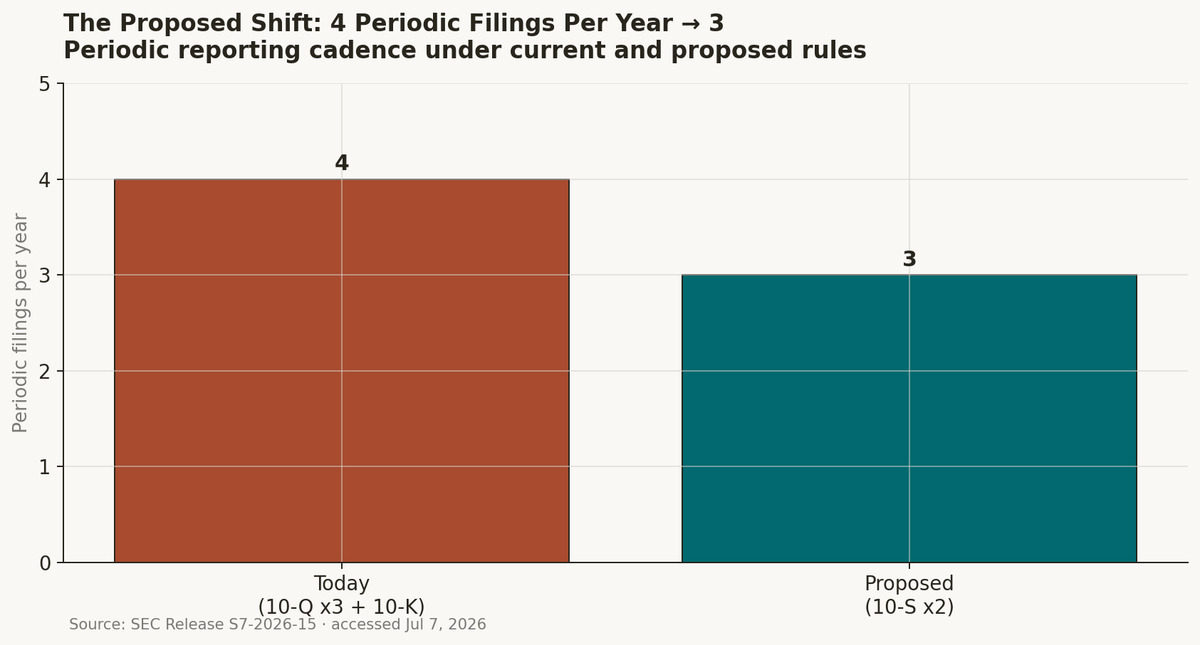
The Securities and Exchange Commission proposed under Release S7-2026-15 to move the periodic reporting cadence for U.S. public companies from quarterly to semiannual.[1] Under the proposal, the current 10-Q filing would be replaced by a new 10-S semiannual filing, with the annual 10-K continuing as today. The stated rationale from the SEC is that the current quarterly cadence imposes significant recurring compliance costs on registrants, encourages short-term corporate decision making, and produces incremental disclosure that may not be proportional to the informational benefit to investors.[1][2]
The proposal is not the first time a shift to semiannual reporting has been debated. Similar proposals were raised in 2018 and again in earlier administrations, though none advanced through to a final rulemaking. What is different in the 2026 iteration is that the SEC has issued a formal proposed rule with a specific comment period, and the comment period has now closed.
The comment period closed on 7/6/2026.[1] Press coverage and comment-letter aggregators have reported on the order of 67,000 comment letters submitted, including large volumes from institutional investor groups, pension funds, and investor advocacy organizations that opposed the change.[3] That level of engagement is unusual for a corporate reporting rulemaking and is consistent with the scale of the proposal's practical implications.
WHY THIS MATTERS FOR FMKT
The Free Markets ETF (Ticker: FMKT) invests in companies that we believe stand to benefit from deregulation. The 10-Q to 10-S proposal is directly relevant to that mandate for two reasons.
First, if finalized, the proposal would reduce the ongoing periodic reporting compliance burden on every U.S.-listed public company. The magnitude of that reduction per company would vary based on internal reporting infrastructure, but the direction is unambiguously toward lower cumulative compliance cost.
Second, the financial services sector, which is central to the fund's broader deregulation exposure, would be affected in two ways. Banks, insurers, and other regulated financial firms would themselves see reduced periodic reporting cost as registrants. Financial services intermediaries who provide audit, disclosure, and reporting services to public companies would see a change in the demand for their services.
The relevance to FMKT is not that the fund is directly speculating on the outcome of the rulemaking. It is that the SEC's willingness to advance a proposal at this scale is another concrete data point in the sustained direction of federal deregulation. Whether the specific rule is finalized as proposed, revised, or withdrawn, the fact that the SEC put the proposal out for public comment is itself a signal about the policy direction the fund is positioned for.
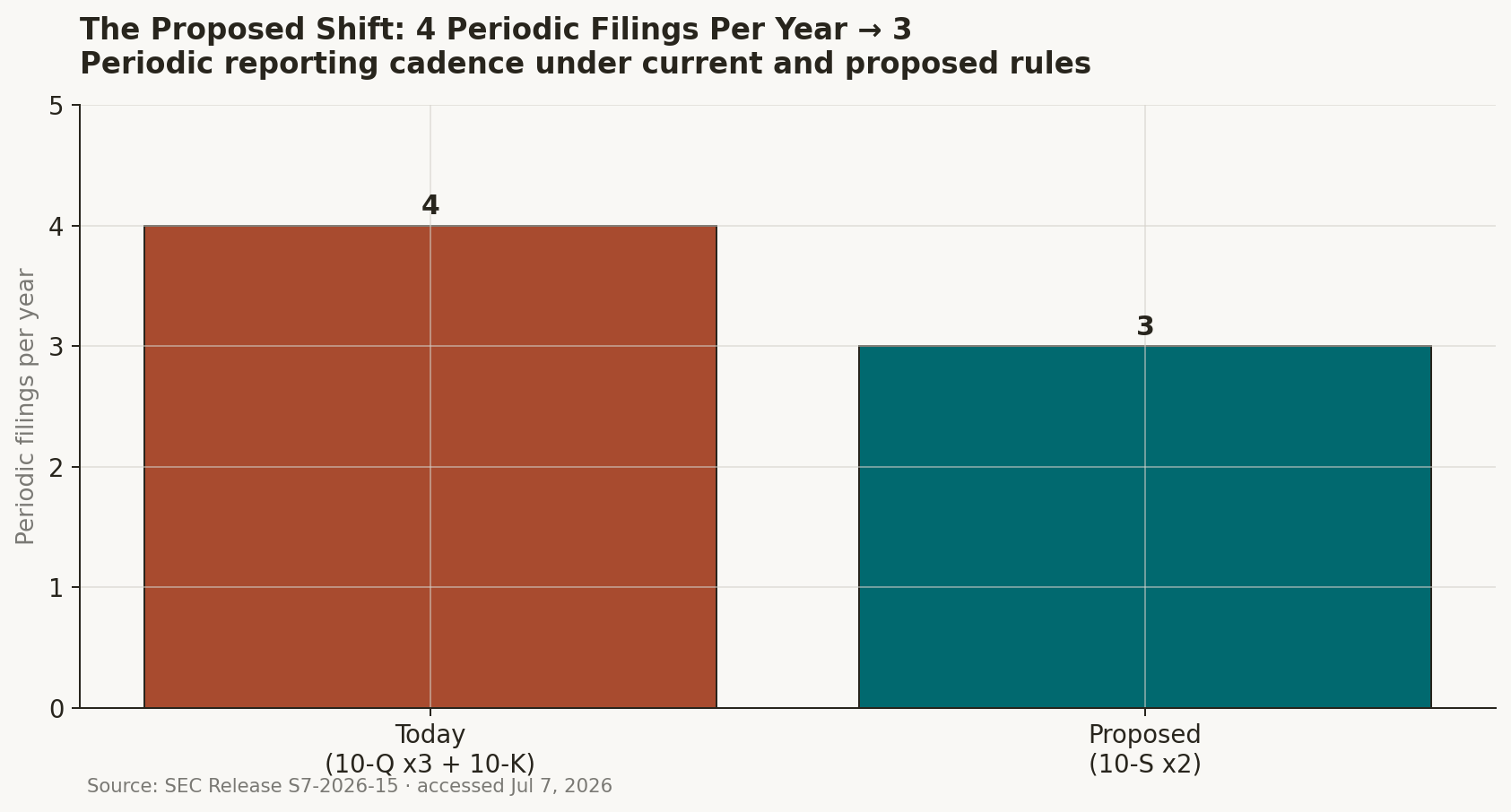
Chart 1: Reporting cadence under current 10-Q regime vs. proposed 10-S regime (illustrative).
HOW TO READ THE COMMENT-LETTER OPPOSITION
The reported \~67,000 comment letters, including significant opposition from institutional investors and investor advocacy groups, is a meaningful piece of the record.[3] Investors evaluating the rulemaking should be honest about what that record signals.
The comment record is a legally required input to the SEC's rulemaking process, but it is not a binding constraint on the SEC's final action. Under the Administrative Procedure Act, the SEC must consider the comments received. It is not required to defer to the numerical weight of opposition, and courts reviewing final agency actions apply a reasoned-decisionmaking standard rather than a majoritarian standard.
The practical effect of a large volume of opposition is threefold. First, it creates a substantive record the SEC must engage with in the preamble to any final rule. Second, it lays a foundation for potential legal challenges to a final rule, because comment letters typically raise the substantive arguments that later appear in Administrative Procedure Act litigation. Third, it can affect the political calculus around the timing and scope of a final rule, particularly during periods of divided government or during transitions.
None of that means the proposal will be withdrawn. It means the finalization process is likely to be contested, both administratively and in court, and the timeline to actual implementation is unlikely to be short.
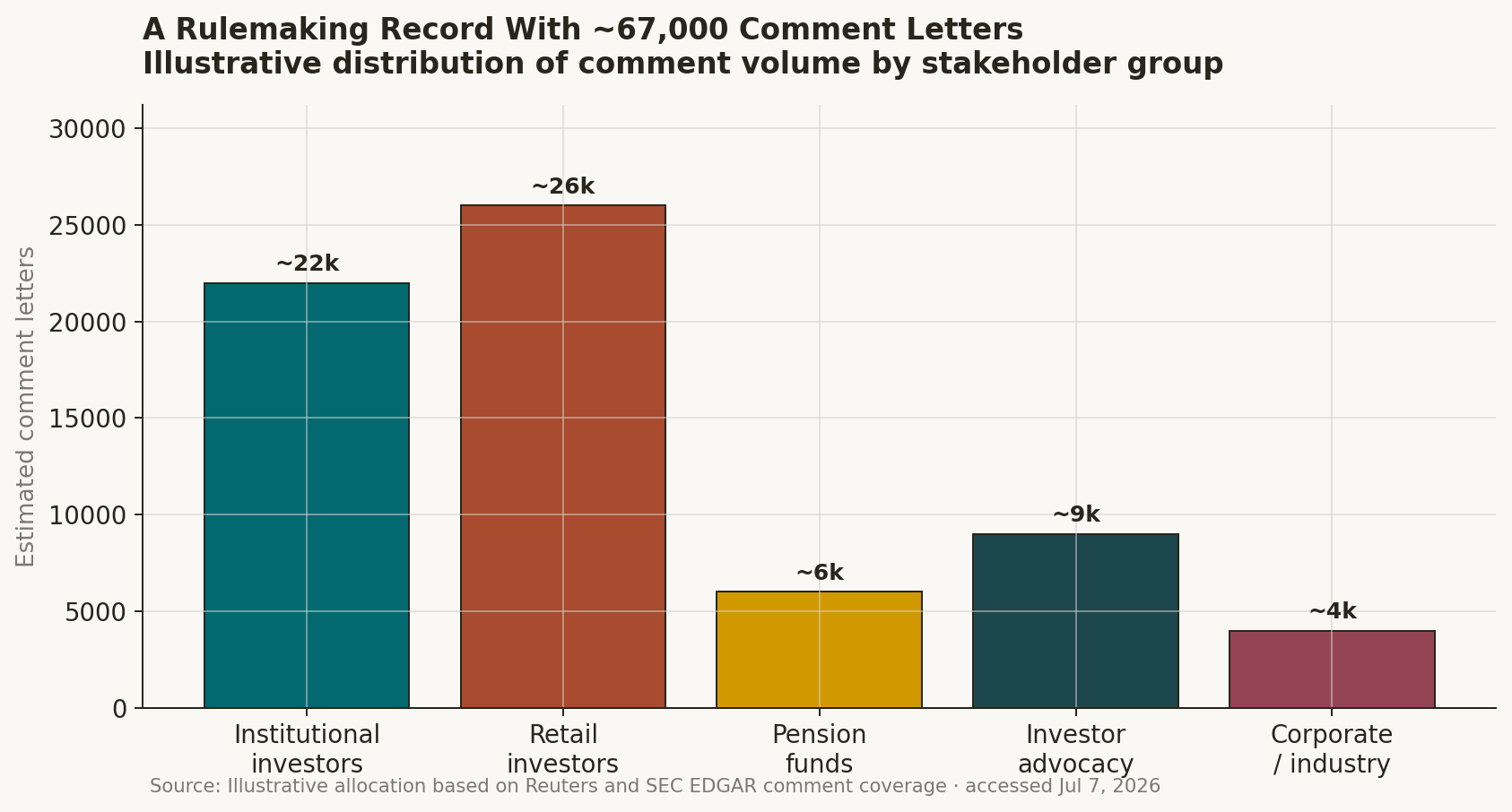
Chart 2: SEC comment file activity for File No. S7-2026-15, approximately 67,000 comment letters at close (illustrative distribution).
THE MECHANICS OF A REPORTING-CADENCE CHANGE
A shift from 10-Q to 10-S is more consequential than a simple change in filing frequency. The 10-Q currently anchors a broader ecosystem of corporate disclosure, investor relations, sell-side research, and market-microstructure practices. A move to semiannual reporting would touch each of those elements.
Corporate finance functions would need to adjust internal budgeting, close, and audit cycles. The number of periodic external audits per year would not change under the proposal, but the interim review of financial statements between annual audits would be substantially reduced. Investor relations teams would need to rethink cadence, guidance practice, and the timing of capital markets activity relative to reporting windows.
Analyst communities and sell-side research would face a genuinely different information environment. Earnings estimate revisions, coverage universes, and the pricing efficiency of individual securities would all adjust to a lower-cadence reporting regime. Passive index products would be relatively less affected, since they do not require ongoing per-security fundamental refresh. Active fundamental managers would need to adjust the tempo of their research processes.
Each of these adjustments is a real cost or benefit depending on which side of the debate an investor is on. The SEC's proposal is a bet that the aggregate compliance cost reduction, plus the potential for reduced short-term corporate decision making, outweighs the informational cost to investors from a slower reporting cadence.[1][2] Opposition to the proposal is a bet that the informational cost outweighs the compliance-cost saving.[3]
WHAT FMKT IS
The Free Markets ETF (Ticker: FMKT) is an actively managed ETF that seeks to invest in companies that we believe stand to benefit from deregulation. The fund's mandate is not tied to the specific outcome of any single rulemaking. It is defined by exposure to industries and companies whose earnings power is materially affected by federal regulatory burden, and by ongoing evaluation of the policy direction relative to those industries.
Financial services firms and, more broadly, the entire universe of U.S.-listed public companies are relevant to the fund's exposure. The 10-Q to 10-S proposal is directly relevant because it affects the cost structure of being a registrant. The fund is not positioned to profit from a specific finalization outcome on a specific timeline. It is positioned to reflect the cumulative narrative and cumulative earnings impact of a sustained direction of federal policy.
WHAT I AM WATCHING FROM HERE
Three things will help translate the S7-2026-15 rulemaking into observable outcomes.
First, the SEC's response to the comment record. The preamble to any final rule, and any interim procedural actions taken by the Commission, will indicate how it intends to engage with the volume of opposition it received. The pace of that engagement will indicate whether the SEC intends to finalize quickly, slowly, or not at all.
Second, the pace of any downstream Financial Accounting Standards Board and Public Company Accounting Oversight Board activity. A shift to semiannual reporting has knock-on effects on interim financial statement standards and on auditor review requirements. Coordination between the SEC and the accounting standard setters would signal the seriousness of the finalization effort.
Third, congressional and litigation response. Institutional investor groups have signaled they may pursue congressional and judicial remedies if a final rule is issued. The trajectory of that response will affect the effective implementation date of any finalized rule and the durability of the deregulatory outcome.
CONCLUSION
The SEC's proposed shift from 10-Q to 10-S under Release S7-2026-15, with the comment period closing on 7/6/2026, is one of the most consequential deregulatory rulemakings currently in process because it touches every U.S.-listed public company.[1][2][3] The Free Markets ETF (Ticker: FMKT) is designed to be positioned in companies whose earnings power is materially affected by federal regulatory direction. Financial services firms, and the broader listed-company universe, all sit inside that exposure.
The value of the fund's investment thesis is not in the specific outcome of this single rulemaking. It is in the sustained direction of policy the SEC's willingness to advance a proposal at this scale continues to reinforce. Investors evaluating the fund should read S7-2026-15 as another dateable data point about the direction, not as a forecast of any specific finalization outcome on any specific timeline.
Michael A. Gayed, CFA
---
Michael A. Gayed, CFA
ENDNOTES
[1] U.S. Securities and Exchange Commission, "Public Comments on File Number S7-2026-15," accessed 7/7/2026, https://www.sec.gov/rules-regulations/public-comments/s7-2026-15
[2] WilmerHale, "SEC Rulemaking Updates: Capital Markets Edition," accessed 7/7/2026, https://www.wilmerhale.com/en/insights/client-alerts/20260701-sec-rulemaking-updates-capital-markets-edition
[3] Reuters, "Wall Street regulator should stick to quarterly reports, investor groups say," accessed 7/7/2026, https://www.reuters.com/legal/government/wall-street-regulator-should-stick-quarterly-reports-investor-groups-say-2026-07-06/ ---
DISCLOSURES (FMKT)
The Free Markets ETF (Ticker: FMKT) is an actively managed exchange-traded fund. The Fund's investment adviser makes discretionary decisions about which companies to include in the portfolio based on its investment process. Actively managed funds may underperform passively managed benchmarks and may have higher expenses than passively managed funds.
The Fund's investment thesis around companies that benefit from deregulation depends on the future direction of federal rulemaking. That direction is subject to political, legislative, and judicial developments that are outside the Fund's control. There is no guarantee that any specific regulatory initiative will be implemented or that any specific company will benefit from it.
Proposed rules issued by the Securities and Exchange Commission are procedural steps in the federal rulemaking process. A proposed rule may be finalized as proposed, revised, withdrawn, or subject to legal challenge. There is no assurance that any specific proposed rescission will result in an actual change in compliance costs for any specific company or in any specific timeline.
Because the Fund concentrates its investments in a specific theme, its performance may differ materially from broad-based equity market indices. Thematic funds may be more volatile than diversified equity funds and may experience periods of significant underperformance if the underlying theme does not deliver on expectations.
Past performance is no guarantee of future results.
Investors should consider the investment objectives, risks, charges and expenses carefully before investing. For a prospectus or summary prospectus with this and other information about the Fund, please call 855-994-4004 or visit our website at www.freemarketsetf.com. Read the prospectus or summary prospectus carefully before investing.
Investing involves risk including the possible loss of principal.
Lead-Lag Publishing, LLC is not an affiliate of Tidal or the Fund's distributor.