The yen is near 158. Who is borrowing it?
The yen is weak, Japanese yields are near 3 percent, and the carry trade question that matters is who has to sell.

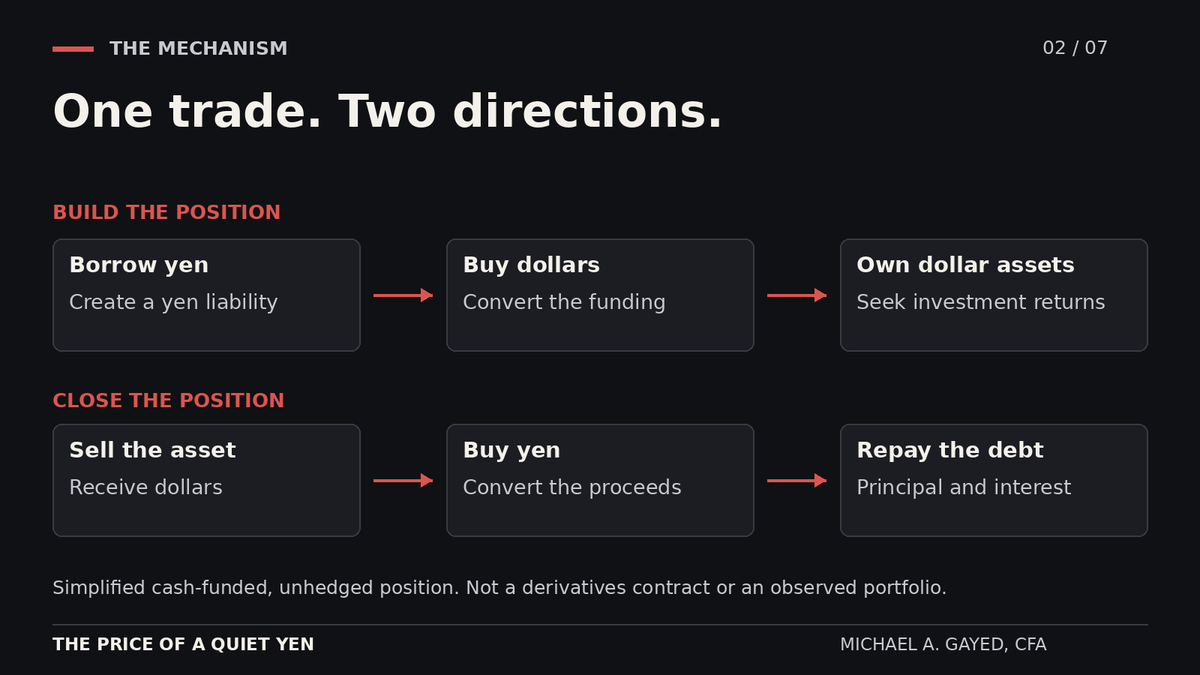
When the yen is quiet, almost nobody asks who is borrowing it.
The dollar is near 158 yen again
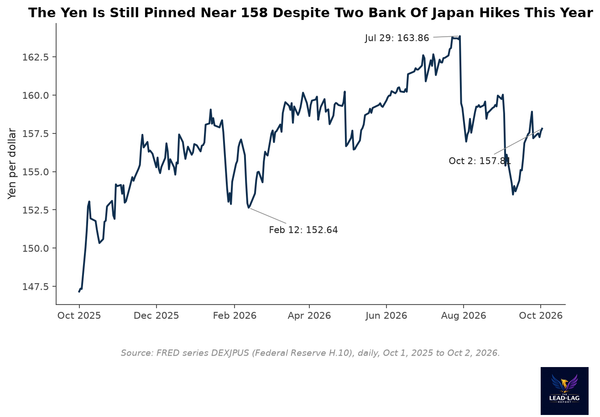
The dollar has been trading near 158 yen this week, with the yen about 2 to 3 percent weaker than a month ago. Japan's 10-year government bond yield has been hovering around 3 percent, a level that would have looked unthinkable for most of the last three decades. Neither number is a crisis. Both are the kind of backdrop in which a funding currency stops being background and starts being the story.
A weak yen and rising Japanese yields pull in opposite directions for anyone who borrowed in yen to own something else. The weak yen has been the friendly side of that trade, because debt gets cheaper to repay in dollar terms. Higher domestic yields are the other side, because they give Japanese money a reason to stay home. The position works as long as those two forces stay balanced and the market stays calm.
Why a calm market is the wrong test
Carry trades look safest right before they are tested. The income arrives steadily, volatility is low, and the position seems to need no attention. The real question is never how the trade performs when nothing happens. It is who has to sell, and how fast, when the funding currency moves against them.
That is the question the book is built around. In 1998, 2008, 2011 and 2024, the asset being held was rarely the problem. The financing behind it was. A holder who could wait out the move survived. A holder who could not was forced to liquidate into the worst possible conditions, and that forced selling spread well beyond the original trade.
What the book does with this
The Price of a Quiet Yen walks through Japan's economic history from the 1970s through September 2026, then shows how the carry trade works, why it unwinds, and what separates an attractive asset from a resilient position. It runs 402 pages with 32 chapters, 30 figures, worked examples, sources, a glossary and an analytical index.
If you already have a copy, thank you. A short honest review on the Amazon listing helps other readers decide whether the book is for them, and I read every one.
Get the hardcover on Amazon: $44.95
Read the Kindle edition: $9.99
Thank you for reading The Lead-Lag Report.
Michael A. Gayed, CFA
Published by Felix Culpa Publishing, LLC. U.S. Amazon prices shown; check the listing for current pricing and availability.
The Lead-Lag Report is provided by Lead-Lag Publishing, LLC. All opinions and views mentioned in this report constitute our judgments as of the date of writing and are subject to change at any time. Information within this material is not intended to be used as a primary basis for investment decisions and should also not be construed as advice meeting the particular investment needs of any individual investor. Trading signals produced by the Lead-Lag Report are independent of other services provided by Lead-Lag Publishing, LLC or its affiliates, and positioning of accounts under their management may differ. Please remember that investing involves risk, including loss of principal, and past performance may not be indicative of future results. Lead-Lag Publishing, LLC, its members, officers, directors and employees expressly disclaim all liability in respect to actions taken based on any or all of the information on this writing.