A Bear Market Hiding Inside a Bull Market
Nvidia's leadership crisis has put South Korea's market 44% below its June peak and Taiwan through its three wildest weeks on record. The S&P 500 is 6% off its high. That gap is the trade.

Today’s Lead-Lag Report post is sponsored by Groundfloor
 |
 |
This 10.5% Fixed Rate is Backed by a Perfect Track Record. Ends Nov. 30.
Groundfloor’s new Preferred Note Plus pays 10.5% fixed for 12 months or 9.5% annualized for 6 months. Backed by a diversified pool of first-lien real estate loans, with every Notes investor paid in full and on time since 2018. Zero fees. Accredited investors only, $10,000 minimum. Ends Nov. 30.
| Invest Now |
DISCLAIMER – PLEASE READ: This is sponsored advertising content for which Lead-Lag Publishing, LLC has been paid a fee. The information provided in the link is solely the creation of Groundfloor. Lead-Lag Publishing, LLC does not guarantee the accuracy or completeness of the information provided in the link or make any representation as to its quality. All statements and expressions provided in the link are the sole opinion of Groundfloor, and Lead-Lag Publishing, LLC expressly disclaims any responsibility for action taken in connection with the information provided in the link.
Investing involves risk, including possible loss of principal. A stated fixed rate is not a guarantee of payment, and past repayment history does not guarantee future results.
A Bear Market Hiding Inside a Bull Market
South Korea's market has given back 44% from its June peak. The S&P 500 is 6% off its high. The gap between those two numbers is the story of this selloff.
MICHAEL A. GAYED, CFA
Key Highlights
- Nvidia chief executive Jensen Huang resigned after disclosures about his personal life and his ties to an alleged Chinese spy, and the company has lost $735 billion of market value since the disclosures, with chief financial officer Colette Kress running it on an interim basis. [1]
- Taiwan's TAIEX fell 2,635 points, or 6.03%, on Monday, its second-largest daily point drop on record, as foreign investors sold a net NT$70.19 billion of shares. [2]
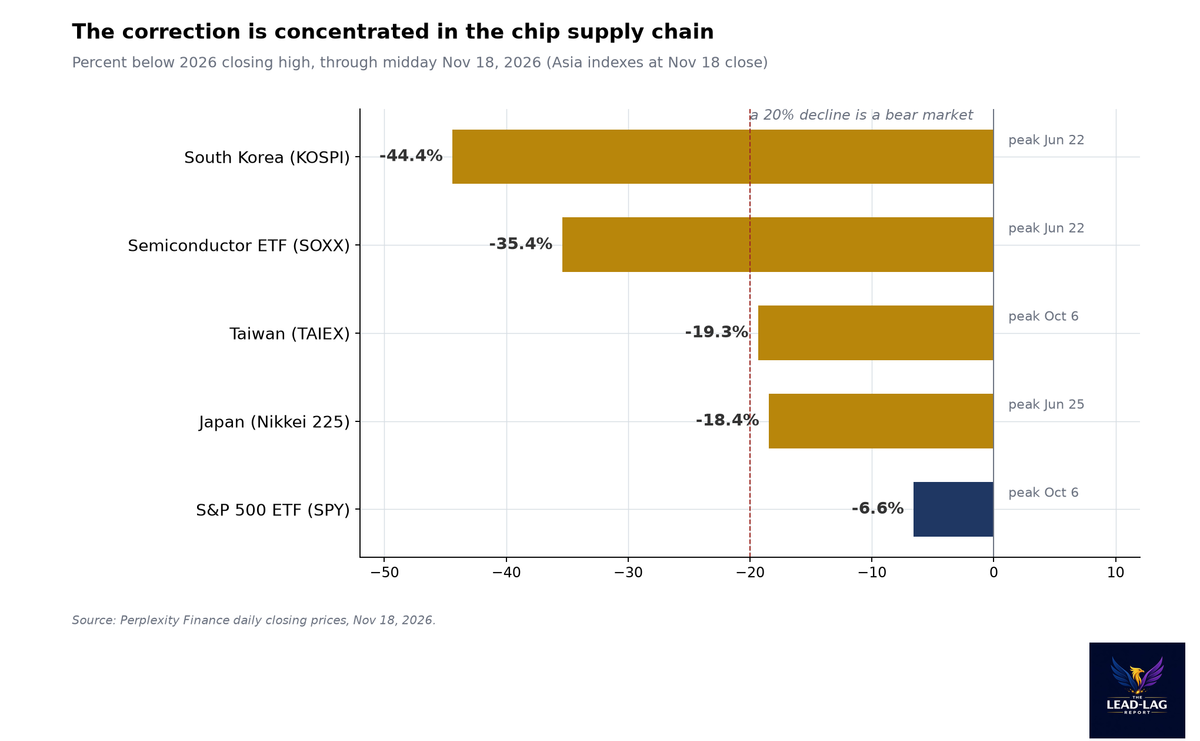
- The chip supply chain is deep in drawdown: the KOSPI is 44% below its June peak, the iShares Semiconductor ETF is 35% below its June peak, and the TAIEX is 19% below its October peak. The S&P 500 ETF is 6% off its high. [8]
- Taiwan swung from a record weekly loss, down 12.2% in the week to Nov. 6, to a record weekly gain, up 10.0% in the week to Nov. 13, and has fallen another 8% this week through Wednesday. [4] [8]
- Nvidia's own numbers say demand is intact: third-quarter revenue of $115.8 billion, up 103%, and a fourth-quarter forecast of $130 billion against a $125.3 billion consensus. [5]
The Week in One Paragraph
The spark was governance, not demand. Nvidia's chief executive resigned after disclosures about his personal life and his ties to an alleged Chinese spy, and Washington tightened rules on advanced AI chip exports in the same week. [1] [6] Asia took the hit first and hardest. Taiwan's index fell 6.03% on Monday, its second-largest point drop on record, and another 2.31% on Tuesday in a session dealers attribute partly to suspected government intervention. [2] [3] Nvidia then reported third-quarter revenue of $115.8 billion, up 103% from a year earlier, and guided the current quarter to $130 billion, above the $125.3 billion consensus. [5] By Wednesday the selling had slowed, and the S&P 500 ETF sits about 6% below its October high. [8] The VIX rose from 18.70 on Nov. 12 to 25.46 on Tuesday, its first close above 25 since Nov. 6. [8] The damage is real. It is also, so far, almost entirely in the supply chain.
A Bear Market Hiding Inside a Bull Market
Start with the arithmetic, because it is starker than the news flow. The KOSPI peaked at 9,114.55 on June 22 and closed Wednesday at 5,067.44, a 44% drawdown. The iShares Semiconductor ETF peaked the same day at 218.34 and sits at 141.05, down 35%. The Nikkei is 18% below its June 25 peak, and Taiwan's index is 19% below its October 6 high. [8] Against that, the S&P 500 ETF is 6% below its own October 6 peak. A 20% decline is the conventional line for a bear market. By that standard, the AI trade's supply chain has been in one since the summer, while the index that supposedly represents it has experienced a dip.
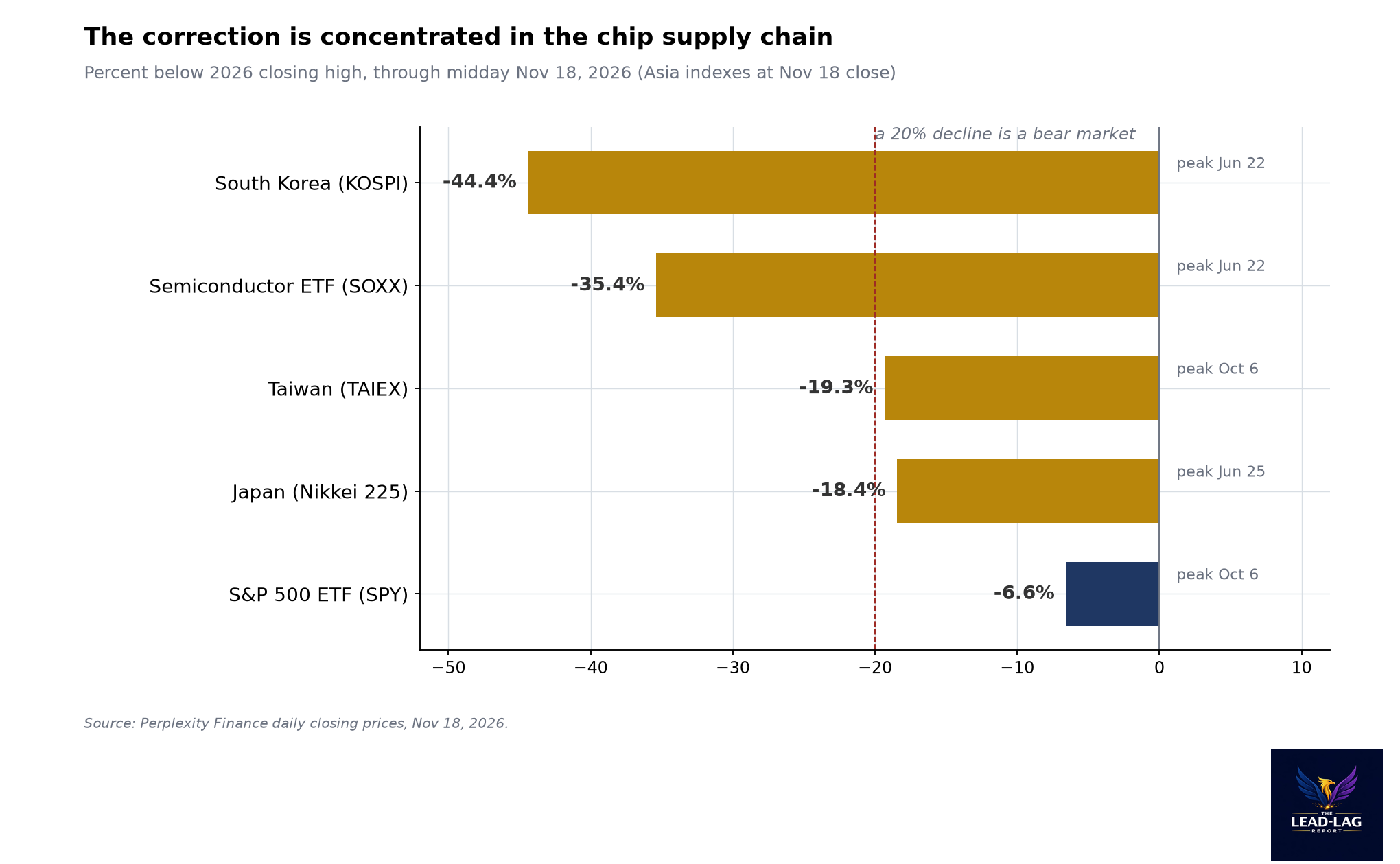
Korea's Tuesday close was its lowest since early February, and Taiwan's two-day drop was its worst since July. [7] This is not a one-week wobble. It is a five-month repricing of the Asian manufacturing complex, compressed into three violent weeks by a leadership crisis at the industry's single most important customer.
Taiwan's Three Weeks
No market expresses the stress better than Taiwan, because no market has more of its index riding on one customer's order book. The TAIEX fell 12.2% in the week to Nov. 6, its worst week on record, then rose 10.0% in the week to Nov. 13, its best week on record, and has fallen another 8% in the three sessions since. [4] [8] TSMC alone accounts for more than 40% of the local market's value, and it fell 5.7% on Monday. [2] When 40% of your index depends on the capital plans of a handful of American customers, the index trades like a leveraged position on those plans. A market that moves 10% a week is not pricing a sector rotation. It is pricing an unwind.
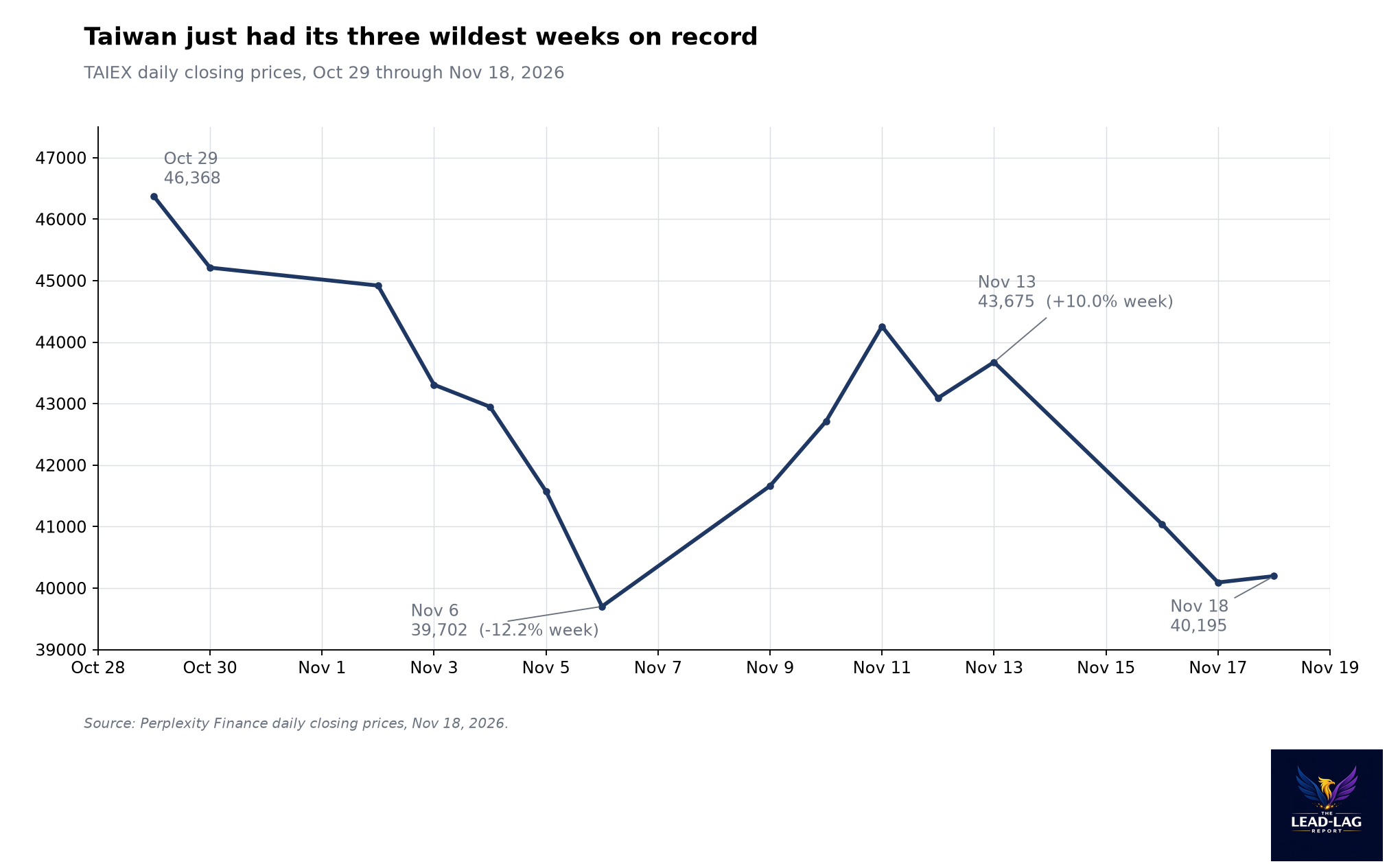
Dealers reported suspected buying from the National Financial Stabilization Fund on Tuesday, and Barclays warned that forced selling by heavily leveraged retail investors could extend the pressure. [3] Those are the mechanics of a market under stress, not one rotating calmly out of a theme.
Why the Index Has Not Noticed
The S&P 500's calm is not a mystery. It is arithmetic too. The fabs, the testers and the memory makers are listed in Taipei, Seoul and Tokyo. The index owns the customers, not the manufacturers. And the year is still enormous: the TAIEX is up 40% year to date even after a 19% drawdown, the semiconductor ETF is up 39%, Korea's market is up 20%, and the S&P 500 is up 6%. [8] A boom that size can absorb a deep correction without breaking the year, and Nvidia's forecast says end demand is still there. [5] The risk layer is policy, not orders. The new export rules reach data-center operators in Singapore, Malaysia, Thailand, Indonesia and Brazil, and they target exactly the overseas capacity the AI buildout has been renting out. [6]
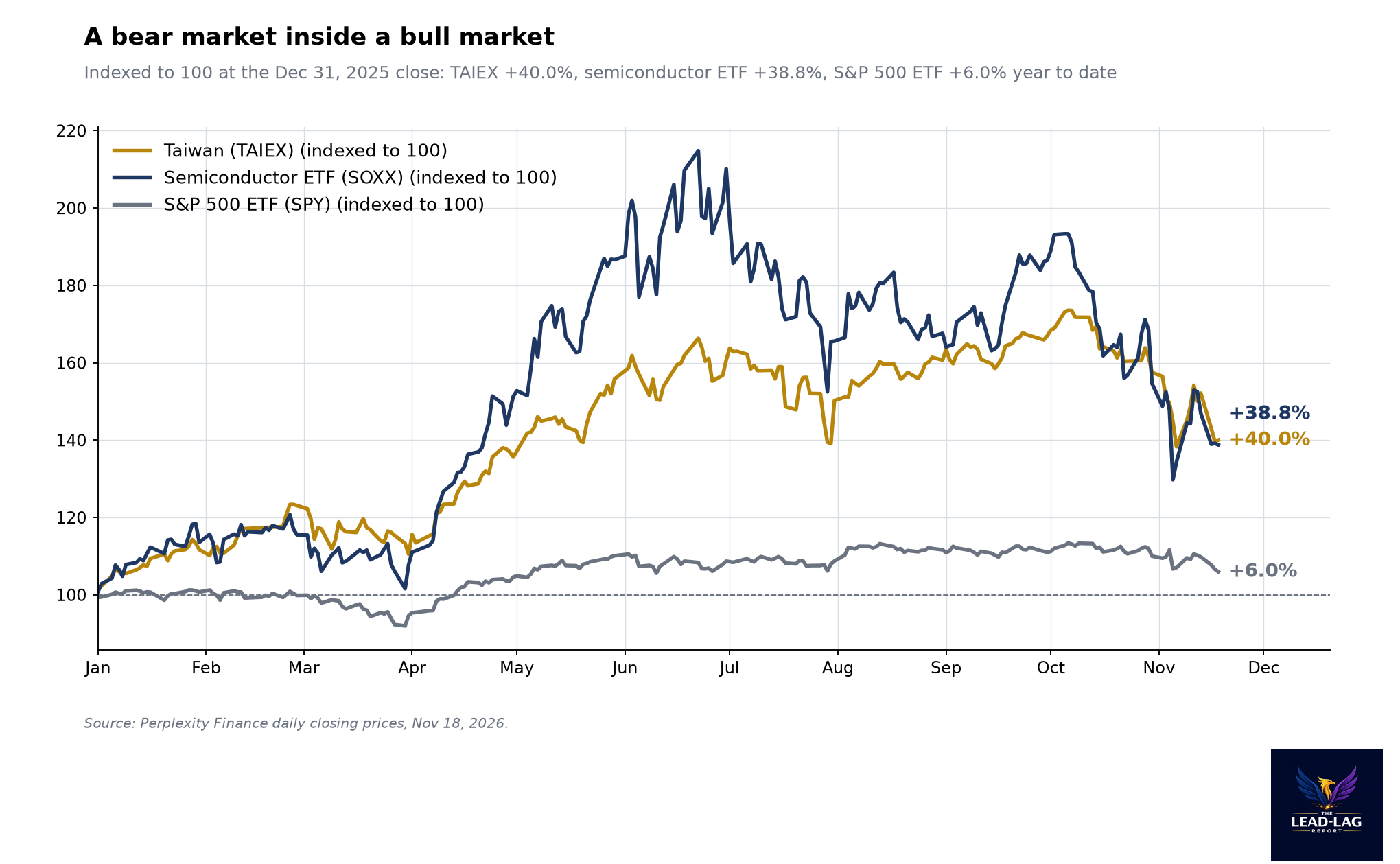
So the divergence resolves one of two ways. Either the supply chain catches up, because capex holds and the Asian indexes stabilize, or the index catches down, because the 2027 guidance disappoints and the spending plans behind it slow. The market is currently pricing the first outcome at full odds.
What I Am Watching
Three things tell you which way this breaks. First, Nvidia's follow-through: the shares rose about 2% in late trading after the beat, and whether the supply chain's indexes hold their Tuesday lows tells you whether the market believes the forecast. Second, the semiconductor ETF's year-start level of 101.64: it is still 39% above it, and the bullish case needs that cushion to hold. Third, the VIX: two closes above 25 in a week is an equity risk-off, and if it comes with the dollar strengthening, the stress is real. A market can trade an AI correction as an Asia story for months. It cannot trade it as one forever. Few understand this.
Notes
- AP via Yahoo Finance, Asian shares decline following stocks tumbled on Wall Street, November 17, 2026: Nvidia has lost $735 billion in market value since the disclosures of chief executive Jensen Huang's extramarital affairs and his ties to an alleged Chinese spy; chief financial officer Colette Kress is interim CEO
- Focus Taiwan (CNA), Taiex posts 2nd-largest point drop amid Nvidia concerns, futures selling, November 16, 2026: the TAIEX fell 2,635.04 points, or 6.03%, to 41,040.08; TSMC, which accounts for over 40% of the local market's total value, fell 5.74% to NT$2,215; foreign institutional investors sold a net NT$70.19 billion on the main board
- Focus Taiwan (CNA), Taiex plunges amid AI concerns, suspected gov't intervention, November 17, 2026: the TAIEX ended down 947.97 points, or 2.31%, at 40,092.11, with the National Financial Stabilization Fund believed to have intervened; the Philadelphia Semiconductor Index plunged 5.28% overnight; Barclays said forced selling by heavily leveraged retail investors could extend the pressure
- Taiwan News, TAIEX swings from record weekly loss to record gain, November 13, 2026
- Investing.com via Yahoo Finance, Asia tech shares turn mixed after Nvidia beat as China chip curbs cloud optimism, November 18, 2026: Nvidia third-quarter revenue of $115.8 billion, up 103%, with data center revenue up 110% to $107.6 billion; fourth-quarter forecast of $130 billion against a $125.3 billion analyst average
- Investing.com via Yahoo Finance, Asia stocks slide as U.S. tightens AI chip curbs ahead of Nvidia results, November 18, 2026: new U.S. rules require data-centre operators in Singapore, Malaysia, Thailand, Indonesia and Brazil to obtain licences to export advanced AI chips
- The Edge Malaysia via Reuters, Taiwan, South Korea stocks slide as Nvidia caution weighs on AI-linked shares, November 17, 2026: the KOSPI hit its lowest close since early February; Taiwan stocks clocked their worst two-day decline since July
- Perplexity Finance, daily closing prices for the TAIEX, KOSPI, Nikkei 225, S&P 500 ETF, iShares Semiconductor ETF and the VIX, December 31, 2025 through November 18, 2026 (U.S. series through midday November 18); KOSPI peak of 9,114.55 on June 22 and 5,067.44 close on November 18; TAIEX peak of 49,822.55 on October 6 and 40,194.91 close on November 18; S&P 500 ETF peak of 779.09 on October 6
The Lead-Lag Report is provided by Lead-Lag Publishing, LLC. All opinions and views mentioned in this report constitute our judgments as of the date of writing and are subject to change at any time. Information within this material is not intended to be used as a primary basis for investment decisions and should also not be construed as advice meeting the particular investment needs of any individual investor. Trading signals produced by the Lead-Lag Report are independent of other services provided by Lead-Lag Publishing, LLC or its affiliates, and positioning of accounts under their management may differ. Please remember that investing involves risk, including loss of principal, and past performance may not be indicative of future results. Lead-Lag Publishing, LLC, its members, officers, directors and employees expressly disclaim all liability in respect to actions taken based on any or all of the information on this writing.