Housing Starts Bounced 10 Percent. Permits Hit a Six-Year Low.
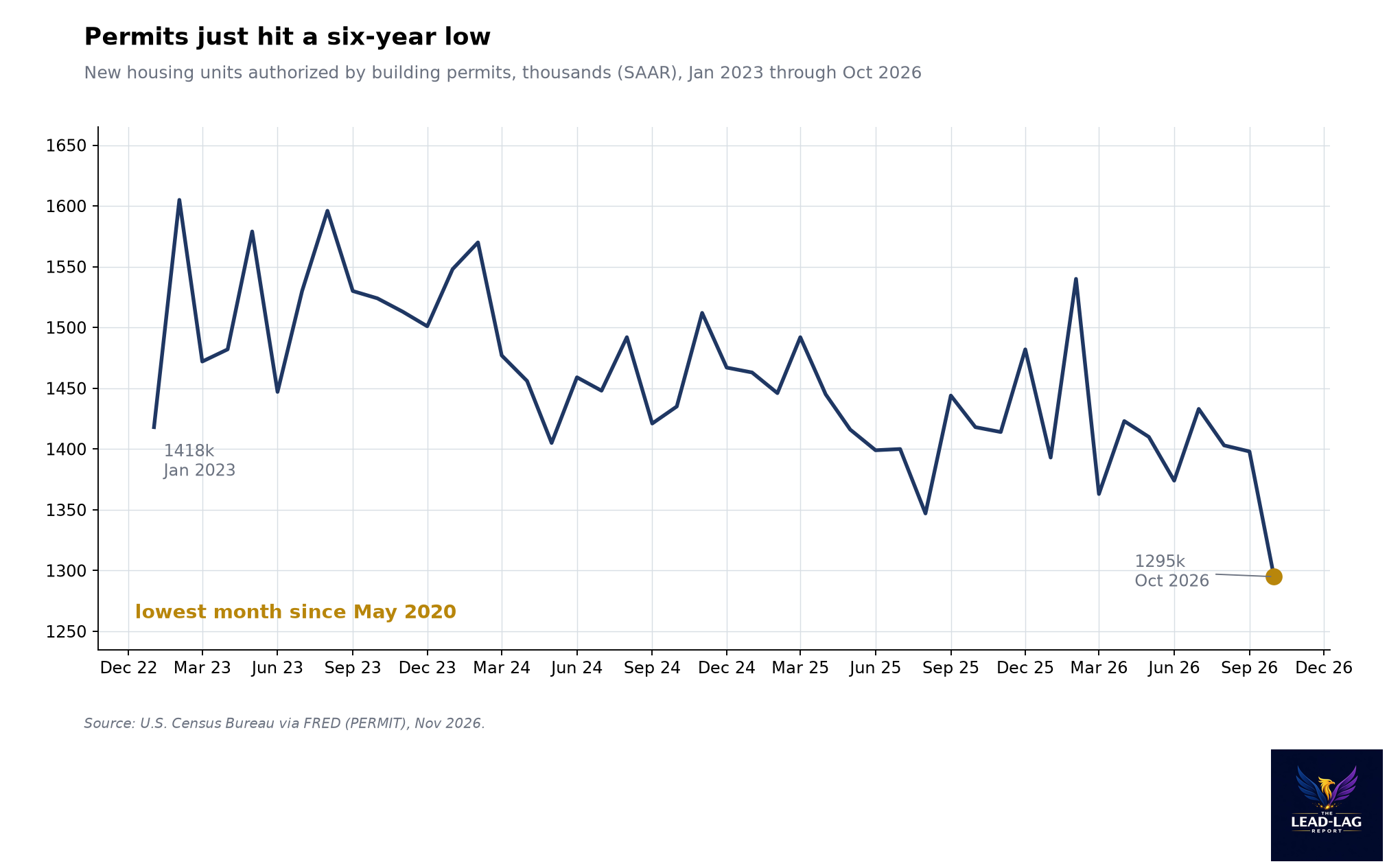
October's 9.9 percent start in housing starts came from apartments; building permits fell to their lowest since May 2020, and the construction pipeline is quietly draining.


Complimentary for advisors today: Podcast Bookings & Media Outreach

A campaign built to get you heard. Positioning, named target outlets, pitch angles, booking emails and a follow-up sequence, so you can pitch podcasts and media with a plan. Bookings are not guaranteed.
What you receive
- Media outreach strategy
- Your media positioning
- Target outlet profile
- Named target package
- Pitch angle set
- One-page media pitch
Cost in credits: 6. Turnaround: Coordinated over campaign window. Delivered as: Handled with the Media Desk. Best for: Advisors who want earned media exposure.
It is complimentary for advisors. There is no invoice from us. You earn the credits by showing up: attend a sponsored Lead-Lag Media webinar, meet a fund issuer in a one-on-one introduction, or join one of our advisor dinners.
Prefer to browse first? See all 34 services at advisor.leadlagmedia.com.
Credits carry no cash value and are not payment for services. Drafts are prepared with AI assistance and are for your and your firm’s review before use; they are not investment, legal, tax or compliance advice, and nothing is guaranteed. Services are offered to financial advisors and are not a solicitation to retail investors. This does not guarantee bookings, secure placements, send pitches, or pay for sponsored media. You and your firm must verify host, producer, and outlet contact paths from public professional sources before use.
Housing Starts Bounced 10 Percent. Permits Hit a Six-Year Low.
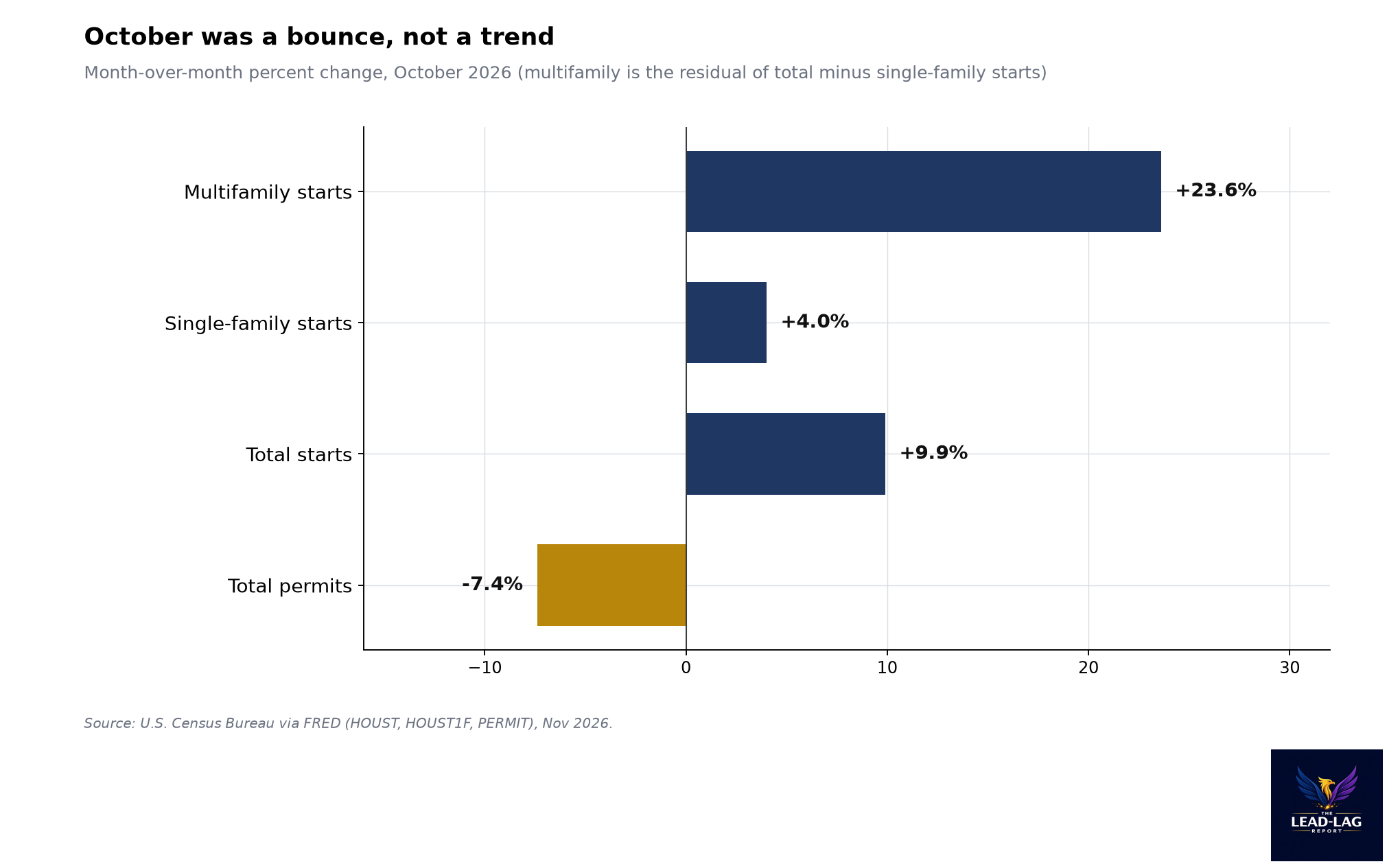
The Census Bureau's new residential construction report for October, released Wednesday, is a lesson in why I watch permits before starts. Total housing starts rose 9.9 percent to a 1.309 million annual rate, the biggest monthly jump since June. But building permits fell 7.4 percent to 1.295 million, the lowest month since May 2020, when the country was still locked down. Starts tell you what one month's weather and one quarter's apartment schedule did. Permits tell you what builders expect to do next, and builders just filed the most cautious paperwork in six years. [1] [2]
Open the starts detail and the bounce gets narrower still. Single-family starts rose 4.0 percent to 864,000, which sounds fine until you line it up against December's 946,000, still 8.7 percent below where the year began. The rest of the headline came from multifamily, 5-or-more-unit starts, which jumped from roughly 360,000 in September to 445,000 in October. Apartments are counted in lumps: one project's foundation pours move the national rate by tens of thousands. The Census Bureau itself flags that the month-to-month swings at the multifamily level routinely exceed 15 percent. [1] [2]
Read the Pipeline, Not the Month
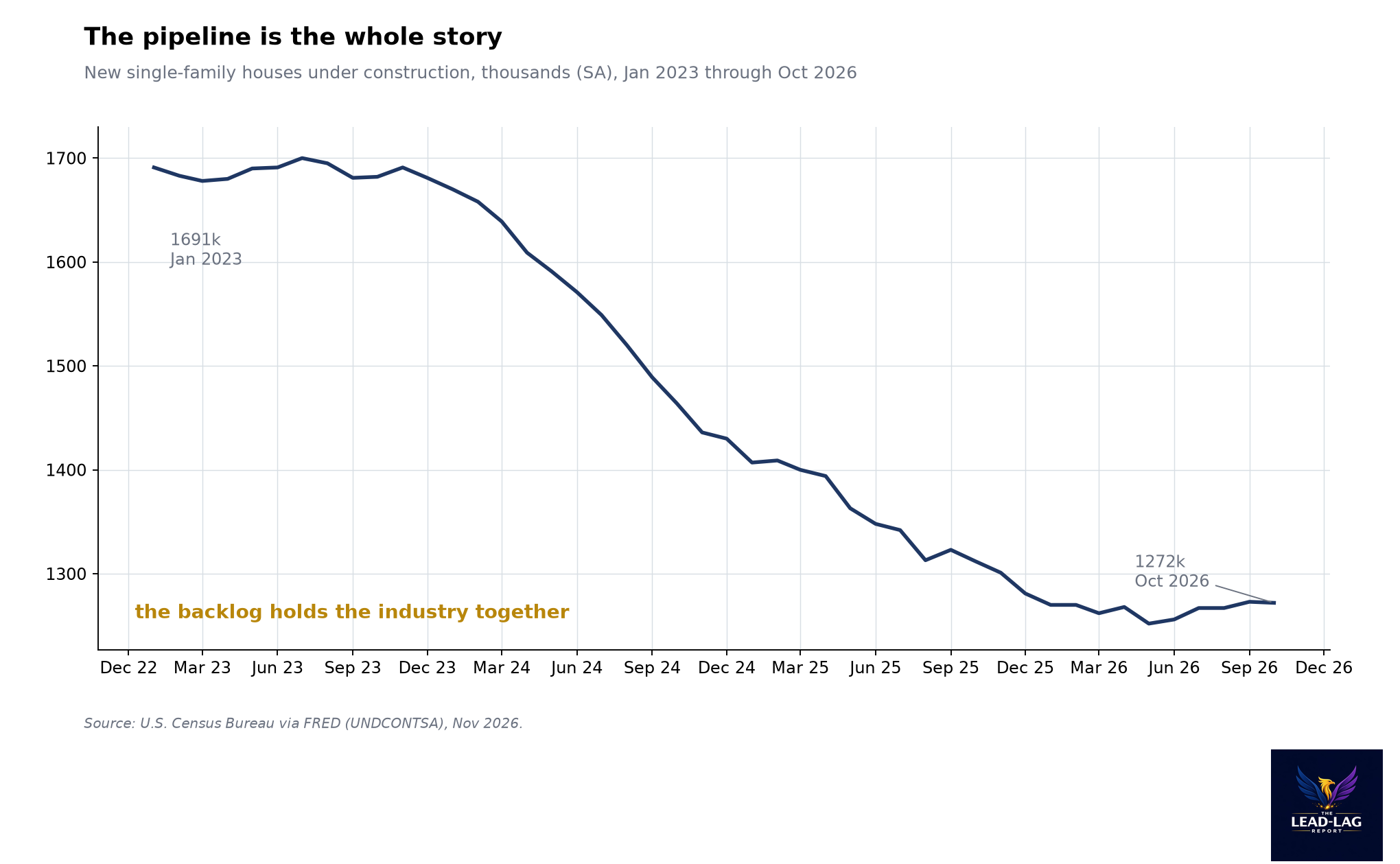
The number that keeps the housing industry employed is not starts and not permits. It is homes already under construction. That count, 1.272 million single-family units, has moved less than 4 percent in three years. Builders slowed the intake valve without abandoning the jobs in progress. That is deliberate: land bought at 2022 prices, labor contracted at 2024 rates and a buyer who will still sign a contract if the house is nearly finished. A builder who has already poured the foundation does not stop at 80 percent completion. So the construction paychecks keep going out long after the permit office goes quiet. [3]
This is also why the housing recession the surveys keep announcing has been so hard to see in the employment data. The pipeline hides the slowdown: fewer new projects enter, the existing ones take longer, and total construction employment barely moves. The reckoning only arrives when the pipeline drains. Permits now run 14.6 percent below their 2023 monthly average. Single-family starts are 8.7 percent below December. The backlog is not being refilled at the front end. [1] [2]
Why Builders Are Careful
The incentive structure explains the gap. Builders do not need a forecast to be right, they need it to be early. A 30-year mortgage rate that refuses to go below 5 percent caps what a monthly payment can support, and affordability math, not land availability, is the binding constraint on the entry-level buyer. On the same loan balance, a 30-year payment at a 5 percent rate runs about a third higher than at 3 percent. That is arithmetic, not forecast, and it means the same wage supports a smaller loan, which means the builder targets the same square footage at a higher price per month. The backlog is the hedge: build slowly, keep the crews, and finish what is already sold. It costs less to slow a foundation than to eat a finished spec house. So the industry's October numbers read exactly the way a careful operator behaves: finish everything, file less, wait. [4]
There is a second reason the permit number keeps falling while completions hold, and it is the incentive of the local government as much as the builder. Entitlement timelines lengthen when construction slows, because the planning desks that review permit applications are staffed for the volume of the boom years, and fees are charged per unit reviewed. A builder holding land can wait a quarter without carrying costs killing the project, so when demand softens the paperwork is the first line item cut, not the last. The result is a permit series that overstates the slowdown in the short run and understates the recovery when it comes, because the filings bunch once the desk clears. That is why I treat a single month of permits as information but not an answer, and why the three-month average, now 5.2 percent below its April peak, is the series to watch. [2]
What I Am Watching
Three things settle the direction from here. First, next month's permits, out December 17: the October drop is one month, but two in a row makes it a trend. Second, the multifamily giveback, the same lumpiness that flattered October will reverse on some future print, and the negative surprise will look worse than the underlying market. Third, completions against new-home inventory: the pipeline drains into either sales or standing specs, and which one it is decides whether builders cut permits further or finally refill them. For now the honest reading of October is this: the construction industry is still busy finishing yesterday's demand, while quietly cutting tomorrow's. That divergence resolves one way or the other. The permits line tells you which. [1] [3]
Notes
- U.S. Census Bureau, New Residential Construction, October 2026, released November 18, 2026: building permits 1.295 million SAAR, -7.4% m/m; total starts 1.309 million SAAR, +9.9% m/m; single-family starts 864,000, +4.0% m/m; multifamily (5+ unit) starts 445,000 vs. 360,000 in September
- FRED, New Housing Units Authorized by Building Permits (PERMIT), U.S. Census Bureau: 1,295 thousand in October 2026, the lowest month since May 2020; no month between June 2020 and September 2026 fell below the October 2026 reading
- FRED, New Single-Family Houses Under Construction (UNDCONTSA), U.S. Census Bureau: 1,272 thousand in October 2026, within a 4 percent range since October 2023; September 2025 1,323 thousand
- FRED, Housing Starts: Single-Family (HOUST1F), U.S. Census Bureau: 864 thousand in October 2026 vs. 946 thousand in December 2025, -8.7%; monthly multifamily swings routinely exceed 15 percent per Census methodology notes
Paid members get the full Weekly Signals, the weekly Leaders and Laggards and every chart behind each call. Start with 7 days free.
The Lead-Lag Report is provided by Lead-Lag Publishing, LLC. All opinions and views mentioned in this report constitute our judgments as of the date of writing and are subject to change at any time. Information within this material is not intended to be used as a primary basis for investment decisions and should also not be construed as advice meeting the particular investment needs of any individual investor. Trading signals produced by the Lead-Lag Report are independent of other services provided by Lead-Lag Publishing, LLC or its affiliates, and positioning of accounts under their management may differ. Please remember that investing involves risk, including loss of principal, and past performance may not be indicative of future results. Lead-Lag Publishing, LLC, its members, officers, directors and employees expressly disclaim all liability in respect to actions taken based on any or all of the information on this writing.