Business Loan Demand Fell 28 Points. Banks Barely Changed Their Terms.
The Fed's loan officer survey shows the first drop in business loan demand in over a year, while standards for larger firms stayed basically unchanged.


Complimentary for advisors today: Personal Brand Positioning

Say who you are, clearly and consistently. Your niche, differentiators, bios, proof points, call-to-action language and voice rules in one messaging foundation you can reuse everywhere.
What you receive
- Positioning statement
- Differentiation statement
- Ideal client profile
- Messaging pillars
- Proof-point map
- Short bio
Cost in credits: 3. Turnaround: 5-7 business days. Delivered as: an AI-prepared draft that you review. Best for: Advisors whose message is not yet sharp.
It is complimentary for advisors. There is no invoice from us. You earn the credits by showing up: attend a sponsored Lead-Lag Media webinar, meet a fund issuer in a one-on-one introduction, or join one of our advisor dinners.
Prefer to browse first? See all 34 services at advisor.leadlagmedia.com.
Credits carry no cash value and are not payment for services. Drafts are prepared with AI assistance and are for your and your firm’s review before use; they are not investment, legal, tax or compliance advice, and nothing is guaranteed. Services are offered to financial advisors and are not a solicitation to retail investors.
Banks say businesses asked for fewer loans last quarter, even though the banks barely changed what they demand from borrowers.
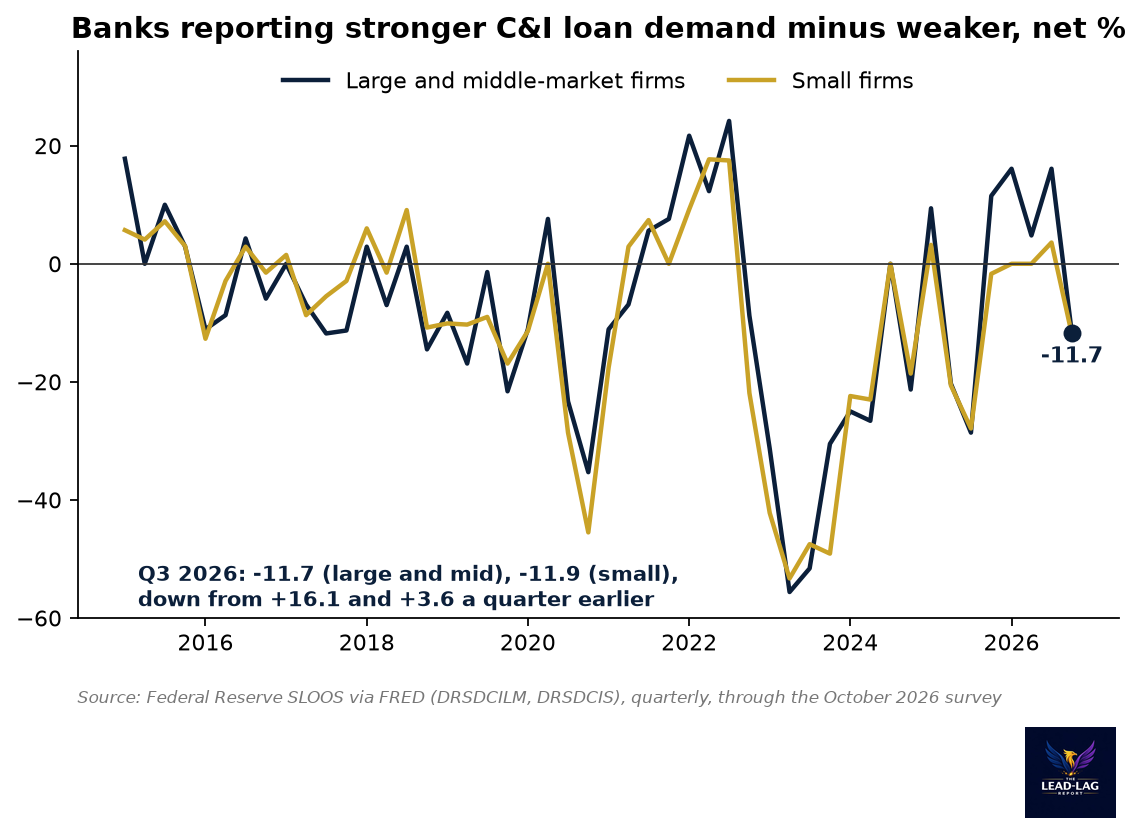
The Federal Reserve's October Senior Loan Officer Opinion Survey, released Nov. 2, found that banks reported weaker demand, on net, for commercial and industrial loans from firms of all sizes over the third quarter.[1] For large and middle-market firms, the net share of banks reporting stronger demand fell to -11.7 from +16.1 in the July survey.[2] For small firms it fell to -11.9 from +3.6.[3]
That 27.8-point swing for larger firms is the sharpest one-quarter drop since the first quarter of 2025.[2] It was also the first quarter of weaker business loan demand in more than a year.[4]
This was not a credit squeeze
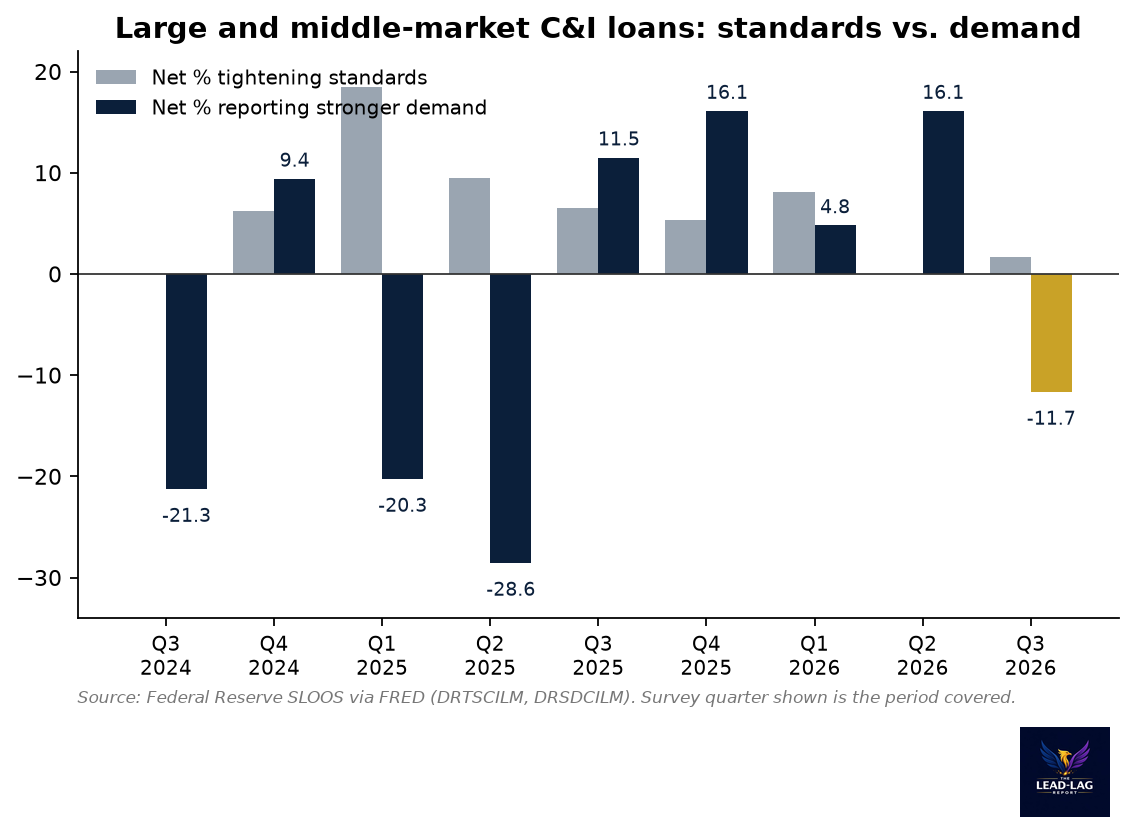
The usual story behind falling loan demand is that banks pulled back first. The survey does not show that for bigger borrowers. Standards for C&I loans to large and middle-market firms were "basically unchanged," and banks eased or left unchanged most of the loan terms the Fed asks about.[1] The net share of banks tightening standards for those firms was 1.7%, down from 8.1% two surveys earlier.[5]
Small firms were the exception. The net share tightening for them rose to 5.1% from 1.8%, and banks tightened collateral requirements and interest rate floors for small borrowers.[6][1] Across firms of all sizes, banks also raised premiums on riskier loans, citing a less favorable or more uncertain outlook and industry-specific problems.[1]
So the door was open for large companies. Fewer of them walked through it.
The two reasons banks gave
When banks reported weaker demand, they named two important reasons: customers were investing less in plant and equipment, and customer borrowing was shifting to "more attractive bank or nonbank funding sources."[1]
Those two reasons point in very different directions.
The first is a real-economy signal. A company that delays a new line or a warehouse does not need the loan. If that is the main driver, weaker loan demand is an early read on softer capital spending.
The second is a market-share signal. A company that refinances with a private credit fund, a bond deal or another bank still borrows. It just borrows somewhere else. Reuters noted that when demand last softened, in the second quarter of 2025, banks did not cite borrowers moving to other lenders as a reason.[4] This time they did.
The survey cannot tell us how much of the drop came from each reason. It is a survey of loan officers, covering 61 domestic banks and 18 U.S. branches of foreign banks, and it measures what banks report about standards and demand, not loan volumes.[7]
The balances have not turned
That is why the loan data matters. C&I loans at commercial banks reached about $2.96 trillion in September, up 10.0% from September 2025.[8] Most of that rise came in 2026. Balances were roughly flat through most of 2025 and then climbed from about $2.71 trillion in December.[8]
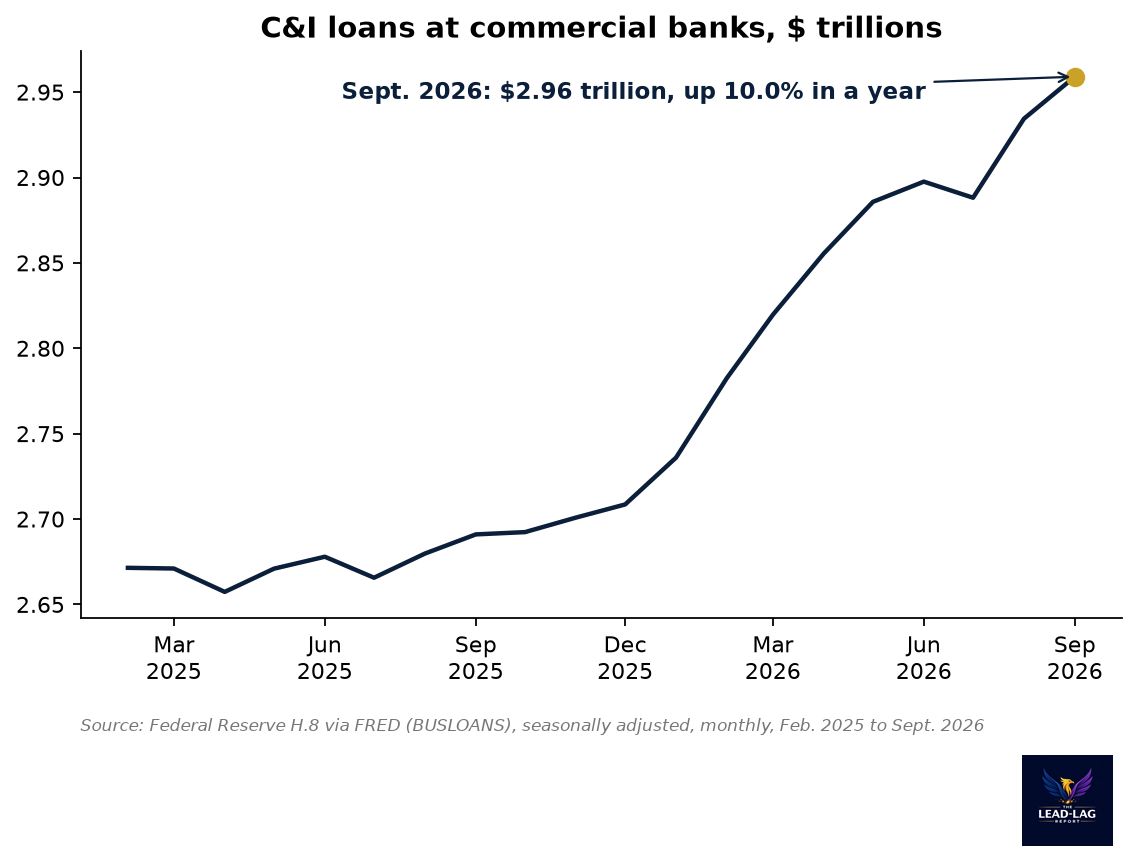
A survey that turns negative while balances keep rising is not a contradiction. The survey asks about the last three months compared with the prior three. Balances reflect everything already drawn. A slowdown in new demand shows up in the survey first and in the balance sheet later, if it shows up at all.
One more detail is worth a line. Foreign banks' U.S. branches reported unchanged standards and stronger C&I demand.[1] Some of the business that domestic banks saw leave may simply have moved down the street.
Commercial real estate points the same way, with less ambiguity. Banks tightened standards for construction and land development, nonfarm nonresidential and multifamily loans, and reported weaker demand in every CRE category.[7] Unlike the C&I picture, that is a case where tighter supply and softer demand line up.
Policymakers had these results in hand when they left short-term rates unchanged at the Oct. 27-28 meeting.[4] A quarter of softer business loan demand, without a broad tightening by lenders, is the kind of reading that lets a central bank wait. It does not force a move in either direction.
What would change the view
Three things would tell us which reason is winning.
- Weekly loan data. If C&I balances on the Fed's H.8 release flatten or fall through year-end, weaker demand is real. If they keep rising, the shift is mostly about where companies borrow.[8]
- Capital spending data. Core capital goods orders and business investment in the GDP report would confirm or contradict the "less plant and equipment" explanation.
- The January survey. Another negative demand reading with unchanged standards would make this a trend rather than one quarter of noise. The series has swung sharply before, from -28.6 in the July 2025 survey to +11.5 one quarter later.[2]
What it means for markets
For bank stocks, the competition reason matters more than the investment reason. Losing borrowers to nonbank lenders pressures loan growth and pricing even when the economy is fine. For credit markets, it means more corporate borrowing is happening outside the banking system, where the Fed's survey cannot see it.
For the economy, the signal is mixed but worth watching. Banks were willing to lend to large firms on roughly the same terms as before. Demand still fell. When companies stop asking for money they can get, it usually says more about their plans than about the banks.
The same survey showed the strongest uptick in credit card demand in four years.[4] Households borrowed more. Businesses borrowed less from banks. That split is the story of the quarter.
Notes
- Federal Reserve, October 2026 Senior Loan Officer Opinion Survey on Bank Lending Practices
- FRED, Net Percentage of Domestic Banks Reporting Stronger Demand for C&I Loans from Large and Middle-Market Firms (DRSDCILM)
- FRED, Net Percentage of Domestic Banks Reporting Stronger Demand for C&I Loans from Small Firms (DRSDCIS)
- Reuters via The News & Observer, Business loan demand softened last quarter, Fed survey shows, Nov. 2, 2026
- FRED, Net Percentage of Domestic Banks Tightening Standards for C&I Loans to Large and Middle-Market Firms (DRTSCILM)
- FRED, Net Percentage of Domestic Banks Tightening Standards for C&I Loans to Small Firms (DRTSCIS)
- CNBC, Banks are turning cautious on lending, according to the Fed, Nov. 5, 2026
- FRED, Commercial and Industrial Loans, All Commercial Banks (BUSLOANS), Federal Reserve H.8
Paid members get the full Weekly Signals, the weekly Leaders and Laggards and every chart behind each call. Start with 7 days free.
The Lead-Lag Report is provided by Lead-Lag Publishing, LLC. All opinions and views mentioned in this report constitute our judgments as of the date of writing and are subject to change at any time. Information within this material is not intended to be used as a primary basis for investment decisions and should also not be construed as advice meeting the particular investment needs of any individual investor. Trading signals produced by the Lead-Lag Report are independent of other services provided by Lead-Lag Publishing, LLC or its affiliates, and positioning of accounts under their management may differ. Please remember that investing involves risk, including loss of principal, and past performance may not be indicative of future results. Lead-Lag Publishing, LLC, its members, officers, directors and employees expressly disclaim all liability in respect to actions taken based on any or all of the information on this writing.