Jobless Claims Match the Lowest Since 1969. Sentiment Is Below 2008.
Initial claims fell to 189,000 while Michigan sentiment sits below its 2008 low. Pay is trailing prices by almost a point, and that explains the gap.

Complimentary for advisors today: LinkedIn Profile Optimization

A profile that reads like a practice, not a résumé. A one-time rewrite of your headline, About section, featured section, experience entries and call to action, tuned for how prospects evaluate an advisor.
What you receive
- Optimized headline
- About section rewrite
- Creator/service positioning line
- Credibility bullets
- Experience section rewrite
- Featured section recommendations
Cost in credits: 2. Turnaround: 3-5 business days. Delivered as: an AI-prepared draft that you review. Best for: Advisors whose LinkedIn profile is their first impression.
It is complimentary for advisors. There is no invoice from us. You earn the credits by showing up: attend a sponsored Lead-Lag Media webinar, meet a fund issuer in a one-on-one introduction, or join one of our advisor dinners.
Prefer to browse first? See all 34 services at advisor.leadlagmedia.com.
Credits carry no cash value and are not payment for services. Drafts are prepared with AI assistance and are for your and your firm’s review before use; they are not investment, legal, tax or compliance advice, and nothing is guaranteed. Services are offered to financial advisors and are not a solicitation to retail investors.
Layoffs are about as rare as they have been in more than half a century. Americans feel worse about the economy than they did in late 2008.
Initial jobless claims fell to 189,000 in the week ending Oct. 31, seasonally adjusted.[1] That matches the July reading as the lowest of this cycle, and before July you have to go back to September 1969 to find a lower print.[1] The four-week average is about 194,750.[1]
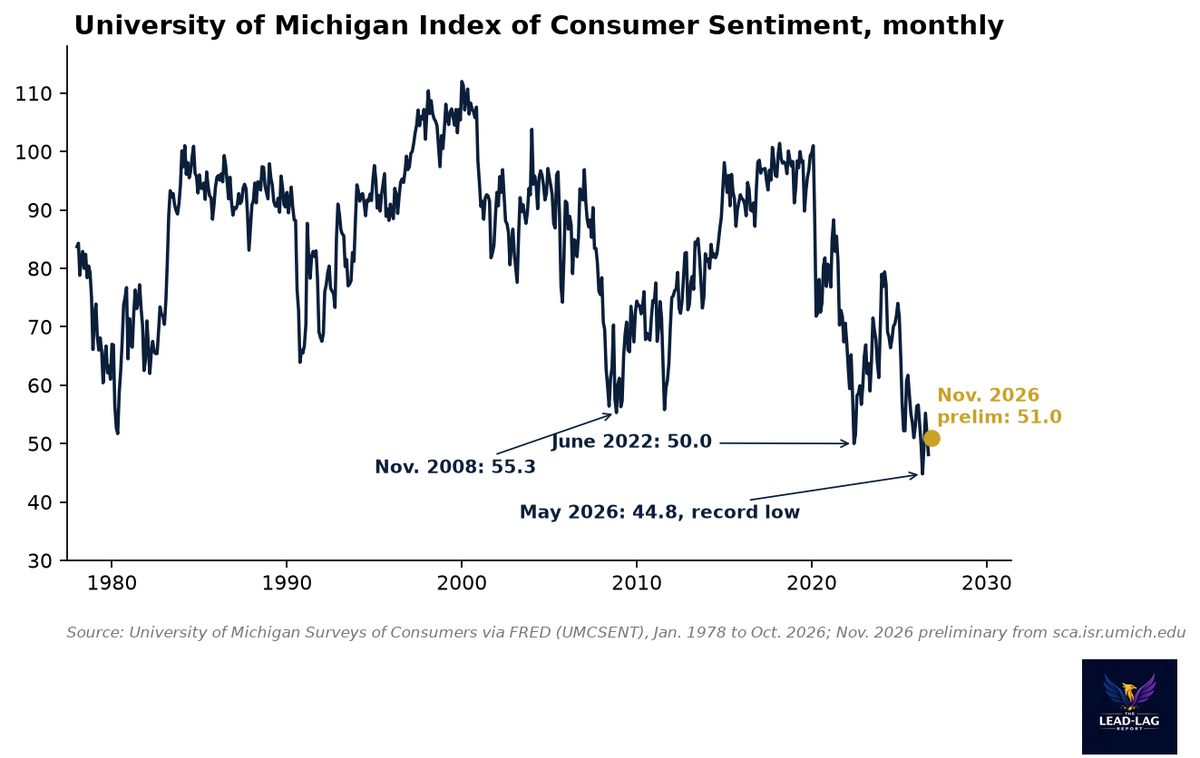
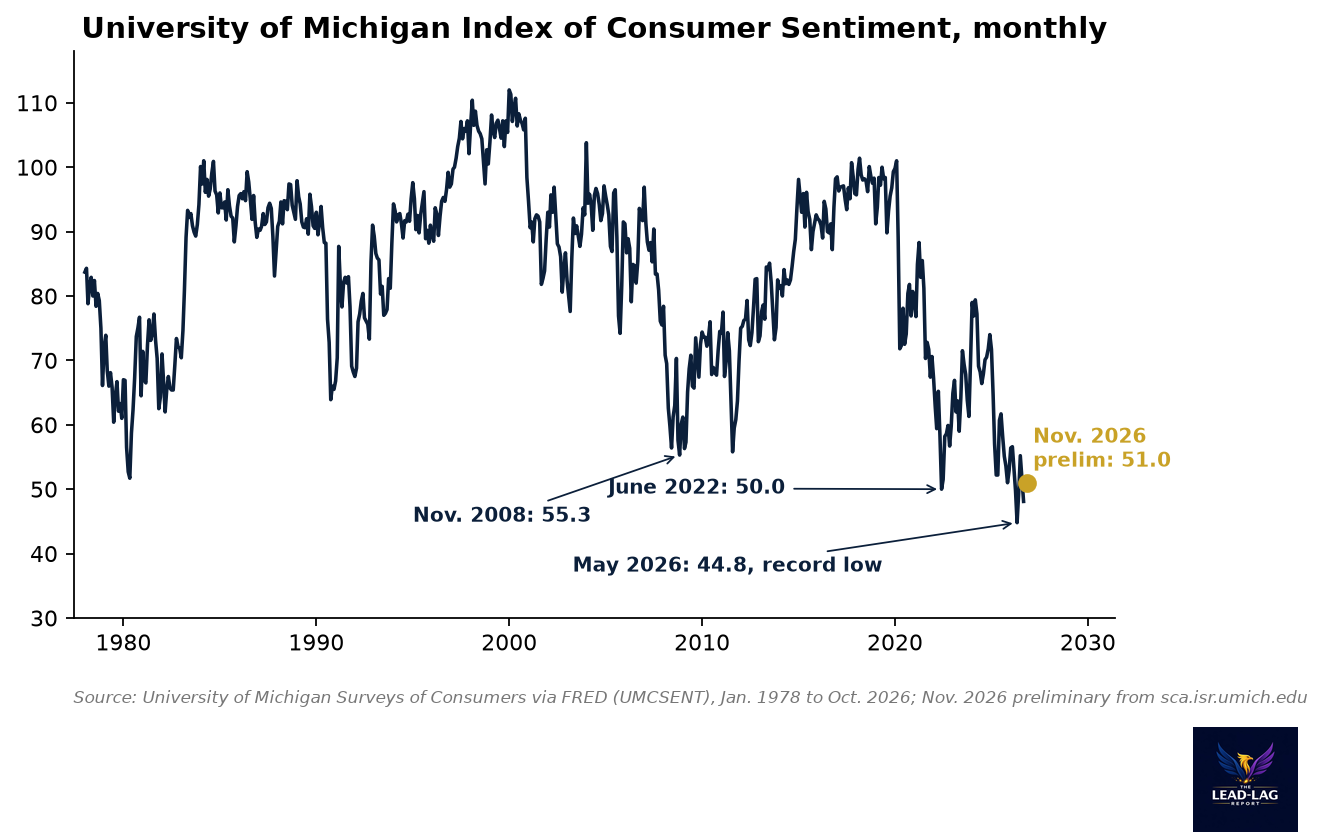
The University of Michigan's sentiment index tells a different story. It rose to 51.0 in the preliminary November survey, up from 48.0 in October.[2] That is still below the 55.3 low of November 2008 and only a few points above the all-time low of 44.8, set in May of this year.[3][4] The series goes back to the 1950s.[4]
Two gauges that used to agree
For most of the last 25 years, sentiment and layoffs moved together. When claims climbed in 2001 and 2008, sentiment fell. When claims drifted lower through the 2010s, sentiment rose with them.[1][3]
That relationship broke in 2022. Claims went back near their lows and stayed there. Sentiment fell to 50.0 in June 2022, recovered for a while, and then made new lows in 2026.[3] The unemployment rate was 4.1% in October.[5] People are not losing jobs at an unusual pace. They are unhappy anyway.
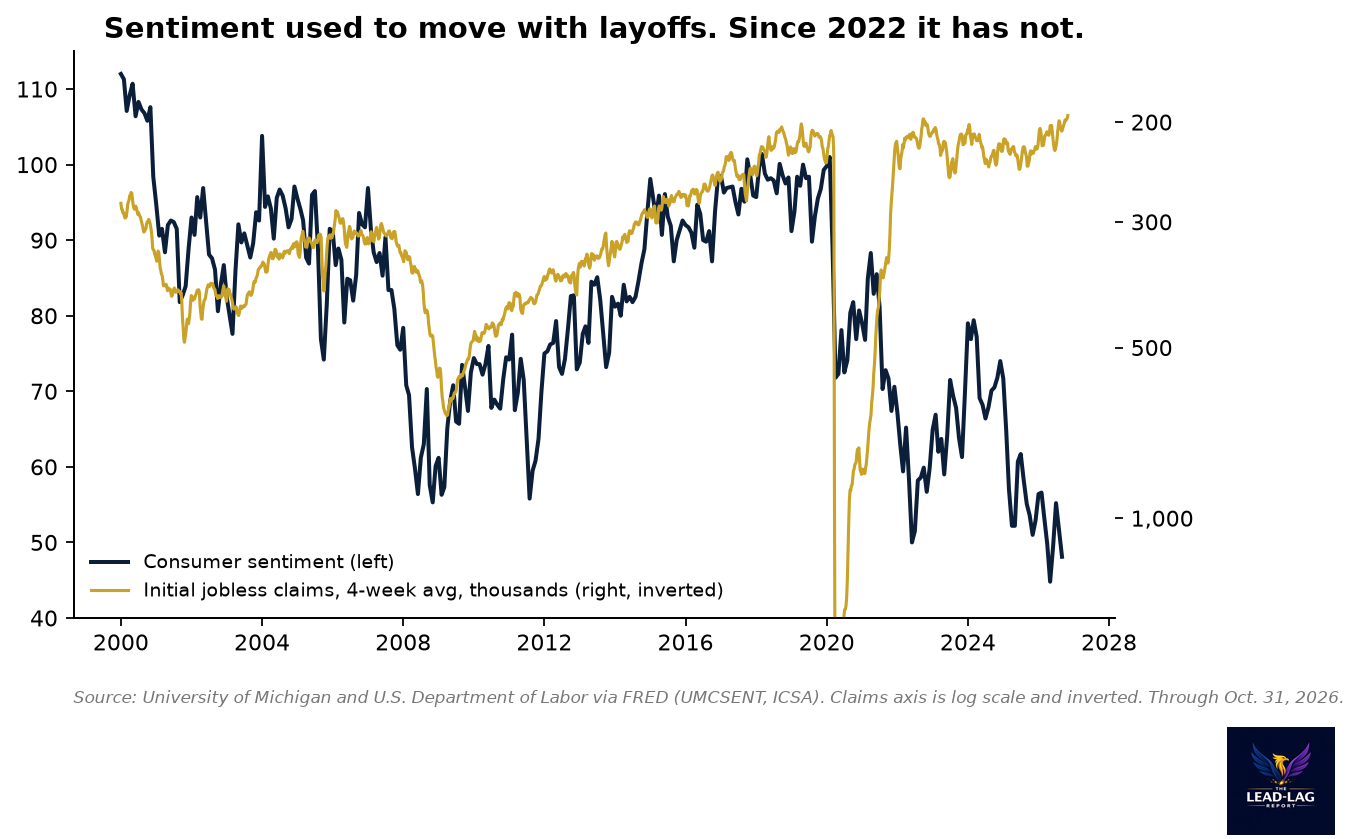
It is worth being precise about what claims do and do not capture. They count people filing for unemployment benefits for the first time in a given week. They say a lot about firing and very little about hiring, pay or hours. A labor market can have very few layoffs and still feel stuck to the people in it, especially if raises are not keeping up.
A common reading is that this is about politics, or about how surveys are taken now. Both play some role. Michigan noted that this month's gain was concentrated among independents.[2] But the survey's own respondents point somewhere more concrete.
The paycheck is losing to prices again
About 57% of respondents spontaneously said high prices had eroded their living standards. That is the highest share since May, up from 46% in February.[2] Michigan's director wrote that worries about a possible AI bubble "were dwarfed by cost of living concerns."[2]
The wage data backs that up. Consumer prices rose 4.08% in the year to October.[6] Average hourly earnings for private workers rose 3.12% over the same period.[7] That leaves pay behind prices by 0.96 percentage points, the widest gap since February 2023.[6][7]
The gap has been negative every month since April. Through 2024 and 2025, pay had been running ahead of prices by around one percentage point on average.[6][7] That cushion is gone.
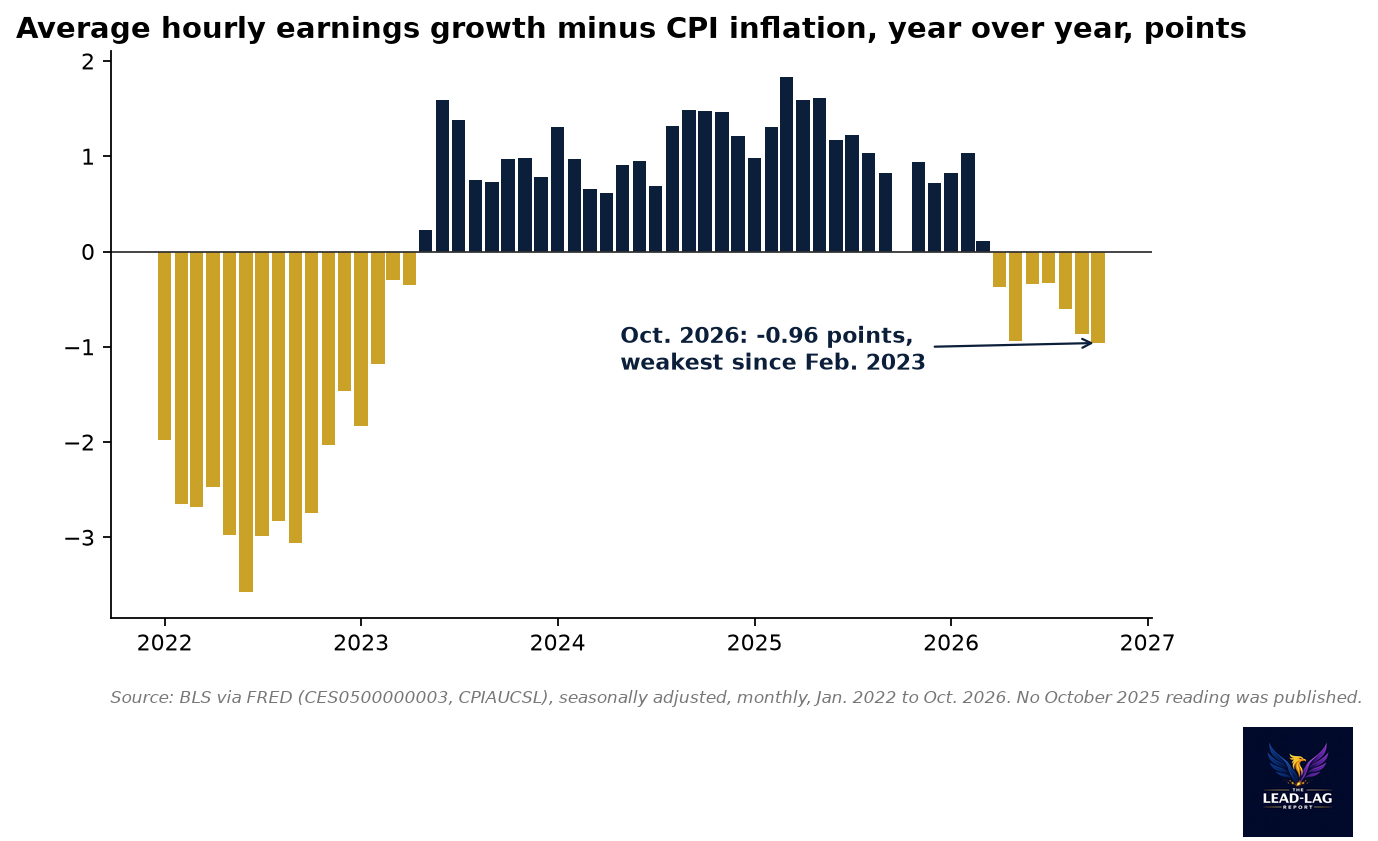
So the two gauges are measuring different things. Claims measure job security. Sentiment, right now, is measuring purchasing power. Job security is close to as good as it gets. Purchasing power is going backward.
Spending has not cracked
None of this has stopped people from spending. Retail and food services sales were up 6.3% from a year earlier in September, in current dollars.[8] With prices up about 4%, that is still real growth in what people buy.[6][8]
That combination is the reason sentiment has been a weak timing signal for markets. A worker with a secure job keeps spending even while complaining about prices. The complaint shows up in surveys right away. A change in spending shows up only when the job is at risk.
Inflation expectations offer one hopeful detail. Year-ahead expectations fell to 4.3% from 4.7%, and long-run expectations dipped to 3.4% from 3.5%.[2] Long-run expectations are still well above their 2024 range of 2.8% to 3.2%.[2]
There are early signs the worst of the mood may be behind us. Michigan's gauge of current personal finances climbed to a four-month high in November, and views of buying conditions for durable goods rebounded from a record low.[10] Those are small moves from very low levels. They are also the first broad improvement since the summer.
What would change the view
- Claims turning up. If initial claims move sustainably above the 2026 range, the job-security leg goes away and gloom can start to show up in spending. Continuing claims were about 1.72 million in late October.[9]
- Prices cooling faster than pay. If inflation falls back below wage growth, the main complaint in the survey fades. Michigan's final November reading comes out Nov. 20 and will include post-election interviews.[2]
- Wealthier households pulling back. Sentiment fell 5% this month among consumers with the largest stock portfolios, after a turbulent stretch for stocks.[2] That group does a large share of discretionary spending.
What it means for markets
For investors, the record-low sentiment readings this year have been more noise than signal on their own. The labor market is what connects mood to spending, and it has held. The thing to watch is whether the real-wage squeeze stays a complaint or becomes a cut in hours and hiring.
For the Fed, the picture is uncomfortable. Inflation above 4% with very low layoffs does not argue for easing. A public that already feels poorer does not make holding rates high any easier politically.
For consumer-facing companies, the split matters more than the level. Households with secure jobs and squeezed budgets tend to trade down rather than stop buying. That pattern rewards value and penalizes pricing power that depends on a confident shopper.
And for anyone reading the headlines, the lesson is simple. A record low in sentiment and a near record low in layoffs can both be true. They are answers to different questions.
Notes
- FRED, Initial Claims (ICSA), U.S. Employment and Training Administration, weekly, seasonally adjusted
- University of Michigan Surveys of Consumers, Preliminary Results for November 2026
- FRED, University of Michigan: Consumer Sentiment (UMCSENT)
- Dow Jones via Morningstar, U.S. Consumer Mood Improved but Remained Gloomy This Month, Nov. 6, 2026
- FRED, Unemployment Rate (UNRATE), BLS
- FRED, Consumer Price Index for All Urban Consumers: All Items (CPIAUCSL), BLS
- FRED, Average Hourly Earnings of All Employees, Total Private (CES0500000003), BLS
- FRED, Advance Retail Sales: Retail Trade and Food Services (RSAFS), Census Bureau
- FRED, Continued Claims (CCSA), U.S. Employment and Training Administration
- Bloomberg via Yahoo Finance, US Consumer Sentiment Unexpectedly Rises, Fueled by Independents, Nov. 6, 2026
Paid members get the full Weekly Signals, the weekly Leaders and Laggards and every chart behind each call. Start with 7 days free.
The Lead-Lag Report is provided by Lead-Lag Publishing, LLC. All opinions and views mentioned in this report constitute our judgments as of the date of writing and are subject to change at any time. Information within this material is not intended to be used as a primary basis for investment decisions and should also not be construed as advice meeting the particular investment needs of any individual investor. Trading signals produced by the Lead-Lag Report are independent of other services provided by Lead-Lag Publishing, LLC or its affiliates, and positioning of accounts under their management may differ. Please remember that investing involves risk, including loss of principal, and past performance may not be indicative of future results. Lead-Lag Publishing, LLC, its members, officers, directors and employees expressly disclaim all liability in respect to actions taken based on any or all of the information on this writing.