The Quiet Dollar Shortage
The consensus says dollar liquidity is abundant. The plumbing says otherwise. The JPY basis is double its post-COVID average, foreign central banks are rebuilding buffers at the Fed, and FIMA repo drew twice after years of dormancy. The shortage builds in the basis before it breaks open.

Today’s Lead-Lag Report post is sponsored by GroundFloor
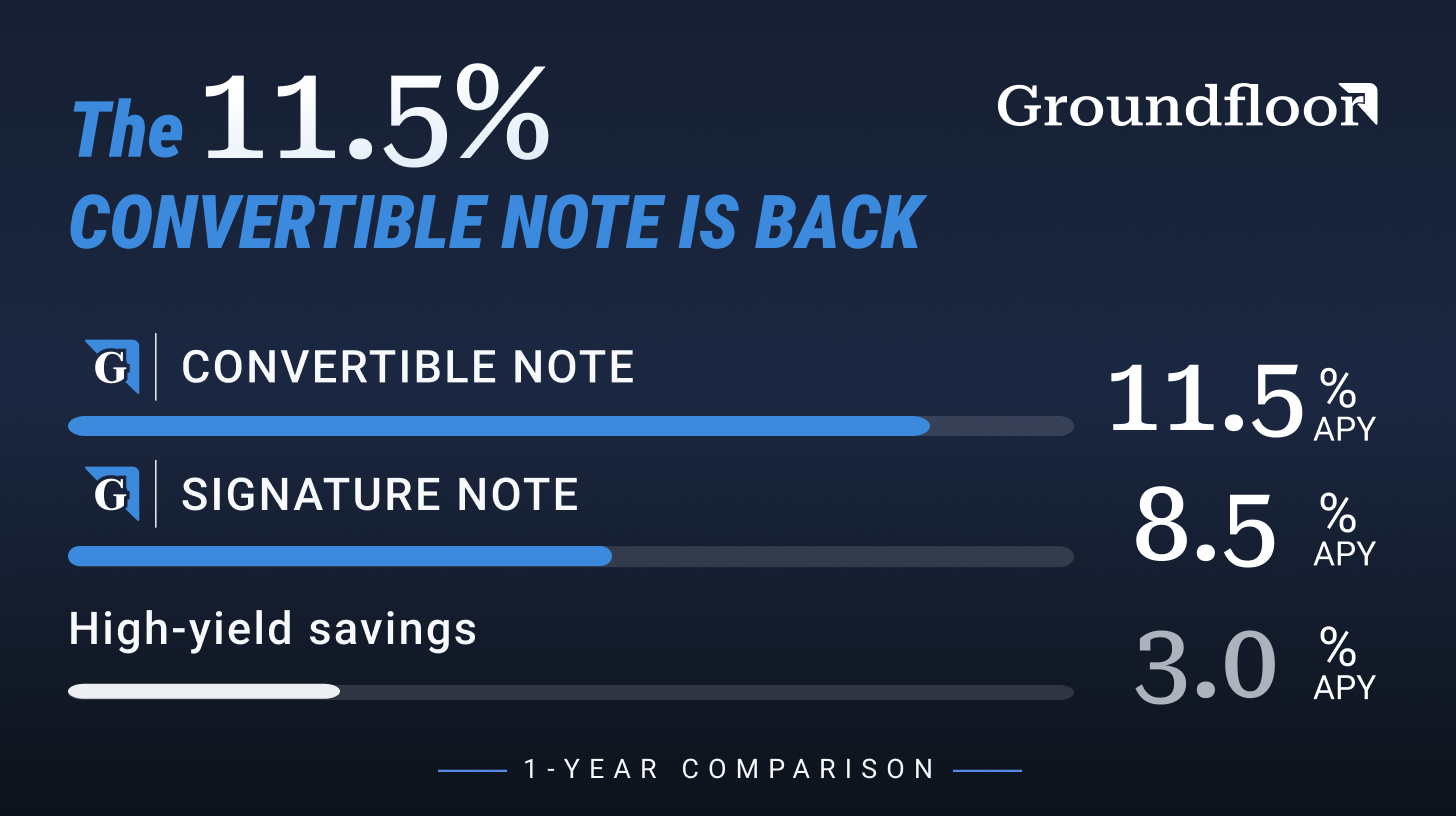
Inflation Is Working Hard Against Your Cash. Groundfloor Notes Offer Real-Estate-Backed Returns Designed To Stay Ahead.
Stop letting inflation chip away at your savings. Earn up to 8.5% with the Signature Note or explore the limited-time 11.5% Convertible Note for accredited investors. Backed by real estate and a perfect payment track record since launch. Use NOTES100 to get $100 when you invest $1,000.
DISCLAIMER — PLEASE READ: This is sponsored advertising content for which Lead-Lag Publishing, LLC is being paid a fee. The information provided is solely the creation of GroundFloor. Lead-Lag Publishing, LLC does not guarantee the accuracy or completeness of the information provided or make any representation as to its quality. All statements and expressions provided are the sole opinion of GroundFloor and Lead-Lag Publishing, LLC expressly disclaims any responsibility for action taken in connection with the information provided.
The Quiet Dollar Shortage
Why FX Basis Is Widening While Nobody Watches
KEY HIGHLIGHTS
- The consensus is that dollar liquidity is abundant. Headline funding rates are calm and the reverse repo facility is nearly drained. That is exactly the environment in which a dollar shortage builds quietly, priced not in the policy rate but in the cross-currency basis that most investors never look at.
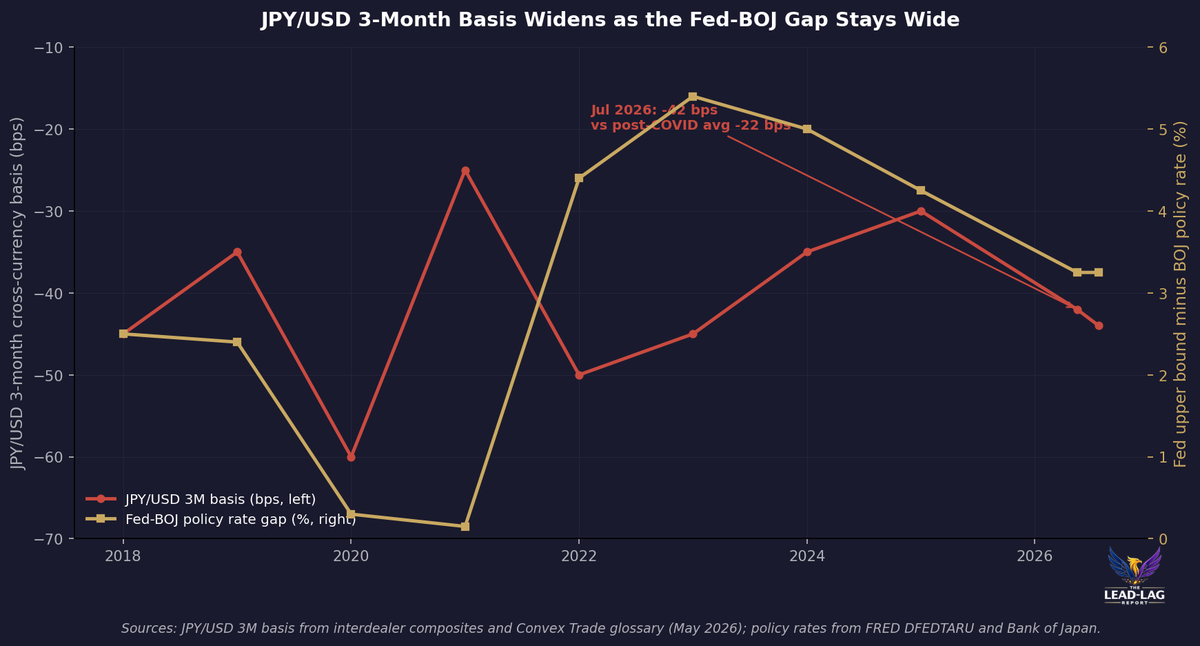
- The JPY/USD three-month basis sits near minus 42 basis points, roughly double its post-COVID average of minus 22, while the Fed-BOJ policy gap holds around 3.25 percentage points. The EUR/USD three-month basis at minus 18 is calmer, but Europe simply needs fewer dollars this cycle. The stress is concentrated where the policy divergence is widest.
- Foreign official balances parked at the Fed's reverse repo pool troughed near $299 billion in late May and rose to roughly $354 billion by mid-July, an 18 percent move in seven weeks. The Fed's FIMA repo line printed two separate drawdowns of over $100 million after years of near-zero usage. Foreign demand for dollars is turning up at the margin.
- There is roughly $14.3 trillion of dollar credit owed by non-bank borrowers outside the United States, growing at the fastest annual pace since 2014, with about $4.3 trillion of that concentrated in emerging and developing economies. That is the collateral stack that must be rolled and hedged. When the hedging spread widens, the tightening has already begun.
Everyone is watching the wrong number. The market has decided that dollar liquidity is abundant, and on the surface it looks that way. The overnight reverse repo facility has drained toward zero. The federal funds rate is sitting quietly at a 3.50 to 3.75 percent target range. Nothing in the headline plumbing is flashing red.
The tightening is not in the headline rate. It is in the price non-US institutions pay to turn their own currency into dollars. That price is the cross-currency basis, and it has been widening in the corners of the market where the policy divergence is largest. A dollar shortage does not announce itself with a spike in the funds rate. It shows up first as a spread, and the spread is the tightening.
This is how it always begins. Quietly, in an instrument almost nobody outside a bank treasury desk quotes, at a moment when the consensus is most convinced that funding is easy.
What the Basis Actually Measures
Start with the mechanism, because the mechanism is the whole argument. A German insurer, a Japanese pension fund, or a Brazilian corporate that owes dollars but earns in its home currency cannot simply borrow dollars in an unsecured market on the same terms an American bank can. It raises its own currency and swaps into dollars through the FX swap market. When dollars are genuinely abundant, that swap costs almost nothing beyond the interest-rate differential, and covered interest parity holds. The cross-currency basis sits near zero.
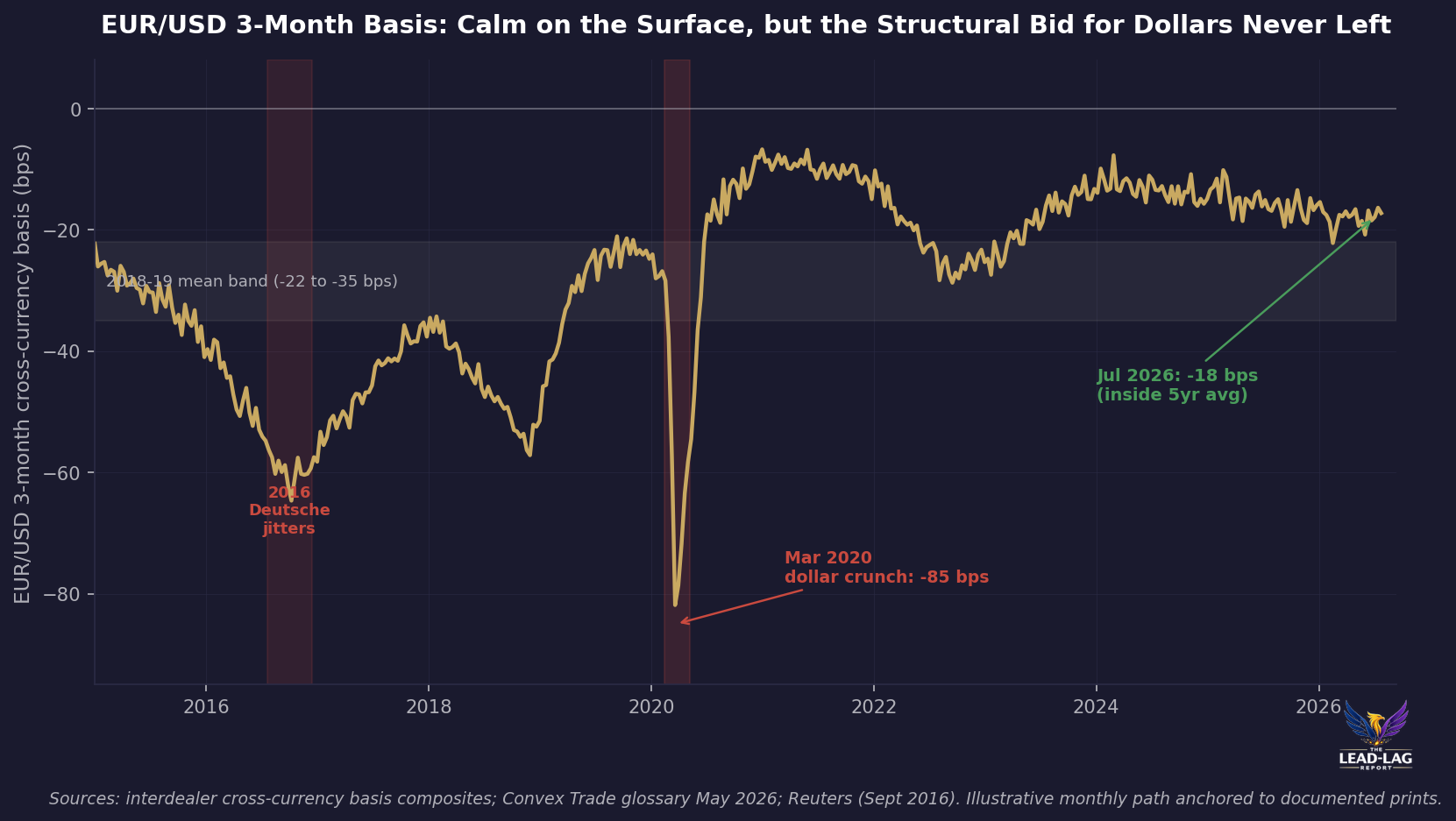
When dollars are scarce, the swap costs more than parity implies. The foreign borrower has to pay a premium to get dollars, and that premium is the negative basis.[1] A basis near zero means orderly funding. A three-month basis in the minus 20 to minus 30 range is the structural background stress that has been a feature of the market since Basel III made bank balance sheets more expensive to rent. A basis at minus 80 or worse is a crisis.[1] The point is that this is not an abstraction. It is the actual, observable cost that $14 trillion of offshore dollar borrowers face when they roll their hedges.
The reason it matters more now than in most cycles is scale. The Bank for International Settlements puts US dollar credit to non-bank borrowers outside the United States at roughly $14.3 trillion as of the end of 2025, growing 8.5 percent year on year, the fastest annual pace since 2014.[2] Emerging and developing economies alone owe about $4.3 trillion of that, up from roughly $3.2 trillion a decade ago.[3] More than half of the total is in the form of debt securities that mature and must be refinanced on a rolling schedule. Every rollover is a fresh demand for dollars. The basis is the toll booth on that flow, and the toll has been creeping higher where it counts.
The Yen Is Where the Stress Is Concentrated
The clearest evidence sits in the yen. The JPY/USD three-month basis was quoted around minus 42 basis points in the spring of 2026, wide of its post-COVID average of roughly minus 22 but still well inside the crisis wides of minus 145 in March 2020 and minus 200 in September 2008.[1] That is not a panic reading. It is a persistent, structural widening, and it tracks the one variable that matters most for Japanese dollar demand: the gap between what the Federal Reserve pays and what the Bank of Japan pays.
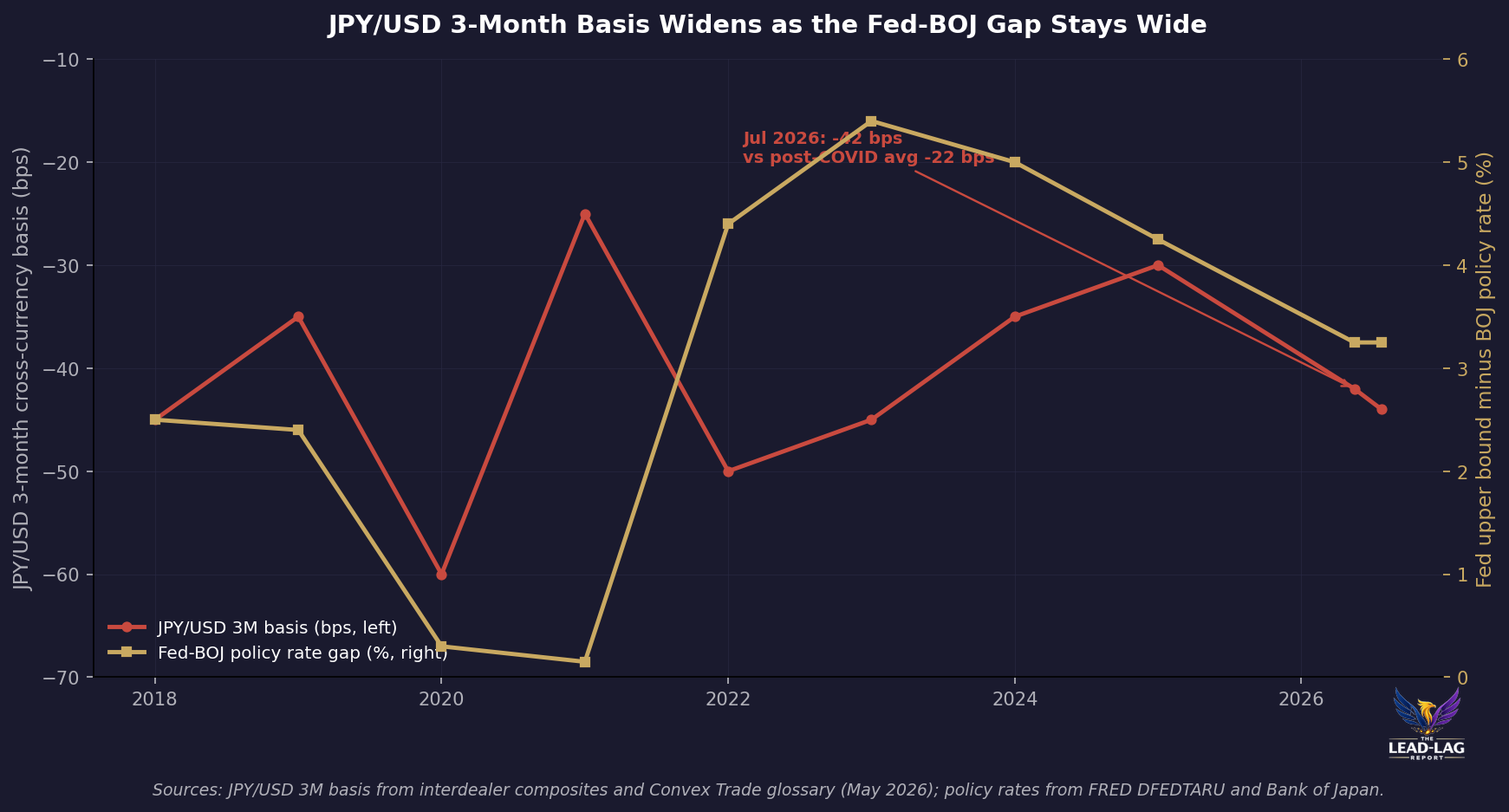
The Fed's target range upper bound sits at 3.75 percent.[4] The Bank of Japan, even after its slow normalization, is still anchored far below that. The policy gap of roughly three and a quarter points is what drives Japanese institutions to hedge dollar assets, and the wider and more persistent that gap, the more relentless the structural bid for dollars through the swap market. USD/JPY trading near 164, close to its cyclical high, is the spot-market echo of the same divergence.[5] A weak yen and a wide basis are two faces of the same coin: Japan needs dollars, and the cost of getting them synthetically is rising.
Europe tells the mirror-image story, and it is instructive precisely because it is calm. The EUR/USD three-month basis sits around minus 18 basis points, comfortably inside its five-year average.[1] With the European Central Bank's policy rate near 2.50 percent, closer to the Fed than in any year since 2019, European institutions simply need fewer synthetic dollars. The euro basis being tight is not evidence against a dollar shortage. It is evidence that the shortage shows up exactly where the divergence is widest and the offshore borrowing is most dollar-dependent. The euro is not the pressure point. The yen and the emerging-market complex are.
The Fed's Foreign Plumbing Is Lighting Up
If the basis were the only signal, a skeptic could dismiss it as swap-desk noise. It is not the only signal. The Fed's own foreign plumbing is corroborating the story.
The pool of dollars that foreign official institutions park at the New York Fed's reverse repo facility troughed near $299 billion in the last week of May 2026 and climbed to roughly $354 billion by mid-July, an increase of about 18 percent in seven weeks.[6] That is a reversal of the multi-quarter drawdown that ran through 2025 and early 2026. Foreign central banks and sovereign funds are rebuilding their dollar buffers at the Fed, which is what prudent reserve managers do when they sense that private dollar funding is becoming less reliable.
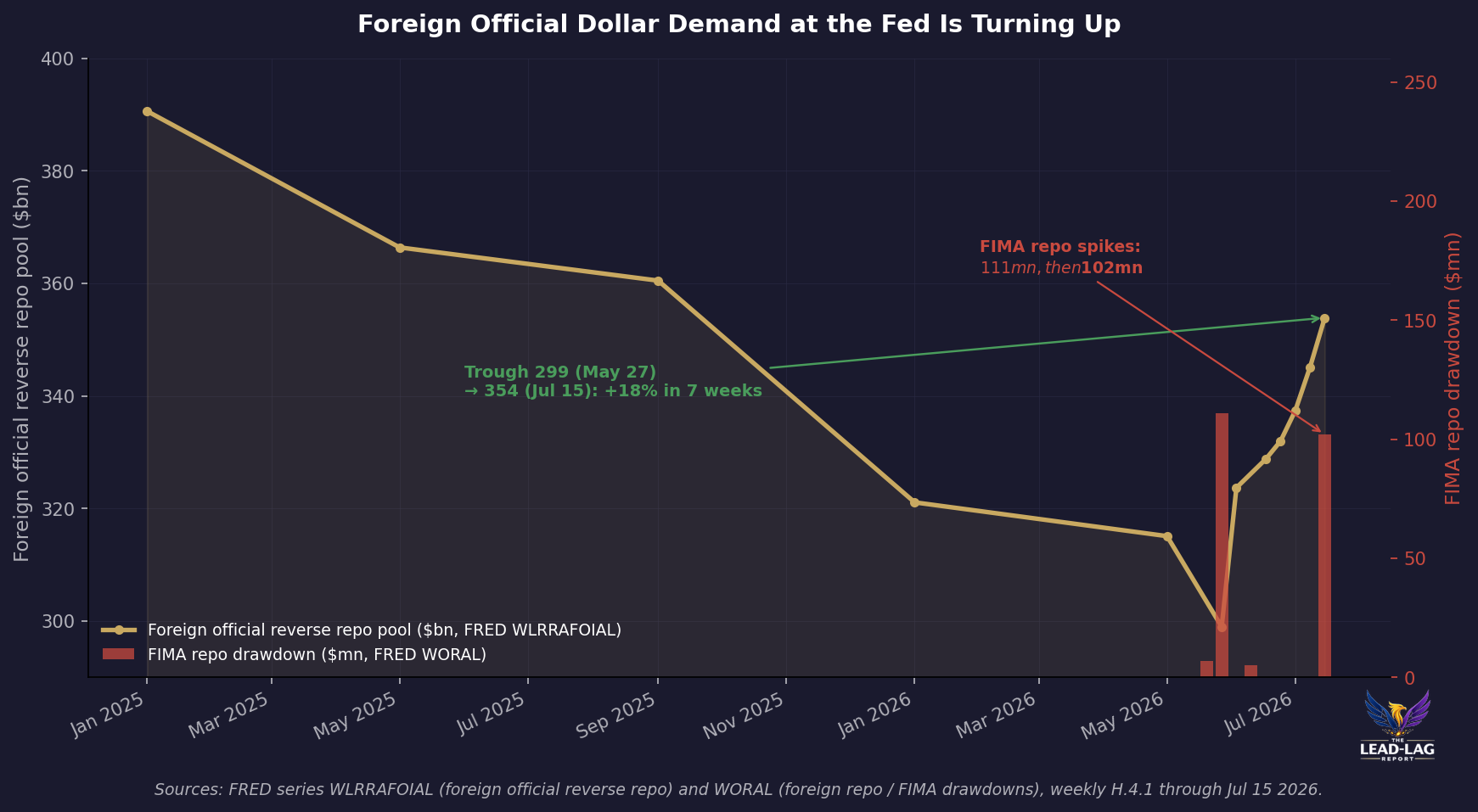
More telling is the FIMA repo facility. This is the standing line the Fed built in 2020 that lets foreign monetary authorities pledge their Treasury holdings for overnight dollars rather than dumping those Treasuries into the market.[7] It is meant to be a pressure-release valve, and for years it sat effectively unused, printing zeros and single-digit millions week after week. In late May 2026 it drew $111 million in a single week, and in mid-July it drew another $102 million.[8] Those are small numbers in absolute terms. They are enormous as a change in behavior. A facility that exists precisely to absorb foreign dollar stress does not get tapped when dollars are genuinely abundant.
Put the two together. Foreign official balances at the Fed turning up, and the emergency dollar-repo line being tapped after years of dormancy, at the same moment the yen basis is running double its post-COVID average. Three independent readings of the same underlying condition. Dollars are getting harder to source abroad, and the institutions closest to the problem are already responding.
The Historical Pattern Consensus Keeps Forgetting
The reason this deserves attention now, rather than after it becomes a headline, is that the sequence has a well-documented rhythm. Dollar funding stress builds in the plumbing before it erupts in asset prices, and the basis is one of the earliest tells.
Go back to September 2019. The repo market seized up almost overnight, with secured overnight rates spiking to nearly 10 percent intraday and forcing the Fed back into balance-sheet expansion. That eruption did not come from nowhere. The three-month funding markets had been signaling strain for weeks beforehand, as quarter-end balance-sheet constraints and a drained reserve base collided. The plumbing warned first.
Then March 2020. The dollar crunch that accompanied the pandemic sell-off was preceded by emerging-market basis widening in February, before equities had fully broken. The EUR/USD three-month basis blew out to roughly minus 85 basis points and the yen basis to minus 145 as every offshore borrower scrambled for dollars at once.[1] The Fed's response was the alphabet soup of swap lines and, ultimately, the FIMA facility that is being tapped again today. The lesson from both episodes is identical: the dollar funding market is the transmission belt, and it tightens before the equity index notices.
This is not a forecast that a 2020-scale crunch is imminent. The current basis readings are nowhere near crisis wides, and that is precisely the point. We are in the early, quiet part of the sequence, the part that in hindsight looks obvious and in real time looks like nothing. The consensus that dollar liquidity is abundant is reading the headline rate and ignoring the spread. That is the same mistake that was made in the summers before both prior episodes.
Where the Fragility Sits
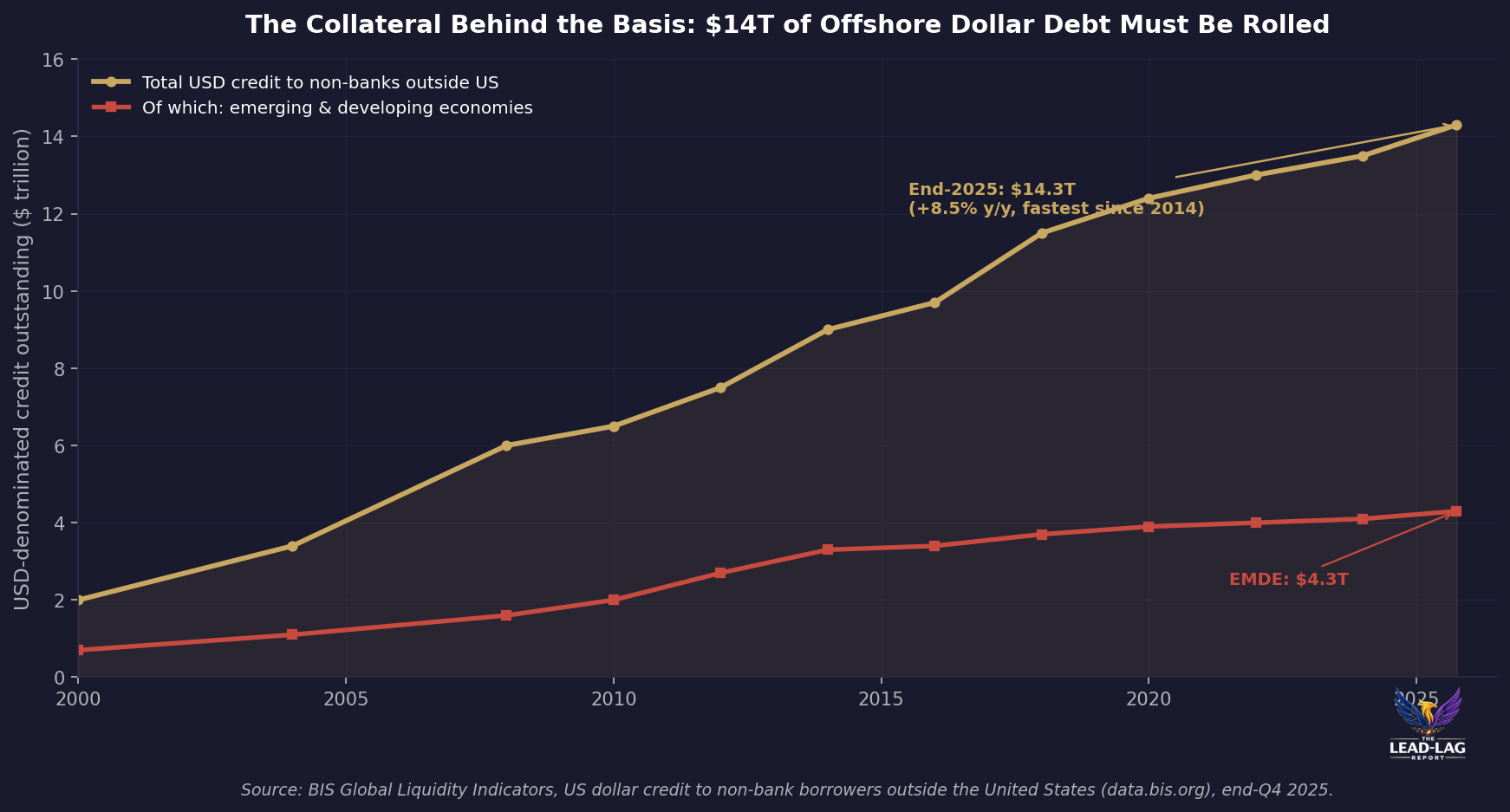
The exposure is not evenly distributed. It concentrates in two places. The first is the emerging-market complex and the dollar-borrowing sovereigns that sit on top of that $4.3 trillion of dollar debt.[3] These are borrowers who earn in local currency and owe in dollars, whose debt-service cost rises mechanically when the synthetic dollar gets more expensive, and who have the least balance-sheet room to absorb a funding shock. The second is the set of non-US banks that intermediate this flow, whose dollar books are funded short and lent long, and for whom a wider basis is a direct hit to net interest margin and a constraint on their ability to keep rolling client hedges.
For a dollar-based investor, the implication is about regime and asymmetry rather than any single position. Risk assets with heavy offshore-dollar-funding dependence, EM local and hard-currency debt, and the equity of dollar-borrowing sovereigns carry a fragility that is not in the headline rate and therefore not in most risk models. The liquidity that looks abundant from a New York trading desk is not abundant from a Sao Paulo or Jakarta treasury. That gap is the exposure. When the next equity wobble arrives, the offshore dollar borrowers are the ones who transmit and amplify it, because they are the ones forced to source dollars into a widening basis at the worst possible moment.
The asymmetry is what makes this worth writing down now. If the consensus is right and dollar funding stays abundant, nothing needs to change and the basis drifts back toward zero. If the plumbing is telling the truth, the portfolios most exposed to offshore dollar funding are positioned for a regime that is quietly ending, and the repricing when it comes will be fast, because funding stress always is.
What Would Prove Me Wrong
I will state the falsification condition plainly, because a thesis that cannot be killed is not a thesis. If the JPY/USD and EUR/USD three-month bases normalize into a sub-five-basis-point range and hold there for sixty consecutive days, while the Fed's foreign official reverse repo balance keeps rising, then the tightening story is wrong. That combination would mean foreign institutions are rebuilding dollar buffers out of abundance rather than scarcity, and that the swap market is signaling comfort rather than strain. If I see that print, I will write the piece that says the dollar shortage was a false alarm.
I do not expect to see it. The policy divergence that drives the yen basis is structural and will not close quickly, the offshore dollar debt stack is growing rather than shrinking, and the FIMA facility does not get tapped in a world of genuine abundance. But the condition is specific, it is measurable, and it is falsifiable. That is more than the consensus offers when it asserts, without a metric, that liquidity is fine.
The dollar shortage is not coming. It is already here, priced in an instrument the consensus does not watch, building in the plumbing the way it always builds before it breaks into the open. The basis is widening while nobody watches. The headline rate is calm, and the calm is the tell.
Few understand this.
— — —
Notes
[1] Convex, "Cross-Currency Swap Basis: Definition & Analysis," updated May 13, 2026. https://convextrade.com/glossary/cross-currency-swap-basis. Documents interpretive thresholds and specific prints: EUR/USD 3-month basis -18 bps and JPY/USD 3-month basis -42 bps as of May 13 2026; JPY post-COVID average -22 bps; September 2008 print -200 bps; March 2020 print -145 bps.
[2] BIS Global Liquidity Indicators, US dollar credit to non-bank borrowers outside the United States. Bank for International Settlements, statistical release at end-Q4 2025 (published April 30 2026). https://data.bis.org/topics/GLI.
[3] BIS Global Liquidity Indicators, US dollar credit to emerging market and developing economies. Approximately $4.3 trillion at end-2025, up from roughly $3.2 trillion a decade earlier. https://data.bis.org/topics/GLI.
[4] Federal Reserve target federal funds rate, upper bound. FRED series DFEDTARU, reading 3.75% as of July 22 2026. https://fred.stlouisfed.org/series/DFEDTARU.
[5] USD/JPY spot 163.79 and EUR/USD spot 1.14 as of July 23 2026, per Perplexity Finance real-time quotes. USD/JPY year high 163.99; year low 145.86.
[6] Federal Reserve H.4.1 release, Liabilities: Reverse Repurchase Agreements: Foreign Official and International Accounts. FRED series WLRRAFOIAL. Trough $299.0 billion for the week of May 27 2026; $353.9 billion for the week of July 15 2026. https://fred.stlouisfed.org/series/WLRRAFOIAL.
[7] Federal Reserve, Foreign and International Monetary Authorities (FIMA) Repo Facility. https://www.federalreserve.gov/monetarypolicy/fima-repo-facility.htm.
[8] Federal Reserve H.4.1 release, repurchase agreements held for foreign official and international accounts. FRED series WORAL. Drawdown of $111 million for the week of May 27 2026 and $102 million for the week of July 15 2026. https://fred.stlouisfed.org/series/WORAL.
[9] Historical funding-stress sequence. September 2019 repo spike and March 2020 dollar crunch. See Federal Reserve Bank of New York, Repo and Reverse Repo Agreements. https://www.newyorkfed.org/markets/domestic-market-operations/monetary-policy-implementation/repo-reverse-repo-agreements.
The Lead-Lag Report is provided by Lead-Lag Publishing, LLC. All opinions and views mentioned in this report constitute our judgments as of the date of writing and are subject to change at any time. Information within this material is not intended to be used as a primary basis for investment decisions and should also not be construed as advice meeting the particular investment needs of any individual investor. Trading signals produced by the Lead-Lag Report are independent of other services provided by Lead-Lag Publishing, LLC or its affiliates, and positioning of accounts under their management may differ. Please remember that investing involves risk, including loss of principal, and past performance may not be indicative of future results. Lead-Lag Publishing, LLC, its members, officers, directors and employees expressly disclaim all liability in respect to actions taken based on any or all of the information on this writing.