The World's Cheapest Money Just Got More Expensive
Matthew Tuttle on the Yen carry trade after Japan's policy rate hit 1% -- cross-posted from The H.E.A.T. Formula.

This is a guest post by Matt Tuttle, CEO of Tuttle Capital Management. Sign up for his H.E.A.T. podcast here.
I’ve been a trader and investor for 44 years. I left Wall Street long ago—once I understood that their obsolete advice is designed to profit them, not you.
Today, my firm manages around $5 billion in ETFs, and I don’t answer to anybody. I tell the truth because trying to fool investors doesn’t help them, or me.
In Daily H.E.A.T., I show you how to Hedge against disaster, find your Edge, exploit Asymmetric opportunities, and ride major Themes before Wall Street catches on.
I’m in Japan today through next Friday, so in honor of the trip I’m talking about another aspect of the Yen carry trade. I’ll try to do some live streams from Japan as well. I plan to send the newsletter every day as usual, but with the time zone difference there could be some interruptions.
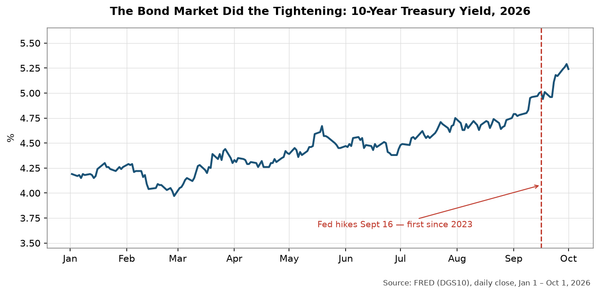
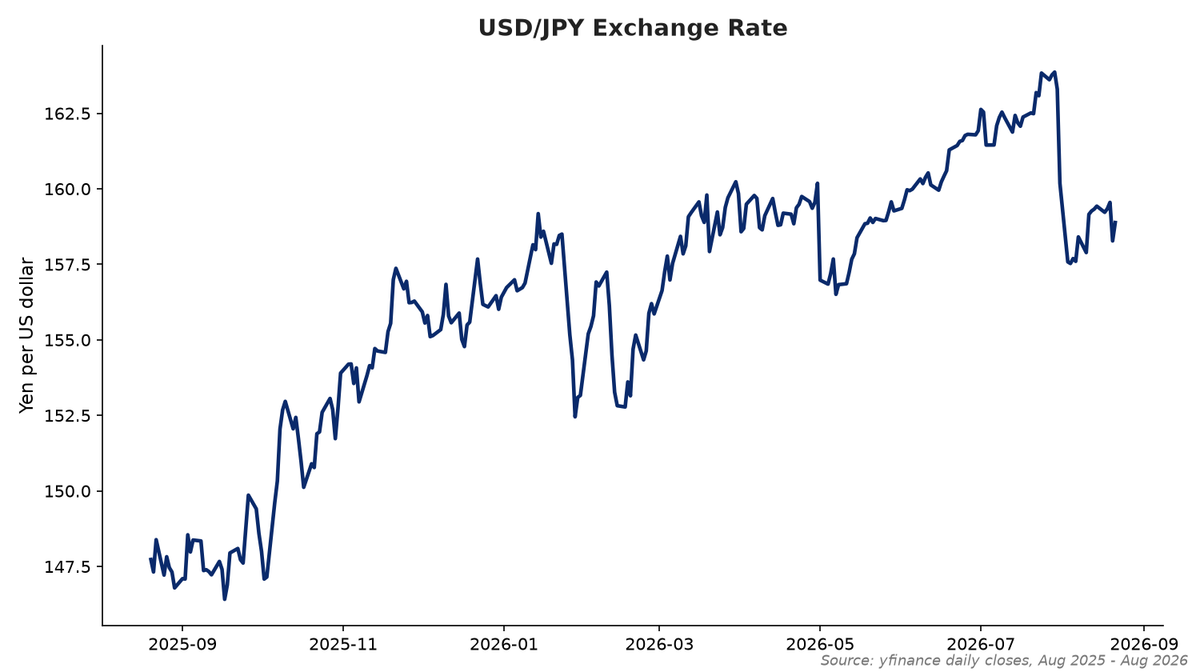
Japan's policy rate is now 1%. The Federal Reserve's target range is 3.5%–3.75%. That gap is still wide enough to fund a trade that's been running for decades — just not as wide as it used to be. Reuters reported the 10-year Treasury yield near 4.75% and the 30-year near 5.28% on Tuesday, while the dollar buys about 159 yen.
The Trade That Isn't Dead — Just Thinner
Last week, I covered how this trade was pressuring Treasuries specifically. Today, let's zoom out — this isn't only a bond story. It's a plumbing story, and the pipes run under nearly every risky asset you own.
Here's the mechanic in full, since the whole piece rests on it. For more than two decades, the yen was one of the world's cheapest major funding currencies. The textbook trade: borrow yen at a low rate, sell it for dollars, and buy a higher-yielding bond, currency, or stock.
The trade works when the asset's return beats the funding cost — and when the yen stays weak enough that repaying the loan doesn't erase the profit. Japan's rate is 1% now, the Fed's is 3.5%–3.75%. The spread still exists.
The trade hasn't lost all its carry. It has lost some of its cushion. A rapid yen rally can erase years of interest income in days. Rising volatility can trigger margin calls before anything about the underlying asset actually changes.
That's when a slow source of return turns into a fast source of forced selling.
Two Pipes Run Under This Story
Last week's piece focused on one channel. This story actually runs through two separate pipes, and they don't behave the same way.
The first pipe belongs to governments. Japan's Ministry of Finance buys yen to support its value, drawing on cash reserves, dollar-asset sales, or short-term borrowing against its Treasury holdings to fund it.
The second pipe belongs to private investors. When a hedge fund unwinds a yen-funded position, it buys yen to repay the loan and sells whatever it bought with the proceeds — a U.S. growth stock, an emerging-market bond, a higher-yielding currency.
Same currency, different balance sheets, different transmission channels — which is why this reaches past the bond market. And nobody can tell you exactly how big the private side is. Much of it runs through foreign-exchange forwards and swaps that never show up as conventional yen loans. The Bank for International Settlements — the institution that tracks global banking and currency data — says the notional value of yen-linked foreign-exchange derivatives runs into the trillions, though most of that activity is hedging and liquidity management, not speculative carry trades. The plumbing is enormous. The speculative slice isn't directly observable until it unwinds.
The Backstop Isn't a New Swap Line
Jim Rickards, an eight-time best-selling financial author and long-time macro investor, has been the loudest voice connecting these dots. In a recent interview with Greg Hunter of USAWatchdog.com, Rickards called this "the biggest story in the world" and argued that preventing Japanese Treasury sales is a central U.S. objective — a plausible motive, and one Reuters' coverage of Treasury Secretary Scott Bessent's approach supports as a real Washington concern. But the plumbing Rickards described isn't quite right.
The Fed and Bank of Japan have had a standing dollar-liquidity swap line since 2013 — Washington didn't open a new one last week. The more relevant tool is the Fed's FIMA repo facility, made permanent in 2021, which lets a foreign central bank temporarily exchange Treasury securities for dollars instead of selling them.
That can reduce forced Treasury sales. It can't stop a private carry trader from selling stocks and bonds when the yen rises.
Bessent initially indicated the FIMA facility had been used. But subsequent Fed data showed no foreign-official repo transaction during the week through August 5. The cleanest read: FIMA was available, but the public data don't show a draw during the latest intervention. The U.S. instead sold euros to buy yen directly, per Reuters.
Nearly $100 Billion Bought Time
The intervention worked in one narrow sense: the yen rallied from roughly 163.65 per dollar into the 157 area, then drifted back beyond 159.
Reuters reports Japan may have sold close to $95.5 billion combined on July 30 and 31, official total still pending. That's enough to move a currency. It wasn't enough to change the incentive behind the trade — Japan's policy rate remains 1%, while the Fed's target remains 3.5%–3.75%. Intervention changed the path. It didn't eliminate the interest-rate incentive supporting the carry trade.
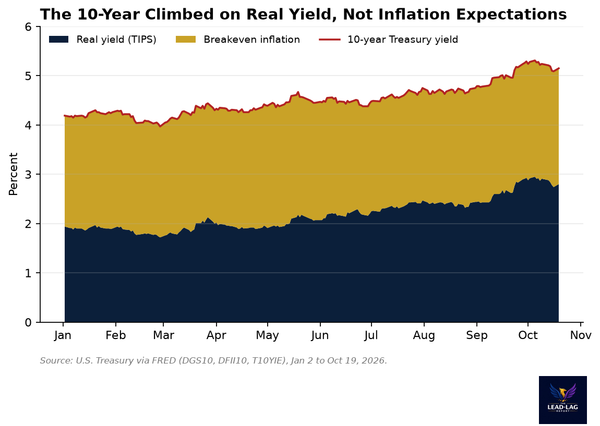
On the yield side, domestic inflation, oil prices, federal borrowing, and doubts about the Fed's credibility are the main reasons long-term yields have climbed. The 10-year moved toward 4.75% Tuesday, while the 30-year approached 5.28%, per Reuters. Japan is a possible amplifier — one more seller in an already nervous market — not the proven cause.
Where Gold Fits
Gold's case here doesn't depend on Rickards' $10,000 target. Physical bullion has no issuing government and isn't another country's debt — useful in a currency-policy fight like this one.
It's not risk-free — gold remains volatile and sensitive to rate expectations. As of Tuesday morning, spot gold traded near $4,394 an ounce, roughly 21% below its January record near $5,595; U.S. gold futures traded near $4,453. I treat it as portfolio insurance, not a forecast contest. A fund like SPDR Gold Shares (NYSE Arca: GLD) is a liquid way in, but it's a fund wrapper with its own custody and structure — not the same as holding physical metal.
Stock Winners — For Now
Toyota Motor Corp. (NYSE: TM). A weak yen raises the yen value of overseas revenue and helps export competitiveness. Risk: imported materials cost more, and a fast yen rebound reverses that benefit quickly.
CME Group Inc. (Nasdaq: CME) and Cboe Global Markets Inc. (Cboe: CBOE). More volatility in currencies, rates, and equities lifts demand for futures, options, and hedges — both companies' core business. Risk: one intervention episode doesn't guarantee elevated volume keeps up.
NVIDIA Corp. (Nasdaq: NVDA). The yen doesn't change NVIDIA's order backlog. It matters here because it's liquid, richly valued, and widely held by leveraged investors — a funding-shock barometer, not evidence AI demand is weakening.
Exposures With More to Prove
Mitsubishi UFJ Financial Group Inc. (NYSE: MUFG). Mixed, not a clean short. Higher Japanese rates improve lending margins — first-quarter profit reportedly rose 48% on wider margins and stronger loan demand — while rapid currency and bond-market moves can create translation, hedging, and mark-to-market pressure. The direction of rates helps the bank. The speed of the move can hurt the portfolio.
iShares 20+ Year Treasury Bond ETF (Nasdaq: TLT). Moves opposite long-term Treasury yields. Domestic inflation and Fed-credibility concerns drive most of the pressure on it; Japanese reserve sales are a possible additional headwind, not a confirmed one.
iShares MSCI Emerging Markets ETF (NYSE Arca: EEM). An imperfect proxy — most of its exposure isn't yen-funded directly — but a broad risk barometer for what happens when cheap-carry dollars pull back from risk assets generally.
What We Are Doing
I'm keeping a gold sleeve across our hedged strategies, not treating it as a short-term trade, and staying light on emerging-market and long-duration Treasury exposure until this settles into a clearer direction.
This isn't about calling the exact day the trade unwinds. It's about not being the last one holding the leveraged side of it when it does.
What Changes My Mind
Private carry unwind: less concerned if USDJPY holds above roughly 161–162 while high-beta stocks and emerging-market assets stay steady — a sign the shock is fading without broader deleveraging. More concerned if USDJPY breaks below 158 while NVIDIA, emerging markets, and credit spreads weaken together. Below 155, I'd treat it as a funding event, not just a currency move.
Weak-yen policy problem: a Bank of Japan pause would ease unwind risk short-term, but likely keeps pressure on the yen and raises the odds of another intervention. The two risks cut in opposite directions.
Treasuries: more concerned if the 10-year holds 4.75% as a floor and pushes toward 5%, especially alongside heavy Treasury sales or real FIMA facility use. These are decision points, not fixed technical levels.
The Bottom Line
The yen carry trade is not dead. It still offers a positive interest-rate spread.
But the spread is smaller, official intervention is larger, and the currency is more volatile.
A weak yen creates a policy problem. A rapidly strengthening yen creates a funding problem.
The Fed's repo backstop may reduce the need for Japan to sell Treasuries. It can't stop a leveraged investor from selling stocks when the yen rises.
That's why the risk extends beyond the bond market.
For years, cheap yen paid investors to ignore the plumbing. The trade still has carry. It no longer has the same margin for error.
The HEAT (Hedge, Edge, Asymmetry and Theme) Formula is designed to empower investors to spot opportunities, think independently, make smarter (often contrarian) moves, and build real wealth.
The views and opinions expressed herein are those of the Chief Executive Officer and Portfolio Manager for Tuttle Capital Management (TCM) and are subject to change without notice. The data and information provided is derived from sources deemed to be reliable but we cannot guarantee its accuracy. Investing in securities is subject to risk including the possible loss of principal. Trade notifications are for informational purposes only. TCM offers fully transparent ETFs and provides trade information for all actively managed ETFs. TCM's statements are not an endorsement of any company or a recommendation to buy, sell or hold any security. Trade notification files are not provided until full trade execution at the end of a trading day. The time stamp of the email is the time of file upload and not necessarily the exact time of the trades. TCM is not a commodity trading advisor and content provided regarding commodity interests is for informational purposes only and should not be construed as a recommendation. Investment recommendations for any securities or product may be made only after a comprehensive suitability review of the investor’s financial situation. © 2026 Tuttle Capital Management, LLC (TCM). TCM is a SEC-Registered Investment Adviser. All rights reserved.
The Lead-Lag Report is provided by Lead-Lag Publishing, LLC. All opinions and views mentioned in this report constitute our judgments as of the date of writing and are subject to change at any time. Information within this material is not intended to be used as a primary basis for investment decisions and should also not be construed as advice meeting the particular investment needs of any individual investor. Trading signals produced by the Lead-Lag Report are independent of other services provided by Lead-Lag Publishing, LLC or its affiliates, and positioning of accounts under their management may differ. Please remember that investing involves risk, including loss of principal, and past performance may not be indicative of future results. Lead-Lag Publishing, LLC, its members, officers, directors and employees expressly disclaim all liability in respect to actions taken based on any or all of the information on this writing.